Tax on Cryptocurrency Staking and DeFi Income
Cryptocurrency has moved well beyond simply buying and holding. If you are staking tokens, providing liquidity, yield farming, or earning interest through decentralised finance (DeFi) protocols, you are generating income — and HMRC wants its share. The tax treatment of crypto staking and DeFi is one of the more complex areas of UK tax, partly because the technology is new and the rules are still evolving, and partly because every transaction can trigger a different type of tax event. In this guide, we will break down how HMRC treats staking rewards and DeFi income, what records you need to keep, and how to stay on the right side of the rules.
How HMRC Views Cryptocurrency
Before diving into staking and DeFi specifically, it helps to understand HMRC's general approach to crypto. HMRC does not treat cryptocurrency as money or currency. Instead, they classify it as a form of property — specifically, exchange tokens, utility tokens, or security tokens, depending on their characteristics. Most common cryptocurrencies like Bitcoin and Ethereum are exchange tokens.
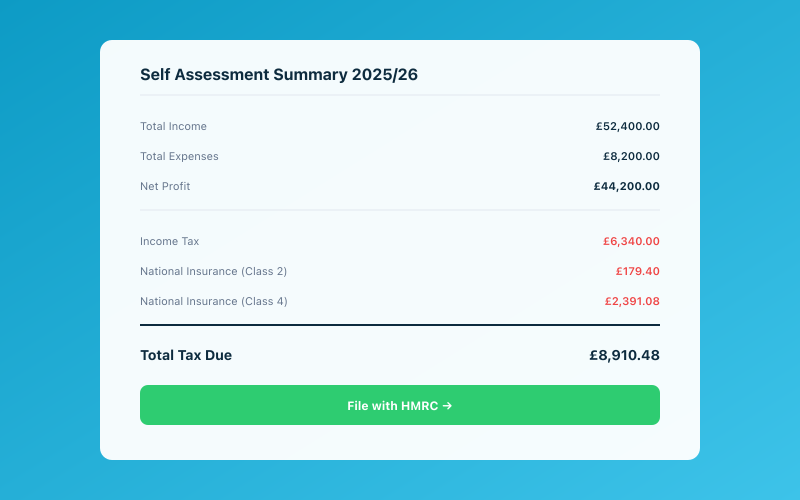 Your Accounted dashboard shows your real-time tax position
For individuals (as opposed to businesses), crypto is subject to:
- Capital Gains Tax (CGT) when you dispose of crypto — selling for fiat currency, swapping one token for another, using crypto to pay for goods or services, or giving it away (unless to a spouse or civil partner)
- Income tax when you receive crypto as payment for services, through mining, through airdrops where you have done something to earn them, or through staking rewards and DeFi income
The key distinction is between capital gains (which arise from the increase in value of an asset) and income (which arises from earning new tokens or rewards). Staking and DeFi often involve both.
For CGT purposes, the 2025/26 annual exempt amount is £3,000. Gains above this threshold are taxed at 10% for basic-rate taxpayers or 20% for higher-rate taxpayers (these are the rates for non-property assets). For a more detailed look at crypto tax generally, our tax guide for crypto in the UK covers the fundamentals.
Staking Rewards — Income or Capital Gain?
Staking involves locking up your cryptocurrency to support the operation of a blockchain network — typically a proof-of-stake network like Ethereum. In return, you receive staking rewards, usually paid in the same token you staked.
HMRC's position is that staking rewards are generally treated as miscellaneous income and are subject to income tax at the point you receive them. The taxable amount is the fair market value of the tokens at the time of receipt, converted to pounds sterling.
Here is a practical example. You stake 10 ETH and over the course of the tax year you receive 0.5 ETH in staking rewards. On the day you received those rewards, ETH was trading at £2,000. Your taxable income from staking is therefore £1,000 (0.5 x £2,000). This is added to your other income for the year and taxed at your marginal rate — 20% if you are a basic-rate taxpayer, 40% if higher-rate, or 45% if additional-rate.
When you later sell or swap those staking reward tokens, you also have a potential capital gains event. The acquisition cost for CGT purposes is the value at which you were taxed on receipt. So if you received 0.5 ETH valued at £1,000, and later sold it for £1,500, you would have a capital gain of £500.
This creates a double layer of taxation — income tax when you receive the rewards, and CGT when you dispose of them (if they have increased in value). It is one of the less-loved aspects of HMRC's crypto tax rules, but it is the current position.
If you are staking through a staking-as-a-service platform (like a centralised exchange), the same rules apply. The platform is just an intermediary — the rewards are still your income.
There is a question about whether staking could be treated as a trade rather than miscellaneous income if you do it at sufficient scale. HMRC's guidance suggests this would be unusual for most individuals, but it is a grey area. If you are running validator nodes as a business, professional advice is recommended.
DeFi Income — Liquidity Provision, Yield Farming, and Lending
DeFi (decentralised finance) covers a huge range of activities, each with potentially different tax implications. Let us look at the most common ones.
Liquidity provision. When you provide liquidity to a decentralised exchange (DEX) like Uniswap or Curve, you deposit tokens into a liquidity pool. In return, you receive liquidity provider (LP) tokens. HMRC's view is that depositing tokens into a liquidity pool constitutes a disposal for CGT purposes — you are exchanging your tokens for LP tokens. This means you may have a capital gain or loss at the point of deposit.
When you later withdraw your liquidity and receive tokens back (plus trading fees earned), the withdrawal is another disposal — this time of the LP tokens. Any fees or rewards earned through the pool are likely to be treated as income, taxable at the point they are earned or received.
The practical challenge is calculating all of this accurately, because the value of your LP position changes constantly, and fees accrue continuously rather than being paid in discrete amounts.
Yield farming. Yield farming typically involves providing liquidity and then staking your LP tokens in a separate contract to earn additional reward tokens. Each step can be a taxable event:
- Depositing tokens into the liquidity pool — potential CGT disposal
- Staking LP tokens — this may or may not be a disposal depending on the mechanism
- Receiving reward tokens — income tax on the value at receipt
- Selling or swapping reward tokens — CGT on any gain
Lending. Lending your crypto through platforms like Aave or Compound earns you interest. HMRC treats this interest as income, taxable at the point it is earned. Some lending protocols issue interest-bearing tokens (like aTokens or cTokens) that represent your deposit plus accrued interest. HMRC may treat the initial deposit as a disposal and the interest component as income, though the guidance in this area is still not entirely clear.
Airdrops from DeFi participation. If you receive airdropped tokens as a result of using a DeFi protocol — for example, governance tokens distributed to early users — these are generally taxable as miscellaneous income at the time of receipt, provided you did something to earn them. Unsolicited airdrops that you did not do anything to earn may not be taxable on receipt, but they will have a zero acquisition cost for CGT purposes when you eventually dispose of them.
Record-Keeping — The Biggest Challenge
Keeping accurate records is probably the hardest part of crypto tax compliance. DeFi transactions happen on-chain, often across multiple protocols and blockchains, and the pace can be relentless if you are actively yield farming.
HMRC expects you to maintain records of:
- The date of every transaction
- The type of transaction (buy, sell, swap, stake, unstake, deposit, withdraw)
- The tokens involved and the amounts
- The value in GBP at the time of each transaction
- Transaction fees (gas fees in ETH, for example)
- The wallet addresses involved
For someone with dozens or hundreds of DeFi transactions per month, this is a significant undertaking. Specialist crypto tax software can help by connecting to your wallets and pulling in transaction data, but even those tools often struggle with complex DeFi interactions and may require manual adjustments.
Using Accounted for your broader business bookkeeping and then integrating your crypto records ensures everything comes together when it is time to file your Self Assessment. Penny, the AI assistant, can help you organise your crypto income alongside your other business activities.
Reporting Crypto Income on Your Tax Return
Crypto staking and DeFi income is reported on your Self Assessment tax return. The specific boxes depend on whether the income is classified as trading, miscellaneous income, or capital gains.
- Staking rewards and DeFi income typically go in the miscellaneous income section (or trading income if HMRC considers you to be trading)
- Capital gains from disposals go in the capital gains section, where you report each disposal, the acquisition cost, and the gain or loss
If your total gains from all asset disposals exceed the £3,000 annual exempt amount, or if the total proceeds from crypto disposals exceed four times the annual exempt amount (£12,000), you must report them to HMRC even if no tax is due after deducting losses.
Crypto losses can be offset against other crypto gains in the same year, or carried forward to offset future gains. But they must be reported within four years to be usable.
Common Pitfalls
Forgetting that token swaps are disposals. Swapping ETH for USDC, or exchanging one DeFi token for another, is a disposal for CGT purposes. Many people assume only selling for GBP triggers a tax event, but that is not the case.
Ignoring gas fees. Gas fees paid to execute transactions can be added to your acquisition cost or deducted from your disposal proceeds, reducing your gain. Over a year of active DeFi use, gas fees can be substantial, so do not overlook them.
Not converting to GBP. All calculations must be done in GBP. If you earned 100 USDC in DeFi fees, you need to convert that to GBP at the exchange rate on the date you received it.
Assuming staking is not taxable until you sell. HMRC taxes staking rewards as income when you receive them, not when you sell them. This is a common and costly misunderstanding.
For a comprehensive overview of cryptocurrency taxation in the UK, take a look at our crypto tax guide. And if you are also selling assets and wondering about business disposal relief, our guide to entrepreneurs' relief and business disposal explains the rules.
Related Reading
Start your free trial and let Penny handle your bookkeeping automatically.
Accounted helps UK sole traders stay on top of their bookkeeping and tax. Start your free 30-day trial at getaccounted.co.uk
Penny, your AI bookkeeper, tracks your tax position in real time and flags opportunities to reduce your bill. Meet Penny →
Tax & Compliance Specialists
Our tax specialists have decades of combined experience in UK sole trader and small business taxation, MTD compliance, and HMRC submissions. All content is reviewed against current HMRC guidance before publication and updated quarterly to reflect legislative changes.
Ready to try Accounted?
Join UK sole traders who are simplifying their bookkeeping and tax.
Start your 14-day free trial