NFTs and Digital Art — The Tax Position in 2026
The NFT market has had a turbulent few years — from the dizzying highs of 2021 and 2022 to a significant correction that wiped out much of the speculative froth. But NFTs have not disappeared. The technology has matured, and in 2026 there is a more grounded ecosystem of digital artists, collectors, and platforms operating in the space. What has not changed is that HMRC expects you to pay tax on your NFT activities.
Whether you are a digital artist minting and selling NFTs, a collector trading them, or somewhere in between, this guide explains the UK tax position as it stands in 2026.
How HMRC views NFTs
HMRC published its first guidance on cryptoassets back in 2019, and has since extended this to cover NFTs specifically. The key takeaway is that HMRC does not treat NFTs as a single category — the tax treatment depends on what you are doing with them.
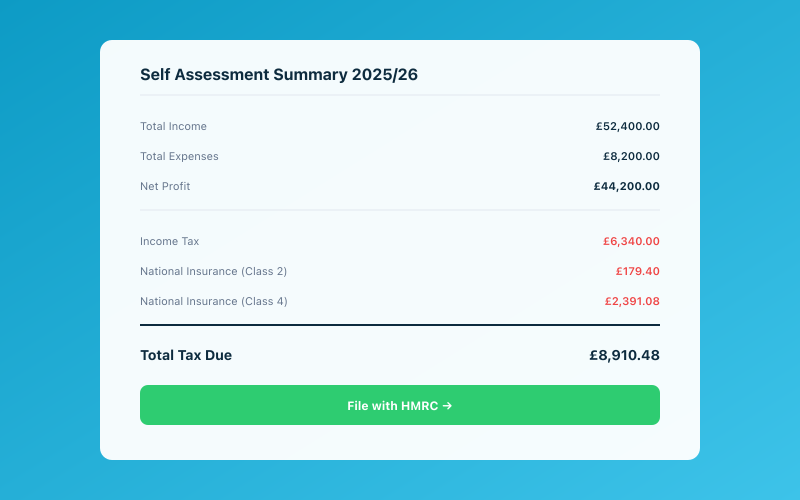 Your Accounted dashboard shows your real-time tax position
There are broadly three scenarios:
- You are creating NFTs and selling them. This is treated as trading income, taxed through income tax and National Insurance.
- You are buying and selling NFTs as investments. Gains are subject to capital gains tax (CGT).
- You are buying and selling NFTs as a trade (i.e., you are a professional dealer). Profits are taxed as trading income rather than capital gains.
The distinction between scenario 2 and scenario 3 matters because the tax rates and rules are different. HMRC looks at factors like the frequency and volume of your transactions, whether you are buying with the intention of reselling for profit, and whether NFT trading is your primary business. For most people who buy and sell NFTs occasionally, capital gains tax applies. For those running it as a business, income tax applies.
Tax for NFT creators (digital artists)
If you are a digital artist creating and selling NFTs, you are running a business. Your income from primary sales is trading income, and you need to report it on a Self Assessment tax return.
Primary sales: When you mint and sell an NFT for the first time, the sale price (minus platform fees, gas fees, and other costs) is your taxable income. If you sell an NFT for 0.5 ETH, you need to convert that to sterling at the exchange rate on the date of sale and report it as income.
Royalties on secondary sales: Many NFT smart contracts include a royalty mechanism — you receive a percentage (typically 2.5–10%) each time the NFT is resold. These royalty payments are also trading income and should be reported.
Expenses you can claim:
- Gas fees (transaction costs on the blockchain)
- Platform fees (OpenSea, Foundation, Rarible, etc.)
- Software and hardware for creating digital art (drawing tablets, design software)
- Marketing costs
- Home office expenses
- Training and professional development
- A proportion of your internet and electricity costs
If your total trading income from NFT sales exceeds the £1,000 trading allowance, you need to register as self-employed. Given that even a single NFT sale can easily exceed this threshold, most active NFT creators will need to register.
One complication for NFT creators is that you may receive payment in cryptocurrency (ETH, SOL, etc.) rather than sterling. You need to convert to sterling at the point of sale for income tax purposes. Additionally, if you hold the cryptocurrency and it changes in value before you convert to sterling, the subsequent disposal could trigger a capital gains tax event. Our guide on cryptocurrency staking and DeFi tax covers this in more detail.
Tax for NFT collectors and investors
If you buy NFTs and later sell them at a profit, the gain is typically subject to capital gains tax. The calculation follows the same principles as any other capital gain:
Gain = Sale proceeds – Acquisition cost – Allowable costs
Allowable costs include:
- The purchase price of the NFT (converted to sterling at the date of purchase)
- Gas fees paid on purchase and sale
- Platform fees
- Any costs incurred in improving or promoting the NFT (for example, commissioning additional art to enhance a collection)
For the 2025/26 tax year, the capital gains tax annual exempt amount is £3,000. Gains above this are taxed at 18% for basic-rate taxpayers and 24% for higher-rate taxpayers.
If you make a loss on an NFT sale (which has been a common experience in recent years), you can offset that loss against other capital gains in the same tax year, or carry it forward to use against future gains. However, you must actually dispose of the NFT — you cannot claim a loss on an NFT you still hold, even if it is essentially worthless.
What about "worthless" NFTs? If an NFT has genuinely become worthless (the project has collapsed, the marketplace has delisted it, or the underlying smart contract is broken), you may be able to make a negligible value claim to crystallise the loss without actually selling the NFT. HMRC's guidance on this is still evolving, so it is worth seeking professional advice.
The crypto-to-NFT conversion problem
One of the trickiest aspects of NFT taxation is that buying an NFT with cryptocurrency is itself a taxable event. When you use ETH to purchase an NFT, you are disposing of your ETH — and if it has increased in value since you acquired it, you have a capital gain on the ETH disposal.
Here is an example:
- You buy 1 ETH for £1,500 in January.
- By March, 1 ETH is worth £2,000.
- You use that 1 ETH to buy an NFT.
- You have a £500 capital gain on the ETH disposal (£2,000 proceeds minus £1,500 cost).
- Your acquisition cost for the NFT is £2,000 (the market value of the ETH at the time of purchase).
This means you could owe tax on the ETH gain even before you sell the NFT. Many people miss this step entirely, which can lead to unexpected tax bills.
Record-keeping for NFT transactions
The blockchain is technically a permanent record of every transaction, but HMRC does not look up your wallet addresses and do the calculations for you. You need to maintain your own records, including:
- The date and time of every purchase and sale
- The cryptocurrency used and the sterling equivalent at the time
- Gas fees and platform fees for each transaction
- Wallet addresses and transaction hashes
- The cost basis of any cryptocurrency used to buy NFTs
- Any royalties received from secondary sales
This can be complex, especially if you are active across multiple blockchains (Ethereum, Solana, Tezos, etc.) and multiple wallets. Dedicated crypto tax tools can help with on-chain tracking, and Accounted can handle the fiat side — tracking payouts from platforms, expenses for your art business, and keeping your overall tax position clear.
VAT on NFTs
HMRC's VAT guidance on NFTs is still developing, but the general position is:
- If you are VAT-registered and selling NFTs as part of a business, you may need to charge VAT on sales to UK customers.
- The VAT registration threshold of £90,000 applies to your taxable turnover from NFT sales (and any other taxable supplies).
- Sales of NFTs to customers outside the UK may be treated as "exported" services and zero-rated or outside the scope of UK VAT, depending on the circumstances.
In practice, most individual NFT creators and collectors are below the VAT threshold and do not need to worry about this. But if your NFT business is generating significant revenue, it is worth reviewing your position.
The bigger picture in 2026
The NFT and digital art tax landscape is still maturing. HMRC has been gradually tightening its focus on cryptoassets, and the introduction of the OECD's Crypto-Asset Reporting Framework (CARF) means that crypto exchanges and platforms will increasingly report user transaction data to tax authorities. The era of flying under the radar is ending.
If you have NFT or crypto gains from previous years that you have not declared, it is better to come forward voluntarily through HMRC's disclosure facilities rather than waiting for them to come to you. Voluntary disclosure typically results in lower penalties.
Going forward, keeping clean records and reporting accurately is not just good practice — it is essential. Whether you are a creator or a collector, building tax compliance into your workflow from the start will save you time, stress, and money in the long run.
Related reading:
- Tax on cryptocurrency, staking, and DeFi
- Side hustle tax guide
- How much can you earn before telling HMRC?
Accounted helps UK sole traders stay on top of their bookkeeping and tax. Start your free 30-day trial at getaccounted.co.uk.
Related Reading
- Gifting Business Assets — Tax Implications
- What's New in the 2026/27 Tax Year — Everything That's Changing
Start your free trial and let Penny handle your bookkeeping automatically.
Penny, your AI bookkeeper, tracks your tax position in real time and flags opportunities to reduce your bill. Meet Penny →
Tax & Compliance Specialists
Our tax specialists have decades of combined experience in UK sole trader and small business taxation, MTD compliance, and HMRC submissions. All content is reviewed against current HMRC guidance before publication and updated quarterly to reflect legislative changes.
Ready to try Accounted?
Join UK sole traders who are simplifying their bookkeeping and tax.
Start your 14-day free trial