What's New in the 2026/27 Tax Year — Everything That's Changing
Every April brings a fresh tax year, and with it a batch of changes that affect how much you earn, how much you keep, and how you report it all to HMRC. The 2026/27 tax year — running from 6 April 2026 to 5 April 2027 — is no exception. In fact, with Making Tax Digital for Income Tax finally landing and several thresholds remaining stubbornly frozen, this is a year that demands more attention than most.
Here's everything that's changing, what's staying the same, and what it all means for you.
Income Tax Rates and Thresholds
The headline news is that the personal allowance and Income Tax thresholds remain frozen for yet another year. This has been the case since 2021/22, and the freeze is currently set to continue until at least 2027/28.
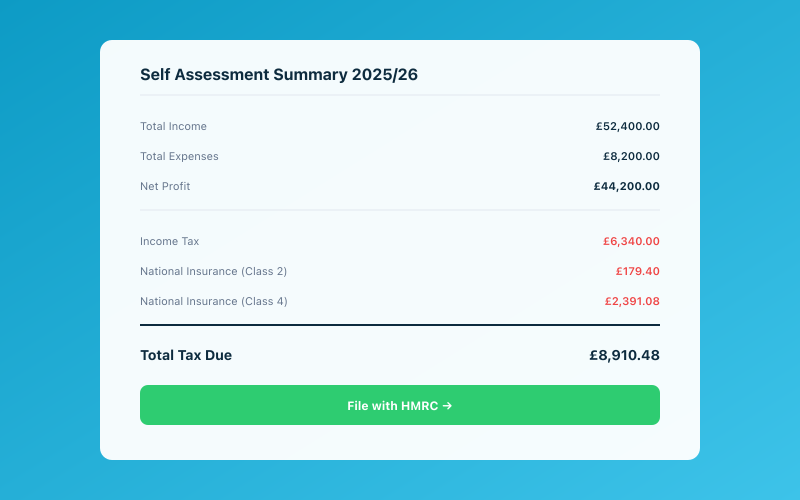 Your Accounted dashboard shows your real-time tax position
Here's what the bands look like for 2026/27:
| Band | Taxable income | Rate | |------|---------------|------| | Personal allowance | Up to £12,570 | 0% | | Basic rate | £12,571 to £50,270 | 20% | | Higher rate | £50,271 to £125,140 | 40% | | Additional rate | Over £125,140 | 45% |
These numbers haven't budged in years, and that's the problem. As wages and self-employment income rise with inflation, more people are being dragged into higher tax brackets — a phenomenon known as fiscal drag. We've written a detailed piece on how frozen thresholds are costing you more through fiscal drag if you want to understand the full impact.
The personal allowance continues to taper for those earning above £100,000, reducing by £1 for every £2 of income over that threshold, and disappearing entirely at £125,140.
Scottish taxpayers should note that Scotland sets its own Income Tax rates and bands, which differ from the rest of the UK. If you're self-employed in Scotland, check the Scottish Government's rates for 2026/27, as the starter, intermediate, and top rates may have been adjusted.
National Insurance Contributions
National Insurance is another area where sole traders need to pay close attention.
Class 2 NICs remain payable at a flat weekly rate for self-employed individuals earning above the Small Profits Threshold. These contributions help protect your State Pension entitlement, so they're worth paying even though the amounts are modest.
Class 4 NICs are the main National Insurance charge on self-employment profits. For 2026/27, the rates are expected to continue at:
- 6% on profits between £12,570 and £50,270
- 2% on profits above £50,270
The reduction from 9% to 6% that took effect in April 2024 remains in place, which is one of the few genuinely positive changes in recent years.
For employees, employer NICs saw increases in 2025/26, and the impact of those changes continues to ripple through the economy. If you employ staff or are considering hiring your first employee, check our guide on National Insurance for sole traders for the full picture.
Making Tax Digital for Income Tax
This is arguably the biggest change of the 2026/27 tax year, though it technically begins from April 2026.
From 6 April 2026, self-employed individuals and landlords with gross income above £50,000 will be required to comply with Making Tax Digital (MTD) for Income Tax. This means:
- Keeping digital records of income and expenses using MTD-compatible software
- Submitting quarterly updates to HMRC (four times a year instead of once)
- Submitting an End of Period Statement (EOPS) after the tax year ends
- Submitting a Final Declaration (replacing the current Self Assessment tax return)
From April 2027, the threshold drops to £30,000, bringing many more sole traders into scope.
If your income is above these thresholds, you need to be using MTD-compatible software before April 2026 — not after. The quarterly submission deadlines won't wait for you to get set up.
Accounted is fully MTD-compatible, and Penny can help ensure your records are in the right format for quarterly submissions. If you've been putting off the switch from spreadsheets, now really is the time. For more detail, see our guide on what's changing in April 2026.
Dividend Allowance
The dividend allowance remains at £500 for 2026/27. This is the amount of dividend income you can receive tax-free each year.
To put this in perspective, the allowance was £2,000 as recently as 2022/23. It was halved to £1,000 in 2023/24 and then halved again to £500 in 2024/25, where it has stayed since.
For company directors who pay themselves through a combination of salary and dividends, this continued squeeze means more of your dividend income falls within the taxable bands. The dividend tax rates remain:
- 8.75% (basic rate)
- 33.75% (higher rate)
- 39.35% (additional rate)
If you're a director trying to optimise your salary-and-dividend split, our guide on dividend vs salary for director pay is worth a read.
Capital Gains Tax
The Capital Gains Tax (CGT) annual exempt amount remains at £3,000 for 2026/27. This was £12,300 as recently as 2022/23, so the reduction has been dramatic.
CGT rates for most assets remain:
- 10% (basic rate taxpayers)
- 20% (higher rate taxpayers)
For residential property, the rates are higher:
- 18% (basic rate)
- 24% (higher rate)
If you're selling a business asset, gifting property, or disposing of shares, the much-reduced annual exempt amount means you're far more likely to have a CGT liability than in previous years.
High Income Child Benefit Charge
The threshold at which the High Income Child Benefit Charge begins to apply was raised to £60,000 in 2024/25, and this remains in place for 2026/27. The charge tapers between £60,000 and £80,000 of individual income, and at £80,000 you effectively lose the full benefit.
This is an improvement on the old threshold of £50,000, but if your income has crept above £60,000 — perhaps partly due to frozen thresholds pushing you into higher tax brackets — it's worth checking whether you're now caught by this charge.
Pension Changes
The Lifetime Allowance for pensions was abolished from April 2024, and that remains the case. There's no cap on the total you can accumulate in your pension.
The Annual Allowance — the maximum you can contribute to your pension and receive tax relief — stays at £60,000 for 2026/27 (or 100% of your earnings, whichever is lower).
If you haven't used your full Annual Allowance in previous years, you can carry forward unused allowance from the past three tax years. This can be a powerful tax planning tool, particularly if you've had a good year and want to shelter some of your profits.
For self-employed pension planning, our guide on using your personal allowance effectively covers strategies worth considering.
VAT Threshold
The VAT registration threshold remains at £90,000 for 2026/27. If your taxable turnover exceeds this amount in any rolling 12-month period, you must register for VAT.
The deregistration threshold stays at £88,000.
For sole traders approaching the threshold, the decision about whether to voluntarily register (or take steps to stay below it) is an important one. VAT adds administrative burden, but it also allows you to reclaim VAT on business purchases.
What Should You Do Now?
With the 2026/27 tax year starting on 6 April 2026, here's a practical checklist:
-
Check whether MTD applies to you. If your gross income exceeded £50,000 in 2024/25, you'll need MTD-compatible software from April 2026. Don't leave this to the last minute.
-
Review your tax position. With frozen thresholds and reduced allowances, you may be paying more tax than you expect. Run the numbers or speak to an accountant.
-
Maximise your pension contributions. If you have the cash flow, pension contributions remain one of the most tax-efficient things you can do.
-
Use your CGT annual exempt amount. If you're planning to sell any assets, consider timing the disposal to make use of the £3,000 exemption.
-
Get your bookkeeping in order. Whether MTD applies to you now or in future years, clean, digital records are essential. Accounted makes this straightforward — and Penny handles the categorisation so you don't have to.
-
Check your National Insurance record. Ensure you're building up State Pension entitlement, especially if your profits fluctuate from year to year.
The 2026/27 tax year brings more continuity than revolution — but the cumulative effect of frozen thresholds, reduced allowances, and new digital reporting obligations means the landscape is materially different from even a few years ago. Staying informed and prepared is the best way to protect your income.
Related reading:
- New Tax Year April 2026 — What's Changing
- National Insurance for Sole Traders
- Personal Allowance — How to Use It Effectively
Accounted helps UK sole traders stay on top of their bookkeeping and tax. Start your free 30-day trial at getaccounted.co.uk
Related Reading
Start your free trial and let Penny handle your bookkeeping automatically.
Penny, your AI bookkeeper, tracks your tax position in real time and flags opportunities to reduce your bill. Meet Penny →
Tax & Compliance Specialists
Our tax specialists have decades of combined experience in UK sole trader and small business taxation, MTD compliance, and HMRC submissions. All content is reviewed against current HMRC guidance before publication and updated quarterly to reflect legislative changes.
Ready to try Accounted?
Join UK sole traders who are simplifying their bookkeeping and tax.
Start your 14-day free trial