Frozen Tax Thresholds — How Fiscal Drag Is Costing You More
If you've noticed your tax bill creeping up year after year, even though it doesn't feel like you're earning dramatically more, you're not imagining things. The culprit is a mechanism called fiscal drag — and it's been quietly eating into the income of millions of UK workers and self-employed people since 2021.
In this article, we'll explain exactly what fiscal drag is, how much it's likely costing you, and what (if anything) you can do to soften the blow.
What Is Fiscal Drag?
Fiscal drag occurs when tax thresholds are frozen while incomes rise. Normally, the government adjusts tax thresholds each year in line with inflation, so that a pay rise that merely keeps pace with the cost of living doesn't push you into a higher tax bracket. When thresholds are frozen, that adjustment doesn't happen — and more of your income gets taxed at higher rates.
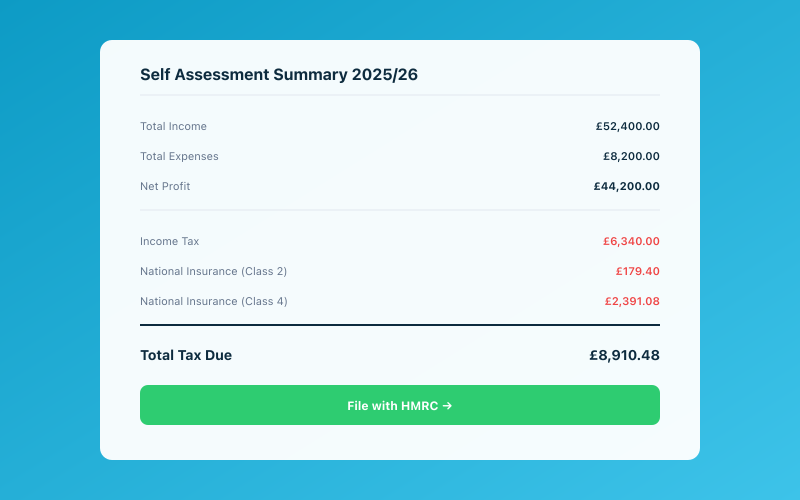 Your Accounted dashboard shows your real-time tax position
Think of it this way. Imagine you're standing in a river. In a normal year, the government raises the riverbank in line with the rising water level, so you stay dry. With frozen thresholds, the riverbank stays where it is, and the water keeps rising. Eventually, your feet get wet — then your knees, then your waist. You're not walking deeper into the river. The river is coming to you.
The UK government froze the personal allowance at £12,570 and the basic rate threshold at £50,270 from 2021/22, initially until 2025/26. That freeze has since been extended to at least 2027/28 — a full seven years with no adjustment.
During the same period, inflation has been significant. CPI inflation reached over 10% in 2022, and while it has since come down, the cumulative effect means prices — and incomes — are substantially higher than they were when the thresholds were set.
How Much Is Fiscal Drag Actually Costing You?
The impact depends on your income level, but here are some illustrations:
If you earn around £30,000: Without the freeze, the personal allowance would have risen broadly in line with inflation — potentially to around £14,000 or more by 2026/27. That means roughly £1,400 of your income that would have been tax-free is now being taxed at 20%, costing you approximately £280 extra per year.
If you earn around £50,000: The basic rate threshold hasn't moved either. If it had risen with inflation, it might be around £56,000 or higher. That means a chunk of income that would have been taxed at 20% is instead being taxed at 40%. The combined impact of the frozen personal allowance and basic rate threshold could be costing you £1,000 or more per year.
If you earn around £55,000: You may now be a higher-rate taxpayer when, with inflation-adjusted thresholds, you wouldn't be. The difference between paying 20% and 40% on several thousand pounds of income is very real.
If you're a sole trader with growing turnover: As your business matures and your income increases — even modestly — frozen thresholds mean a larger proportion of your profit is taxed at higher rates. A £5,000 increase in profit doesn't deliver a £5,000 improvement in your take-home pay. Depending on your bracket, you might keep only £3,000 or even £2,000 of that increase.
This is why fiscal drag is often described as a "stealth tax." It raises revenue for the Treasury without the government having to announce a headline-grabbing rate increase. Politically, it's far easier to freeze thresholds than to raise rates — even though the effect on your wallet is the same.
The Cumulative Impact Since 2021
It's not just the current year's impact that matters. Fiscal drag is cumulative. Each year the thresholds remain frozen, the effect compounds.
According to various estimates, by 2027/28 the freeze will have pulled around 3 to 4 million more people into paying Income Tax (who otherwise wouldn't have been paying it), and a similar number into the higher rate bracket. The total additional revenue raised is estimated in the tens of billions.
For individual taxpayers, the cumulative cost over the full freeze period can run into thousands of pounds. It's the kind of thing that's easy to overlook because it happens gradually — a bit more tax here, a slightly larger deduction there — but when you add it all up, it's substantial.
If you're tracking your income and tax through Accounted, you'll be able to see this pattern clearly in your financial reports. Penny can show you how your tax liability has changed year on year, which helps make the invisible visible.
Who Is Most Affected?
Fiscal drag doesn't affect everyone equally:
People whose incomes are rising with inflation are hit hardest. If your income goes up by 5% but thresholds stay flat, more of your income is taxed at higher rates even though your purchasing power hasn't meaningfully improved.
People near threshold boundaries feel the impact most acutely. If you're close to £50,270 (the basic/higher rate boundary), even a small income increase can push a chunk of your earnings from 20% to 40% tax. Similarly, if you're near £100,000, the personal allowance taper (which reduces your allowance by £1 for every £2 earned above £100,000) becomes a 60% effective marginal rate — and frozen thresholds make it easier to stumble into this trap.
Self-employed people are particularly vulnerable because business income can fluctuate. A good year might push you well above a threshold, resulting in a disproportionately large tax bill.
Lower earners who were previously below the personal allowance may now be paying Income Tax for the first time. The personal allowance of £12,570 was set when the National Living Wage was lower — full-time minimum wage workers may now earn above the tax-free threshold.
What Can You Do About It?
You can't change government policy, but you can take steps to manage the impact:
1. Maximise your pension contributions. Money paid into a pension reduces your taxable income. If fiscal drag has pushed you into the higher rate bracket, pension contributions are particularly valuable because you get 40% tax relief. Even basic rate taxpayers benefit from 20% relief. For self-employed sole traders, a SIPP (Self-Invested Personal Pension) is usually the most flexible option.
2. Use your ISA allowance. The annual ISA allowance is £20,000. Income and gains within an ISA are tax-free, which means they're not affected by frozen thresholds. If you have savings or investments outside an ISA, moving them inside one is one of the simplest tax-efficient moves you can make.
3. Claim all allowable expenses. If you're self-employed, every legitimate business expense you claim reduces your taxable profit. Ensure you're claiming everything you're entitled to — from office costs and travel to professional subscriptions and insurance. A tool like Accounted makes it easy to track and categorise expenses throughout the year, so nothing gets missed. For a comprehensive list, check our guide on how to use your personal allowance effectively.
4. Consider timing your income. If you have some control over when you receive income — for example, if you can delay invoicing or accelerate expenses — you may be able to manage which tax year income falls into. This is particularly useful if you're near a threshold boundary.
5. Pay into your partner's pension. If your spouse or civil partner earns less than you, making pension contributions on their behalf can be tax-efficient. They get their own Annual Allowance, and if they're a basic rate taxpayer (or below the personal allowance), the effective tax saving is better than contributing more to your own pension where you've already used up your higher-rate relief.
6. Keep your records immaculate. When thresholds are tight and every pound matters, having accurate, up-to-date records is more important than ever. You don't want to overpay tax because you missed an expense claim, and you don't want to underpay because your records were incomplete. Penny, the AI bookkeeper in Accounted, helps with exactly this — categorising your transactions and flagging anything that looks off.
Will Thresholds Ever Be Unfrozen?
That's the question everyone's asking. The current freeze is scheduled to run until at least 2027/28. Whether the government extends it further, adjusts it, or allows thresholds to rise with inflation again will depend on the fiscal situation at the time.
Some commentators have suggested that the freeze could be extended into the 2030s if the public finances remain under pressure. Others argue that the political backlash will grow as more people feel the impact and the freeze becomes harder to defend.
For now, the pragmatic approach is to plan on the assumption that thresholds will remain frozen. If they're eventually raised, that's a bonus — but don't count on it.
The Bigger Picture
Fiscal drag is a reminder that tax planning isn't just about what happens this year — it's about understanding trends and positioning yourself accordingly. The combination of frozen thresholds, reduced allowances (dividend allowance, CGT annual exempt amount), and new reporting obligations (MTD) means that managing your tax affairs proactively has never been more important.
If you haven't reviewed your tax position recently, now is a good time. Whether you do it yourself using a tool like Accounted or work with an accountant, understanding where you stand — and what levers you can pull — is the first step towards keeping more of what you earn.
For more on what's changing in the upcoming tax year, see our full summary of changes in the 2026/27 tax year.
Related reading:
- New Tax Year April 2026 — What's Changing
- Personal Allowance — How to Use It Effectively
- National Insurance for Sole Traders
Accounted helps UK sole traders stay on top of their bookkeeping and tax. Start your free 30-day trial at getaccounted.co.uk
Related Reading
- Electric Car Salary Sacrifice — How It Works for Directors
- Tax When You Separate or Divorce — Business Implications
Start your free trial and let Penny handle your bookkeeping automatically.
Penny, your AI bookkeeper, tracks your tax position in real time and flags opportunities to reduce your bill. Meet Penny →
Tax & Compliance Specialists
Our tax specialists have decades of combined experience in UK sole trader and small business taxation, MTD compliance, and HMRC submissions. All content is reviewed against current HMRC guidance before publication and updated quarterly to reflect legislative changes.
Ready to try Accounted?
Join UK sole traders who are simplifying their bookkeeping and tax.
Start your 14-day free trial