Electric Car Salary Sacrifice — How It Works for Directors
Why Everyone's Talking About Electric Car Salary Sacrifice
If you're a company director, you've probably heard other business owners raving about their electric car salary sacrifice scheme. And with good reason — it's one of the most tax-efficient perks available in the UK right now.
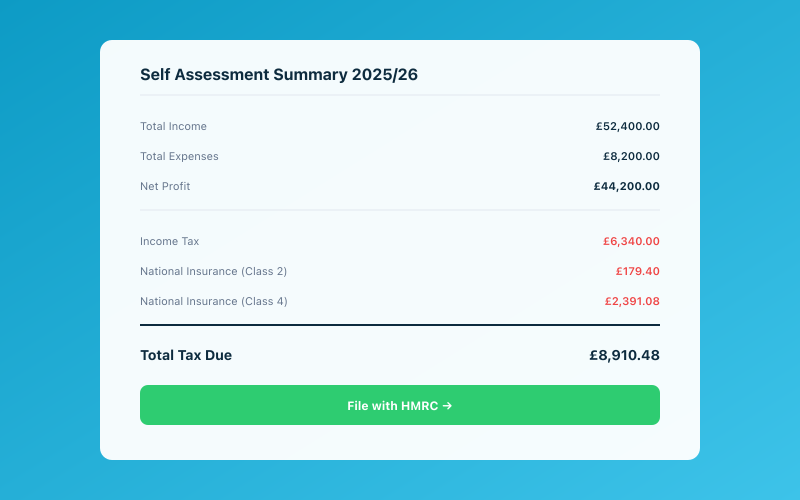 Your Accounted dashboard shows your real-time tax position
Here's the headline: a company director earning £60,000 can get a brand-new electric car worth £40,000 for an effective monthly cost that's significantly less than leasing the same car personally. We're talking savings of 40-60% in some cases.
Sounds too good to be true? It's not. But it does only work for certain business structures, and there are rules you need to understand. Let's break it all down.
How Salary Sacrifice Works
Salary sacrifice is exactly what it sounds like: you agree to give up (sacrifice) a portion of your salary in exchange for a non-cash benefit — in this case, a car.
Here's the basic mechanics:
- Your company leases an electric car through a salary sacrifice scheme
- Your gross salary is reduced by the monthly lease cost
- You pay Benefit in Kind (BIK) tax on the car — but because it's electric, the BIK rate is incredibly low
- Your company saves employer's NI on the salary you've sacrificed
- You save income tax and employee's NI on the salary you've sacrificed
The net result is that you get a brand-new electric car for significantly less than you'd pay if you leased or bought it personally.
BIK Rates for Electric Vehicles
The magic of this scheme lies in the Benefit in Kind (BIK) rate for electric vehicles. In the 2025/26 tax year, the BIK rate for a pure electric car with zero emissions is just 2%.
To put that in context, a petrol car with CO2 emissions of 150 g/km would have a BIK rate of around 37%. The difference is enormous.
What the 2% BIK Rate Means in Practice
Let's take a car with a list price of £40,000:
- BIK value: £40,000 x 2% = £800 per year
- Tax at basic rate (20%): £800 x 20% = £160 per year (£13.33/month)
- Tax at higher rate (40%): £800 x 40% = £320 per year (£26.67/month)
So a higher-rate taxpayer driving a £40,000 electric car pays just £26.67 per month in BIK tax. Compare that with the same car as a petrol variant at 37% BIK: that's £14,800 BIK value and £5,920 per year in tax at 40% — nearly £500 a month.
Future BIK Rates
The government has confirmed BIK rates for electric cars through to 2027/28:
| Tax Year | BIK Rate (0g/km CO2) | |----------|---------------------| | 2025/26 | 2% | | 2026/27 | 3% | | 2027/28 | 4% |
Even with the gradual increase, electric car BIK rates remain exceptionally low compared to petrol and diesel vehicles.
The Tax Savings Calculation
Let's work through a full example for a company director earning £60,000 per year who takes a £40,000 electric car through salary sacrifice, with a monthly lease cost of £500.
Without Salary Sacrifice
If you leased the car personally, you'd pay £500 per month from your net (after-tax) income. As a higher-rate taxpayer:
- Gross income needed: approximately £833 per month (to have £500 after 40% tax)
- Plus employee's NI at 2% (above £50,270): approximately £10 extra
- Total cost to you: around £843/month in gross terms
With Salary Sacrifice
Your salary drops from £60,000 to £54,000 (a £6,000 annual sacrifice for £500/month lease).
- Income tax saved: £6,000 x 40% = £2,400 per year
- Employee NI saved: £6,000 x 2% = £120 per year
- BIK tax payable: £40,000 x 2% x 40% = £320 per year
- Net saving to you: £2,400 + £120 - £320 = £2,200 per year (about £183/month)
Your effective cost for the car: £500 - £183 = £317 per month.
Company Savings
The company also saves:
- Employer's NI saved: £6,000 x 13.8% = £828 per year
- Corporation tax relief on the lease payments (as a business expense)
- No Class 1A NI on the BIK (well, 13.8% on the £800 BIK = £110 — still much less than the NI saved on the salary sacrifice)
Net company saving: approximately £718 per year.
Combined, you and the company save roughly £2,918 per year compared to you leasing the car personally.
Who It Works Best For
Salary sacrifice for electric cars works best for:
Higher-Rate Taxpayers
The savings are proportionally larger if you pay 40% tax. Basic-rate taxpayers still save, but the difference is less dramatic.
Directors Paying Themselves a Salary
If you pay yourself primarily through dividends (with a small salary), salary sacrifice might not be practical — you need enough salary to sacrifice. Your salary must remain at or above the National Minimum Wage after the sacrifice.
People Who Want a New Car Anyway
Salary sacrifice makes most sense if you'd be getting a car regardless. If you're currently driving a paid-off car and don't need a new one, the monthly cost (even at a reduced rate) is still a cost you weren't incurring before.
People Who Don't Need the Salary Immediately
Sacrificing salary reduces your take-home pay. If cash flow is tight, this might not be the right time — even though the long-term savings are significant.
Lease vs Purchase
Salary sacrifice schemes are almost always structured as a lease (Personal Contract Hire or Operating Lease), not a purchase. This is important because:
- Leasing keeps it simple — the company leases the car, you drive it, and at the end of the term you hand it back
- No depreciation risk — you don't own the car, so you don't bear the risk of it losing value
- VAT recovery — the company can recover 50% of the VAT on lease payments (100% if the car isn't available for private use, but that's rare)
- Corporation tax relief — the full lease cost is deductible against corporation tax
If you wanted to buy an electric car outright through your company instead, you'd get 100% first-year capital allowances (meaning you can deduct the full purchase price from your company's profits in year one). This is also very tax-efficient but ties up more cash and involves depreciation risk.
For most directors, leasing through salary sacrifice is the cleaner option. For a broader comparison of electric vehicle options, see our guide on electric vehicle tax relief.
Home Charging Costs
If you charge your electric car at home (which most people do), the electricity cost is a legitimate business expense. Your company can reimburse you for the electricity used to charge the car without creating an additional tax liability.
HMRC's Advisory Electricity Rate (AER) for fully electric cars is currently 7p per mile. Your company can pay you this rate tax-free for business miles driven. This is similar to the 45p per mile rate for petrol/diesel cars but reflects the lower running costs of electric vehicles.
For actual home charging costs (which might be higher or lower than the AER), you can track the electricity used and claim the actual cost. A smart charger that logs usage makes this much easier.
If your company installs a charging point at your home, the installation cost is an exempt benefit — meaning no BIK tax for you and a deductible expense for the company. This was extended through to April 2025, and at the time of writing the exemption still applies.
Restrictions: Who Can and Can't Use This
Company Directors — Yes
If you operate through a limited company and pay yourself a salary, you can set up a salary sacrifice scheme. You'll need a formal salary sacrifice agreement (your accountant can help with this) and a lease arranged through an approved salary sacrifice provider.
Sole Traders — No
Here's the important restriction: salary sacrifice does not work for sole traders. You can't sacrifice a salary to yourself. As a sole trader, you're not employed by a company — your business income is personal income.
If you're a sole trader considering an electric vehicle, there are still tax advantages (capital allowances, mileage claims), but the salary sacrifice route isn't available to you. You'd need to incorporate first, which is a bigger decision with many other implications.
Employees — Yes (If Their Employer Offers It)
Salary sacrifice is increasingly offered by larger employers, but it's at the employer's discretion. As a company director, you have the advantage of being able to set up the scheme yourself.
Practical Steps to Set It Up
- Check your salary — make sure you're paying yourself enough to sacrifice the lease amount while remaining above National Minimum Wage
- Choose your car — research electric vehicles and get lease quotes
- Speak to a salary sacrifice provider — companies like Octopus Electric Vehicles, KINTO, and Tusker specialise in this
- Set up the formal agreement — a salary sacrifice agreement must be documented in writing before the benefit starts
- Update your payroll — your salary is reduced, and the BIK is reported through P11D or payrolled benefits
- Enjoy the savings — and the quiet, smooth ride
Things to Watch Out For
Impact on Pension Contributions
If your pension contributions are based on your pre-sacrifice salary, a salary sacrifice reduces your pension contributions. Make sure your pension scheme uses "reference salary" (pre-sacrifice) rather than "actual salary" for contribution calculations.
Impact on Mortgage Applications
Lenders look at your actual salary, not your pre-sacrifice salary. A reduced salary could affect your borrowing capacity. If you're planning to apply for a mortgage, time your salary sacrifice carefully.
Impact on Other Benefits
Statutory benefits (maternity pay, sick pay) are based on actual earnings. A salary sacrifice that takes your earnings below certain thresholds could reduce these benefits. For most directors earning well above the thresholds, this isn't an issue — but check.
Insurance
Make sure the lease arrangement includes comprehensive insurance, or arrange it separately. Electric cars can be more expensive to insure due to higher repair costs, so factor this into your calculations.
Is It Worth It?
For most company directors who need a car and are higher-rate taxpayers, electric car salary sacrifice is one of the most tax-efficient benefits available. The combination of ultra-low BIK rates, income tax savings, NI savings (both employee and employer), and corporation tax relief creates a compelling case.
At Accounted, we help company directors understand exactly how these arrangements affect their overall tax position. Penny can track your car-related expenses and mileage, ensuring you claim everything you're entitled to. Whether you're considering your first electric car or optimising an existing arrangement, getting the numbers right from the start makes all the difference.
Related Reading
- Electric Vehicle Tax Relief in 2026 — What You Need to Know
- Salary vs Dividends — The Director's Pay Guide
- Tax Deductions Every Sole Trader Should Know About
- Christmas Tax Tips for Small Businesses
- Tax When You Retire From Self-Employment
Penny, your AI bookkeeper, tracks your tax position in real time and flags opportunities to reduce your bill. Meet Penny →
Tax & Compliance Specialists
Our tax specialists have decades of combined experience in UK sole trader and small business taxation, MTD compliance, and HMRC submissions. All content is reviewed against current HMRC guidance before publication and updated quarterly to reflect legislative changes.
Ready to try Accounted?
Join UK sole traders who are simplifying their bookkeeping and tax.
Start your 14-day free trial