Salary vs Dividends 2025/26: The Most Tax-Efficient Way to Pay Yourself
If you run a limited company, the way you pay yourself matters. A lot. The difference between a good salary-dividend split and a bad one can easily be several thousand pounds a year. This guide walks you through the numbers for the 2025/26 tax year so you can take home more of what your company earns.
Why the Split Matters
As a company director, you have two main ways to take money out of your business:
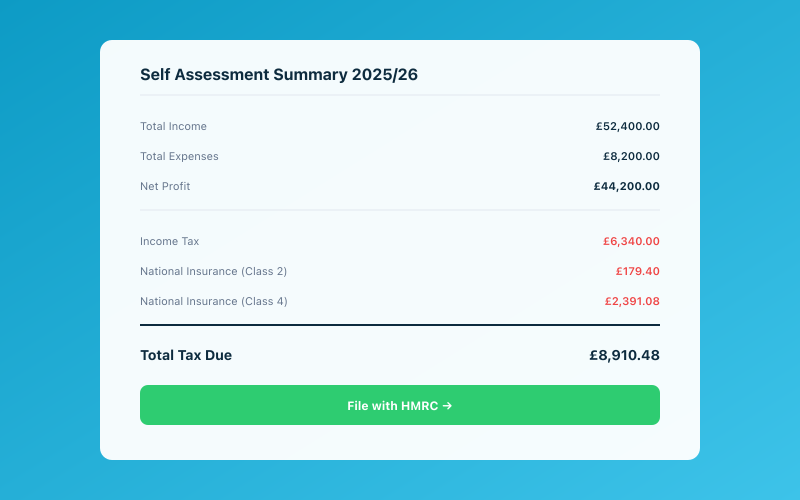 Your Accounted dashboard shows your real-time tax position
Salary is subject to income tax and National Insurance Contributions (NICs) — both employee NICs (paid by you) and employer NICs (paid by your company). It is an allowable expense for the company, reducing its Corporation Tax bill.
Dividends are paid from after-tax profits. There is no National Insurance on dividends. But dividends are taxed at different rates to salary, and since April 2023 the dividend allowance has been slashed.
The trick is finding the combination that gives you the lowest overall tax bill — personal tax, National Insurance, and Corporation Tax all considered together.
Key Tax Rates and Thresholds for 2025/26
Before running the numbers, here are the figures you need:
Personal Allowance and Income Tax Bands
- Personal allowance: £12,570 (reduced by £1 for every £2 earned over £100,000)
- Basic rate (20%): £12,571 to £50,270
- Higher rate (40%): £50,271 to £125,140
- Additional rate (45%): over £125,140
National Insurance (Employee — Class 1)
- Primary threshold: £12,570 per year
- Rate: 8% on earnings between £12,570 and £50,270
- Rate: 2% on earnings above £50,270
National Insurance (Employer — Class 1)
- Secondary threshold: £5,000 per year (from April 2025)
- Rate: 15% on earnings above £5,000
- Employment Allowance: £10,500 (but not available to single-director companies with no other employees)
Dividend Tax Rates
- Dividend allowance: £500 (tax-free)
- Basic rate: 8.75%
- Higher rate: 33.75%
- Additional rate: 39.35%
Corporation Tax
- Small profits rate: 19% on profits up to £50,000
- Main rate: 25% on profits over £250,000
- Marginal relief: on profits between £50,000 and £250,000
The Optimal Salary for 2025/26
For most single-director companies with no other employees, the optimal salary is one of two amounts. Which one suits you depends on your circumstances.
Option A: Salary at the Primary Threshold — £12,570
You pay yourself £12,570 a year. This uses up your personal allowance so no income tax is due. No employee NICs are due because you are at the threshold, not above it.
However, your company must pay employer NICs on the amount above the £5,000 secondary threshold. That is 15% on £7,570, which comes to £1,135.50 in employer NICs.
The salary plus employer NICs (£12,570 + £1,135.50 = £13,705.50) is deductible from company profits, saving Corporation Tax.
If your company pays the small profits rate of 19%, the CT saving is £13,705.50 x 19% = £2,604.05. The net cost of employer NICs after the CT saving is £1,135.50 minus £2,604.05 saved... wait, let us be precise:
- Employer NIC cost: £1,135.50
- CT saved on the full salary cost (salary + employer NIC): £13,705.50 x 19% = £2,604.05
- Without the salary, that £12,570 would be profit, taxed at 19% = £2,388.30 in CT, then taxed again as dividends
The upshot: taking £12,570 as salary is almost always more efficient than taking the same amount as dividends, even after employer NICs at the new 15% rate.
Option B: Salary at the Secondary Threshold — £5,000
Some advisers now suggest setting salary at £5,000 to avoid employer NICs altogether. At £5,000 salary, there is zero employer NIC (you are at the threshold) and zero employee NIC. You would then take the remaining £7,570 of your personal allowance as dividends tax-free (within the allowance limits).
This can work in narrow circumstances, but for most directors the Corporation Tax saving from the higher salary outweighs the employer NIC cost, making £12,570 the better choice. Run the numbers for your specific situation or ask your accountant.
For most single-director companies in 2025/26, a salary of £12,570 per year remains the optimal starting point.
Worked Examples at Different Profit Levels
Let us compare total tax paid at three different profit levels, assuming a single-director company, no other employees, no Employment Allowance, and small profits rate of 19%.
Example 1: Company Profit of £50,000
Salary: £12,570 Employer NIC: £1,135.50 Remaining profit after salary cost: £50,000 - £13,705.50 = £36,294.50 Corporation Tax (19%): £6,895.96 Available for dividends: £36,294.50 - £6,895.96 = £29,398.55
Dividend tax:
- First £500 at 0% = £0
- Remaining £28,898.55 at 8.75% = £2,528.62
Total tax and NIC paid: £1,135.50 (employer NIC) + £6,895.96 (CT) + £2,528.62 (dividend tax) = £10,560.08
Total take-home: £12,570 (salary) + £29,398.55 (dividends) - £2,528.62 (dividend tax) = £39,439.93
Example 2: Company Profit of £80,000
Salary: £12,570 Employer NIC: £1,135.50 Remaining profit after salary cost: £80,000 - £13,705.50 = £66,294.50 Corporation Tax: This falls in the marginal relief band, so the effective rate is between 19% and 25%. Let us use approximately 26.5% marginal rate on the band. Effective CT is roughly £16,245 (the exact figure depends on the marginal relief calculation). Available for dividends: approximately £50,049.50
Dividend tax:
- First £500 at 0% = £0
- Next £37,200 at 8.75% (up to the basic rate band ceiling of £50,270, minus £12,570 salary) = £3,255.00
- Remaining £12,349.50 at 33.75% = £4,167.96
Total tax and NIC paid: approximately £24,803
Total take-home: approximately £55,197
Example 3: Company Profit of £30,000
Salary: £12,570 Employer NIC: £1,135.50 Remaining profit: £30,000 - £13,705.50 = £16,294.50 Corporation Tax (19%): £3,095.96 Available for dividends: £13,198.55
Dividend tax:
- First £500 at 0% = £0
- Remaining £12,698.55 at 8.75% = £1,111.12
Total tax and NIC paid: £1,135.50 + £3,095.96 + £1,111.12 = £5,342.58
Total take-home: £12,570 + £13,198.55 - £1,111.12 = £24,657.43
The Impact of Employer NIC at 15%
From April 2025, the employer NIC rate rose from 13.8% to 15%, and the secondary threshold dropped from £9,100 to £5,000. This makes salary more expensive for your company.
For single-director companies, the Employment Allowance of £10,500 is not available (it is only for companies with at least one employee who is not a director, or companies with employer NIC liabilities under £100,000 in the prior year — but single-director companies are specifically excluded).
This means you are paying more employer NIC than in previous years. But the salary at £12,570 still beats the alternative for most people because of the Corporation Tax deduction. The employer NIC is also deductible, so the government is effectively subsidising part of the cost.
Common Mistakes to Avoid
Taking too much salary. Going above the personal allowance means income tax kicks in on the salary AND you are still paying employer NIC. Dividends are almost always cheaper for the next slice of income.
Ignoring the dividend allowance. The £500 allowance is small, but it is free money. Make sure you use it.
Forgetting about the basic rate band. Dividends within the basic rate band are taxed at 8.75%. Once you push into higher rate territory, they are taxed at 33.75%. That is a big jump. If you can keep total income under £50,270, the savings are meaningful.
Not planning ahead. The optimal split can change if you have other income — rental income, interest, or a second job. Look at your total income picture, not just your company.
Track It Properly
Getting the salary-dividend split right is only half the battle. You also need to record it correctly. Your salary needs to go through payroll (even if it is just you) with RTI submissions to HMRC. Dividends need proper board minutes and dividend vouchers.
Accounted makes this easier by tracking both salary payments and dividend withdrawals in your accounts. Penny keeps everything categorised so you can see at a glance how much you have taken as salary versus dividends, and what is left in the company.
Want to see exactly where your money is going? Start your free trial of Accounted today. Penny tracks your income, expenses, salary, and dividends automatically — so you can focus on making the right decisions for your tax bill instead of wrestling with spreadsheets.
Related Reading
Start your free trial and let Penny handle your bookkeeping automatically.
Penny, your AI bookkeeper, tracks your tax position in real time and flags opportunities to reduce your bill. Meet Penny →
Tax & Compliance Specialists
Our tax specialists have decades of combined experience in UK sole trader and small business taxation, MTD compliance, and HMRC submissions. All content is reviewed against current HMRC guidance before publication and updated quarterly to reflect legislative changes.
Ready to try Accounted?
Join UK sole traders who are simplifying their bookkeeping and tax.
Start your 14-day free trial