Christmas Tax Tips for Small Businesses
Christmas is a wonderful time of year, but for small business owners and sole traders, it can also be an expensive one. Between client gifts, staff celebrations, charitable donations, and the general festive generosity that takes hold in December, costs add up quickly.
The good news is that some of those costs are tax-deductible. The less good news is that the rules around what you can and can't claim are surprisingly specific, and getting them wrong could cost you more than a box of premium crackers.
Here's a plain-English guide to the tax rules around Christmas spending for small businesses, with some practical tips for keeping more of your hard-earned money.
Staff Christmas Parties
If you employ people — even one part-time employee — you can claim the cost of a Christmas party as a tax-free benefit, provided certain conditions are met.
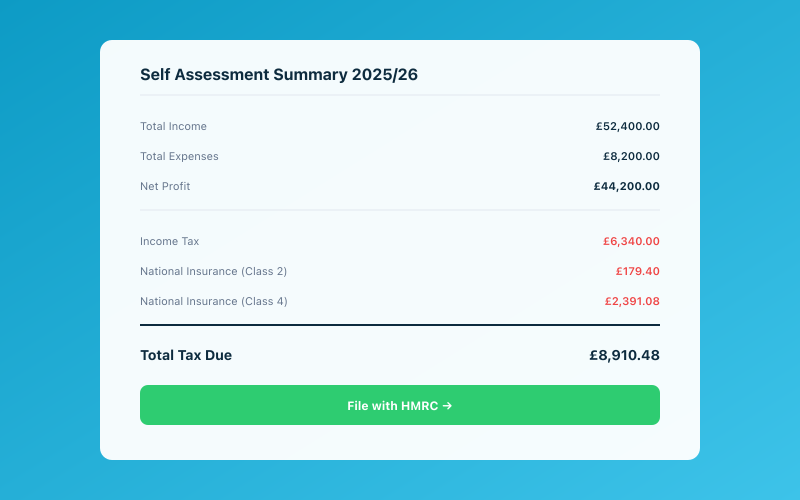 Your Accounted dashboard shows your real-time tax position
The rules:
- The party must be open to all employees (or all employees at a particular location). You can't throw an exclusive dinner for your favourite team member and call it a staff party.
- The cost must not exceed £150 per person, including VAT. This covers everything: food, drink, venue hire, entertainment, transport, accommodation.
- The £150 limit is not an allowance — it's a threshold. If the cost comes to £151 per person, the entire amount becomes taxable, not just the £1 over the limit. So keep it at or below £150.
- The £150 covers all annual events, not just Christmas. If you also hold a summer barbecue, the combined cost per head across all events must stay within £150.
For sole traders without employees: If you're a sole trader working on your own, you can't claim a Christmas party as a business expense. Entertaining yourself isn't a business cost, no matter how festive the occasion.
If you do employ staff and want a deep dive into the party rules, our guide to staff Christmas party rules covers the detail.
Client Gifts
Giving gifts to clients is common at Christmas, but the tax treatment depends on what you give and how much you spend.
Business entertainment is not deductible. HMRC classifies client meals, drinks, and entertainment as "business entertaining," which is never an allowable expense for income tax purposes. A lavish Christmas lunch for your best client might be good for the relationship, but you can't deduct it from your taxable profits.
Gifts with a conspicuous advert are deductible — with conditions:
- The gift must carry a conspicuous advertisement for your business (e.g., your logo).
- The cost must not exceed £50 per recipient per year.
- The gift must not be food, drink, or tobacco, or a voucher exchangeable for those items.
In practice, this means branded items like notebooks, pens, calendars, or tech accessories can qualify. A bottle of wine with your logo on it does not — because it's food/drink, regardless of the branding.
If the gift doesn't meet the criteria, it's treated as business entertaining and is not deductible.
Charitable Donations
Many businesses make charitable donations at Christmas, and there are tax advantages if you do it correctly.
For sole traders: Charitable donations aren't usually an allowable business expense. However, if you make a donation through Gift Aid, you can claim tax relief on your Self Assessment return. This effectively reduces your tax bill by the difference between the higher rate of tax you pay and the basic rate the charity has already claimed.
For example, if you're a higher rate taxpayer and donate £100 through Gift Aid, the charity claims £25 from HMRC (the basic rate relief), and you can claim a further £25 on your tax return. The donation costs you £75 in real terms.
Sponsorship vs. donation: If you sponsor a charity event and receive advertising or publicity in return (your name on a banner, a mention in a programme), it may count as a marketing expense rather than a donation. Marketing expenses are fully deductible. The key is that you must receive genuine advertising value in return.
Christmas Decorations and Supplies
Can you claim for decorations, Christmas cards, and festive supplies? It depends on the context.
Office decorations: If you have a dedicated business premises, decorations for your office are a legitimate business expense. They're part of making your workspace presentable for clients and employees.
Home office decorations: If you work from home, claiming for decorations is trickier. HMRC would likely take a dim view of claiming fairy lights and a tree as a business expense. Stick to claiming your usual home office proportion of household bills instead.
Christmas cards and postage: Sending cards to clients and contacts is a marketing activity, and the cost of the cards and postage is deductible as an advertising or marketing expense.
Staff Gifts and Bonuses
If you want to give your employees a little something extra at Christmas, the tax treatment depends on what you give.
The trivial benefits exemption allows employers to give small, non-cash gifts to employees without triggering a tax charge, provided:
- The cost of each gift is £50 or less.
- The gift is not cash or a cash voucher.
- The gift is not a reward for work or performance.
- The gift is not part of the employee's contract.
A box of chocolates, a hamper, or a bottle of wine costing under £50 would typically qualify. A £50 Amazon voucher would not (it's a cash voucher). A £50 envelope of cash definitely would not.
Christmas bonuses are treated as additional salary and are subject to income tax and National Insurance — both the employee's and employer's contributions. If you want to reward your team, factor in the additional cost.
Timing Your Spending
December is a natural time to review your spending plans for tax efficiency, especially as the tax year is three-quarters done.
Bring forward expenses. If you're planning to buy equipment or invest in your business early in the new year, consider whether it makes sense to bring the purchase forward into the current tax year. This could increase your expenses for 2025/26 and reduce your taxable profit now, rather than in 2026/27. Accounted can show you your running profit figure, making it easier to judge whether this is worthwhile.
Defer income (carefully). If you have flexibility over when you invoice, delaying a December invoice until after 5 April could push the income into the next tax year. This only works if you use the cash basis and actually receive the payment after 5 April. Be careful, though — HMRC doesn't look kindly on artificial arrangements designed purely to avoid tax.
Review your payments on account. If your income for 2025/26 is lower than the previous year, you may be able to reduce your payments on account and improve your cash flow. You can do this by contacting HMRC or through your online tax account. For guidance on managing a big tax bill, see our guide to planning for a large tax bill.
Don't Forget the VAT
If you're VAT-registered, the rules around Christmas expenses and VAT are worth noting:
- Staff party: You can reclaim VAT on the cost of a staff party, provided the £150-per-head limit isn't exceeded.
- Client entertainment: You cannot reclaim VAT on client entertainment, even if you're VAT-registered. This is one of the rare situations where VAT on a business purchase isn't reclaimable.
- Gifts under £50: You can reclaim VAT on business gifts costing up to £50 per recipient per year (provided the other conditions for deductible gifts are met).
Keep Records of Everything
Whatever you spend at Christmas, keep the receipts. HMRC can enquire into your return for up to 12 months after the filing deadline (or longer if they suspect carelessness or fraud), and you'll need to justify any claims.
A quick snap on your phone and a note in Penny about what the expense was for takes seconds and could save you considerable hassle down the line.
The festive season should be enjoyable, not a source of tax anxiety. With a bit of planning and awareness of the rules, you can be generous to your clients and team while making sure your business finances stay on track.
Related reading:
Accounted helps UK sole traders stay on top of their bookkeeping and tax. Start your free 30-day trial at getaccounted.co.uk.
Related Reading
- How to Claim Tax Relief on Charitable Donations Through Your Business
- 10 Tax Myths That Could Cost You Money
Start your free trial and let Penny handle your bookkeeping automatically.
Penny, your AI bookkeeper, tracks your tax position in real time and flags opportunities to reduce your bill. Meet Penny →
Tax & Compliance Specialists
Our tax specialists have decades of combined experience in UK sole trader and small business taxation, MTD compliance, and HMRC submissions. All content is reviewed against current HMRC guidance before publication and updated quarterly to reflect legislative changes.
Ready to try Accounted?
Join UK sole traders who are simplifying their bookkeeping and tax.
Start your 14-day free trial