Staff Christmas Party Rules — The £150 Per Head Limit
The annual staff Christmas party is a time-honoured tradition in British workplaces. Whether it's a lavish black-tie dinner or a modest gathering at the local pub, it's a chance to thank your team for their hard work. But did you know there are specific tax rules governing staff parties? Get them right and everyone enjoys a tax-free celebration. Get them wrong and you could land your employees with an unexpected tax bill.
In this guide, we'll explain the £150 per head exemption, how to calculate it, common pitfalls to avoid, and how the rules apply to sole traders with employees.
The £150 Per Head Annual Exemption
HMRC provides a tax exemption for staff annual parties and similar social functions, provided the cost doesn't exceed £150 per head per tax year. This is set out in ITEPA 2003, s.264.
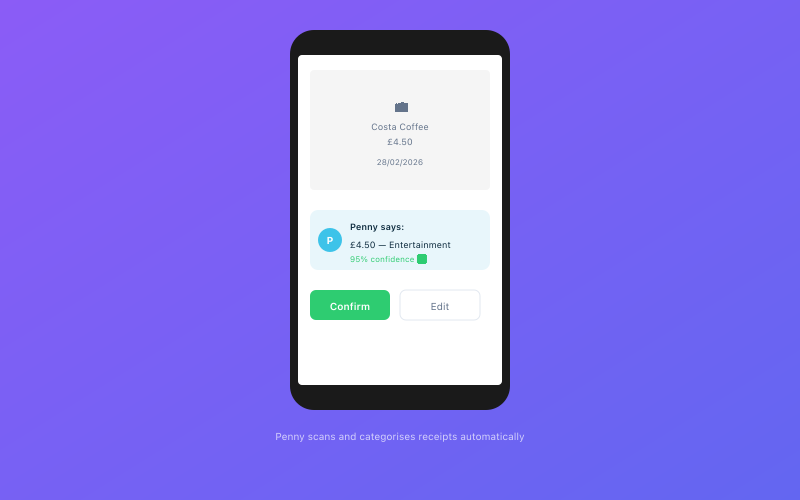 Penny scans and categorises your receipts automatically via WhatsApp
Here are the key points:
- The £150 figure is an exemption, not an allowance. This is a crucial distinction. If the cost per head is £150 or less, the entire amount is tax-free. If it goes even a penny over — say £150.01 — the entire amount becomes taxable, not just the excess.
- The limit is per head, per tax year — not per event. You can hold multiple events during the year, and as long as the combined cost per head of the events you're using the exemption for doesn't exceed £150, you're fine.
- The event must be open to all employees (or all employees at a particular location if you have multiple sites).
- The event must be an annual function. It doesn't have to be at Christmas — a summer barbecue counts too.
How to Calculate the Cost Per Head
The £150 limit includes everything associated with the event, not just the food and drink. You need to factor in:
- Food and drink
- Entertainment (DJ, band, comedian)
- Venue hire
- Decorations
- Transport to and from the event (e.g., taxis, minibuses)
- Accommodation if it's an overnight event
- VAT on all of the above
To calculate the cost per head, add up the total cost of the event including VAT, then divide by the number of people who attended — not the number invited. This includes employees and their partners or guests.
Worked Example
You organise a Christmas dinner for your team. Here are the costs:
| Item | Cost | |------|------| | Restaurant meal for 12 people | £960 | | Taxi fares | £120 | | DJ | £200 | | Total | £1,280 |
There were 10 employees and 2 partners in attendance, so 12 people in total.
Cost per head: £1,280 ÷ 12 = £106.67
This is under £150, so the entire cost is exempt from tax and National Insurance.
Now imagine the DJ charged £500 instead. The total would be £1,580, and the cost per head would be £131.67. Still under £150 — still fine.
But if the total crept up to £1,810 (say you added a premium bar tab), the cost per head would be £150.83. Because this exceeds £150, the entire £150.83 per head becomes a taxable benefit — not just the 83p overage.
Multiple Events in a Year
Many businesses hold more than one social event during the year — perhaps a Christmas party and a summer outing. You can split the £150 exemption across multiple events, but you need to be strategic about it.
HMRC lets you choose which events to apply the exemption to. If you hold two events costing £100 per head and £80 per head, you can't use the exemption for both (because £100 + £80 = £180, which exceeds £150). Instead, you'd use the exemption for one event and the other would be taxable.
The sensible approach is to apply the exemption to the most expensive event that still falls within the £150 limit. In the example above, you'd exempt the £100 event and treat the £80 event as a taxable benefit — or, better yet, try to keep the combined cost under £150.
If you hold a single annual party and keep it under £150 per head, you don't need to worry about any of this.
Does This Apply to Sole Traders?
Here's where it gets a bit nuanced. The staff party exemption is for employees. If you're a sole trader working on your own with no employees, this exemption doesn't apply to you. You can't throw yourself a Christmas party and claim the cost.
However, if you're a sole trader with employees — even just one — then the exemption applies to those employees. You, as the business owner, can also attend the party, and the exemption covers you too (HMRC accepts that the business owner attending a staff function is reasonable).
If you operate through a limited company and you're both a director and an employee, you're eligible for the exemption even if you're the only person in the company. A director-employee having a £150 Christmas dinner with their spouse (the spouse counts as a guest) is technically within the rules, though it's wise to make sure the event genuinely has the character of an annual staff function.
The Trivial Benefits Exemption — A Useful Alternative
Alongside the staff party exemption, there's another tax break worth knowing about: the trivial benefits exemption. This allows employers to provide small benefits to employees tax-free, provided:
- The cost is £50 or less per benefit
- It's not cash or a cash voucher
- It's not a reward for work or performance
- It's not in the terms of the employee's contract
This means you could give each employee a small Christmas gift — a hamper, a bottle of something nice, or a gift card (non-cash vouchers are fine) — up to £50, completely tax-free. This works alongside the party exemption, giving you two separate ways to celebrate the festive season without creating a tax headache.
For directors of close companies (typically owner-managed limited companies), there's an additional cap of £300 per year on trivial benefits. Sole traders giving trivial benefits to their employees don't have this director-specific cap to worry about.
Common Mistakes to Avoid
Going Over by a Small Amount
The most common mistake is exceeding the £150 limit by a small margin. Because it's an exemption (not an allowance), going over by even £1 means the whole amount is taxable. Build in a buffer — aim for £130-£140 per head to give yourself some headroom for last-minute costs.
Forgetting to Include All Costs
People often forget to include transport, accommodation, or VAT in their per-head calculation. HMRC expects you to include everything related to the event. If you book a minibus to take everyone to the restaurant, that cost goes into the pot.
Not Tracking Guest Numbers
The cost per head is based on attendees, not invitees. If you budget based on 20 people attending but only 15 turn up, your per-head cost jumps by a third. Keep an eye on RSVPs and actual attendance.
Excluding Some Employees
The exemption requires the event to be open to all employees (or all employees at a particular location). If you only invite senior staff or a select group, the exemption doesn't apply.
Recording Costs and Planning on a Budget
Staff party costs that fall within the £150 exemption are a deductible business expense — you can reduce your taxable profits by the amount you spent. This is different from client entertaining, which is never deductible regardless of the amount.
When you record the costs in Accounted, categorise them as staff entertaining or staff welfare. Penny will help you keep track of the running total per head, so you can see at a glance whether you're within the £150 limit before the party even happens. It's much better to know in advance than to get a nasty surprise when you're doing your Self Assessment.
Keep all receipts, invoices, and a record of who attended. HMRC can ask to see these if they enquire into your return, and good documentation is your best defence.
If you're conscious of staying under £150 per head, here are some ideas:
- Choose a set menu rather than à la carte — it's easier to control costs.
- Set a drinks limit or offer a fixed number of drinks per person.
- Consider a daytime event — a long lunch is usually cheaper than an evening do.
- Use your own premises if you have suitable space — it saves on venue hire.
- Get quotes from multiple venues and negotiate a package deal.
The £150 limit is actually reasonably generous for a small gathering. For a team of five, you've got a £750 budget to play with, which can stretch to a very enjoyable evening.
The Bottom Line
The staff Christmas party exemption is a genuinely useful tax break, but only if you stay within the rules. Keep the cost at or below £150 per head (including VAT, transport, and everything else), make the event open to all staff, and keep good records. Go even a penny over and you lose the exemption entirely.
Combined with the trivial benefits exemption for small gifts, you can give your team a meaningful festive celebration without creating any tax complications. For more on what you can and can't claim, see our complete guide to sole trader expenses.
Related Reading
Start your free trial and let Penny handle your bookkeeping automatically.
Accounted helps UK sole traders stay on top of their bookkeeping and tax. Start your free 30-day trial at getaccounted.co.uk
Accounted categorises your expenses automatically using AI, with confidence scores on every transaction. See how expenses work →
Tax & Compliance Specialists
Our tax specialists have decades of combined experience in UK sole trader and small business taxation, MTD compliance, and HMRC submissions. All content is reviewed against current HMRC guidance before publication and updated quarterly to reflect legislative changes.
Ready to try Accounted?
Join UK sole traders who are simplifying their bookkeeping and tax.
Start your 14-day free trial