Subsistence Expenses — What You Can Claim When Travelling
When you travel for business, you need to eat and drink. Sometimes you need somewhere to sleep. These costs — collectively known as subsistence expenses — are a legitimate part of doing business, and in many cases, they're tax deductible. But the rules aren't as simple as "I was working, so I can claim my lunch."
In this guide, we'll explain what HMRC considers subsistence, when you can and can't claim, and how to keep records that will stand up to scrutiny.
What Are Subsistence Expenses?
Subsistence expenses are the costs of food, drink, and accommodation incurred while you're travelling on business away from your normal place of work. They cover the basic necessities of sustaining yourself while working away from base.
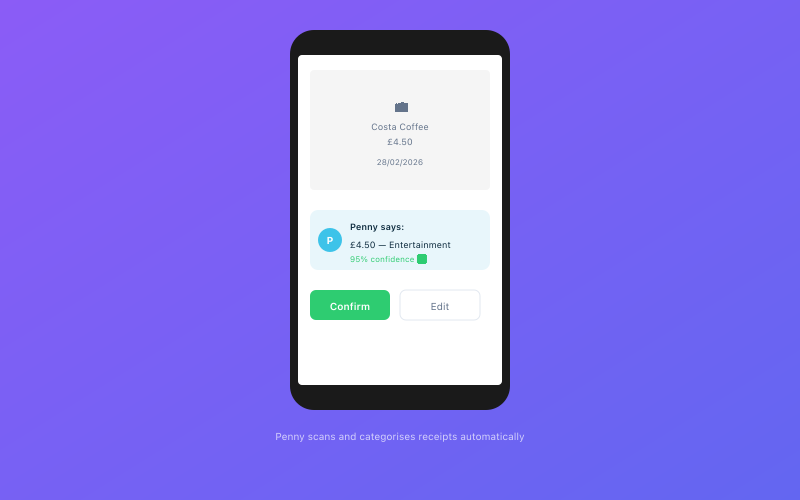 Penny scans and categorises your receipts automatically via WhatsApp
Typical subsistence costs include:
- Meals (breakfast, lunch, dinner, snacks)
- Non-alcoholic drinks (and alcoholic drinks in moderation with a meal)
- Hotel or B&B accommodation
- Incidental overnight expenses (laundry, personal phone calls)
The key phrase is "away from your normal place of work." This is where most of the confusion arises, and where HMRC focuses its attention.
The "Normal Place of Work" Rule
To claim subsistence, you must be travelling away from your normal workplace. This concept is fundamental to the whole system.
For employees, the normal place of work is usually clear — it's the office, factory, or site where they habitually work. For sole traders, it's a bit more nuanced.
If you work from home, your home is your normal place of work. Any travel to client sites, meetings, or other business locations is travel "away from your normal workplace," and subsistence on those journeys is potentially claimable.
If you rent an office or workshop, that's your normal place of work. Lunch at the sandwich shop next to your office isn't subsistence — it's your everyday meal, which you'd eat regardless of your business. But if you travel to a client's premises two hours away and buy lunch en route, that's subsistence.
If you have multiple regular workplaces (say you work from home three days a week and from a co-working space two days a week), both could be considered normal workplaces. Travel between them and subsistence on those journeys may not be claimable, because you're moving between two regular bases rather than travelling away from your normal workplace.
When Can You Claim Subsistence?
Let's break this down into common scenarios.
Travelling to a Client or Customer
You leave home (your normal workplace) in the morning and travel to a client's office for a meeting. You grab a sandwich on the way back. Claimable. You were travelling away from your normal place of work for business purposes, and the meal was incurred as a result of that travel.
Working Away for the Day
You spend a full day at a conference in another city. You buy breakfast at the station, lunch at the venue, and a coffee in the afternoon. Claimable. You were away from your normal workplace for the entire day, and all of these costs were incurred because of that travel.
Overnight Stays
You travel to a two-day project in Edinburgh and stay in a hotel. Your hotel, dinner, breakfast, and reasonable incidental expenses are all claimable. This is one of the clearest subsistence scenarios — you're away from home overnight for business purposes.
For overnight stays, HMRC also allows you to claim a small amount for incidental overnight expenses — things like personal phone calls home, newspapers, and laundry. The limit is £5 per night for stays within the UK and £10 per night for overseas stays. If you go over this limit, the entire amount becomes taxable (not just the excess), so it's worth tracking.
Lunch at Your Normal Workplace
You work from home and pop out to buy a sandwich from the local café. Not claimable. This is an everyday meal, not subsistence. You haven't travelled anywhere for business — you're eating at or near your normal place of work. This is the case even if you eat at your desk while working.
For more on this topic, see our guide on whether you can claim lunch as a business expense.
Working Late and Ordering Takeaway
You're working late at home on a deadline and order a pizza. Not claimable. Working late doesn't turn an everyday meal into subsistence. You're at your normal place of work, and the meal is a personal expense regardless of why you're eating it.
What Counts as "Reasonable"?
HMRC doesn't set specific meal limits for sole traders (unlike for employees, where benchmark rates exist). Instead, the rule is that subsistence costs must be reasonable.
There's no bright-line figure, but as a rule of thumb:
- A sandwich, drink, and snack for lunch: clearly reasonable
- A modest dinner at a local restaurant when staying overnight: reasonable
- A three-course meal at a Michelin-starred restaurant: HMRC may question whether this is reasonable subsistence
- A takeaway coffee and a pastry: reasonable
- A £50 bottle of wine with dinner: likely to be seen as excessive for one person's subsistence
Use common sense. You're claiming what it costs to sustain yourself while working away from home — not funding a gourmet dining experience. If you'd be comfortable explaining the expense to an HMRC officer, it's probably fine.
The Duality of Purpose Problem
HMRC's "wholly and exclusively" rule creates a particular tension with meals. Everyone needs to eat, whether they're working or not. So how can a meal ever be "wholly and exclusively" for business purposes?
The answer lies in the concept of additional cost. When you travel for business, you incur meal costs that you wouldn't have incurred if you'd been at home or at your normal workplace. That additional cost — the fact that you had to buy lunch from a café instead of making a sandwich at home — is the business element.
HMRC accepts this reasoning for genuine business travel. But it doesn't extend to everyday meals near your normal workplace, which is why lunch at the café next to your home office isn't claimable — you're not incurring an additional cost because of business travel.
This is why the "travelling away from your normal place of work" condition is so important. It's what distinguishes claimable subsistence from non-claimable personal meals.
Sole Traders vs. Employees: Different Rules
It's worth noting that employees and sole traders have slightly different subsistence rules. Employees (and their employers) can use HMRC's benchmark subsistence rates, which provide set daily amounts for meals:
- Breakfast: £5 (after starting work before 6am)
- One meal (5-hour trip): £5
- Two meals (10-hour trip): £10
- Evening meal (finishing work after 8pm): £15
- Overnight stay (excluding accommodation): £25
These benchmark rates are for employers paying expenses to employees. Sole traders cannot use these benchmark rates. Instead, sole traders claim their actual costs. This means you need receipts for everything you claim.
In practice, this is usually better for sole traders — actual costs are often higher than the benchmark rates. But it does mean more record-keeping.
Record-Keeping and Practical Tips
Good records are essential. For every subsistence claim, you should keep:
- The receipt — showing what you bought, the date, and the amount
- A note of the business purpose — where you were travelling to and why
- Evidence of the journey — train tickets, fuel receipts, mileage log entries that correspond to the subsistence claim
If HMRC enquires into your return, they'll want to see that each subsistence expense corresponds to a genuine business journey. An isolated meal receipt with no evidence of travel will be harder to defend.
When you use Accounted to record your expenses, Penny prompts you to add context to subsistence claims — the destination, the purpose of the trip, and the associated travel costs. This builds a clear audit trail that connects each meal to a specific business journey, making your records much more robust.
Tips for Managing Subsistence Costs
Photograph Your Receipts
Paper receipts fade, crumple, and get lost. Snap a photo of every receipt as soon as you get it. Accounted lets you upload receipt photos directly against each expense entry, so you always have a backup.
Record Expenses Promptly
Don't wait until the end of the month to log your subsistence costs. By then, you'll have forgotten where you went and why. Record each expense on the day it happens — a quick entry in the Accounted app takes seconds and saves hours of reconstruction later.
Separate Subsistence From Entertaining
If you buy lunch for yourself while travelling to a client meeting, that's subsistence. If you buy lunch for the client too, the client's portion is business entertaining (not deductible). Keep these separate in your records. If the bill covers both, split it and categorise each portion correctly.
Be Consistent
HMRC looks for patterns. If you consistently claim reasonable subsistence when travelling and don't claim everyday meals at your home base, your expenses look credible. If your records show sporadic large claims with no clear pattern of travel, expect questions.
Subsistence and VAT
If you're VAT-registered, you can reclaim the VAT on subsistence costs, provided you have a valid VAT receipt (showing the supplier's VAT number, the VAT amount, and the date). Many cafés and restaurants provide till receipts that don't include a VAT number — these aren't sufficient for a VAT claim.
Get into the habit of asking for a proper VAT invoice if you want to reclaim the input VAT. For small amounts, some businesses issue simplified VAT invoices, which are acceptable for purchases up to £250 (including VAT).
Note that you cannot reclaim VAT on business entertaining, even if you have a valid receipt. Only subsistence for yourself is eligible.
The Bottom Line
Subsistence expenses are a legitimate and often significant cost for sole traders who travel for business. The key is understanding the boundary: you can claim meals and accommodation when you're travelling away from your normal place of work, but not for everyday meals at or near your home base.
Keep your receipts, record the business purpose of each journey, and be reasonable about what you spend. If you do that, subsistence claims are straightforward and unlikely to attract HMRC attention.
For the full picture on travel-related expenses, see our guide on travel expenses for the self-employed, and for a broader overview of all claimable costs, check out the complete guide to sole trader expenses.
Related Reading
Start your free trial and let Penny handle your bookkeeping automatically.
Accounted helps UK sole traders stay on top of their bookkeeping and tax. Start your free 30-day trial at getaccounted.co.uk
Accounted categorises your expenses automatically using AI, with confidence scores on every transaction. See how expenses work →
Tax & Compliance Specialists
Our tax specialists have decades of combined experience in UK sole trader and small business taxation, MTD compliance, and HMRC submissions. All content is reviewed against current HMRC guidance before publication and updated quarterly to reflect legislative changes.
Ready to try Accounted?
Join UK sole traders who are simplifying their bookkeeping and tax.
Start your 14-day free trial