Business Entertaining — What You Can and Can't Claim
Taking a client out for lunch, buying drinks at a networking event, treating a supplier to a thank-you dinner — it all feels like a natural part of doing business. So it comes as a surprise to many sole traders that business entertaining is one of the most restricted expense categories in the UK tax system.
In this guide, we'll explain exactly what HMRC considers business entertaining, what you can and can't claim, and how to stay on the right side of the rules.
What HMRC Means by "Business Entertaining"
HMRC defines business entertaining as any hospitality or entertainment provided to clients, potential clients, suppliers, or other business contacts. This includes:
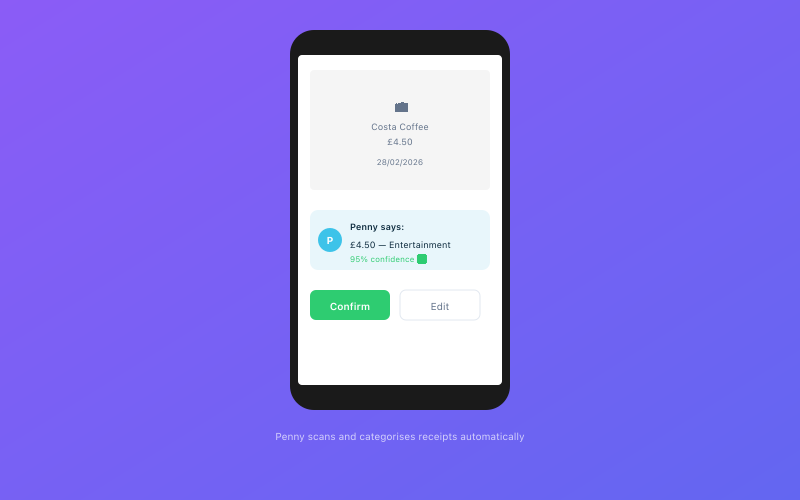 Penny scans and categorises your receipts automatically via WhatsApp
- Meals and drinks — taking a client to lunch, buying coffees at a meeting, dinner with a supplier
- Event tickets — inviting a contact to a sporting event, concert, or theatre show
- Hospitality — hosting a reception, providing refreshments at a client meeting, or organising a corporate day out
- Gifts related to entertaining — a bottle of wine sent to a client, flowers for a supplier
The key factor is that the hospitality is directed at people outside your business. HMRC draws a clear line between entertaining external contacts (generally not deductible) and looking after your own staff (often deductible, within limits).
The Bad News: Business Entertaining Is Not Tax Deductible
Here's the blunt truth: business entertaining is not an allowable expense for tax purposes. This applies whether you're a sole trader, in a partnership, or operating through a limited company.
You cannot deduct the cost of entertaining clients, suppliers, or business contacts from your taxable profits. It doesn't matter how directly the entertaining relates to winning or keeping business. Even if you can prove that a specific dinner led to a £50,000 contract, the cost of that dinner is still not deductible.
This rule is set out in legislation (specifically, ITTOIA 2005, s.45 for sole traders) and has been tested in court multiple times. HMRC is very firm on this point.
No VAT Recovery Either
If you're VAT-registered, there's a double blow: you also cannot reclaim the VAT on business entertaining costs. The input VAT on client meals, event tickets, and hospitality is blocked. This means the true cost of a £100 client dinner is £100, not £80 plus reclaimable VAT.
There is one exception to the VAT rule: if you're entertaining overseas customers (not UK-based), you may be able to reclaim the VAT. This is a niche situation, and you'd need to keep detailed records showing that the guests were genuinely from outside the UK.
What You Can Claim: Staff Entertaining
While client entertaining is blocked, staff entertaining follows different rules — and this is where sole traders sometimes get confused.
If you have employees (not subcontractors, but genuine employees on your payroll), you can claim the cost of entertaining them, subject to certain conditions. The most well-known example is the staff Christmas party, which has its own £150 per head annual exemption. We've written a separate guide on staff Christmas party rules if you want the full details.
For sole traders without employees, staff entertaining rules don't apply. You can't "entertain yourself" and claim the cost. If it's just you having a meal, the question is whether it falls under subsistence (which can be claimable when travelling) rather than entertaining. Our guide on subsistence expenses when travelling covers this in detail.
Common Scenarios and How HMRC Treats Them
Let's walk through some everyday situations to make the rules more concrete.
Lunch With a Client
You meet a potential client for lunch to discuss a project. The bill comes to £45. Not deductible. This is textbook business entertaining. Even though the meeting has a clear business purpose, the hospitality element means the cost is disallowed.
Coffee at Your Desk During a Client Call
You buy a coffee from a café and drink it while on a video call with a client. Potentially deductible as subsistence, depending on your circumstances. The coffee wasn't provided to the client — you bought it for yourself. If you were working away from your normal place of business, this could qualify as a subsistence expense.
Networking Event With Refreshments
You attend a local business networking group that charges £15 per session, including tea and biscuits. The attendance fee is likely deductible as a business cost (marketing or professional development). The fact that refreshments are included doesn't automatically make it entertaining, because you're not providing the hospitality — you're attending an event.
Sending a Gift to a Client
You send a £30 bottle of champagne to a client who's just renewed their contract. Not deductible. Gifts to clients are treated as business entertaining. However, there's an exception for small gifts that carry a conspicuous advertisement for your business, cost less than £50 per recipient per year, and are not food, drink, or tobacco. So a branded pen or diary might qualify, but the champagne doesn't.
Team Lunch With Your Employee
You take your one employee out for a pizza to celebrate finishing a big project. The bill is £35. Deductible as staff entertaining, provided you stay within reasonable limits. This isn't client entertaining because it's directed at your own staff.
The Advertising Gift Exception
There's a useful carve-out for promotional gifts that's worth knowing about. You can claim the cost of gifts to clients if all of the following conditions are met:
- The gift carries a conspicuous advertisement for your business (e.g., your logo and business name)
- The cost is less than £50 per recipient per tax year
- The gift is not food, drink, or tobacco
- The gift is not a voucher exchangeable for goods or services
So branded merchandise — mugs, notebooks, USB drives, calendars — can be a tax-deductible way to stay front of mind with clients, where a dinner or bottle of wine wouldn't be.
Record-Keeping and Practical Tips
Even though business entertaining isn't tax deductible, you should still record it in your accounts. Here's why:
- Accurate profit and loss — your accounts should reflect what you actually spent, even if some costs are disallowed for tax purposes.
- HMRC enquiries — if HMRC reviews your records, they'll want to see that you've correctly identified and disallowed entertaining costs, rather than quietly claiming them.
- VAT returns — if you're VAT-registered, you need to make sure you're not reclaiming VAT on blocked entertaining costs.
When you use Accounted, Penny helps you categorise expenses correctly. If you log a meal with a client, Penny will flag it as business entertaining and ensure it's not included in your deductible expenses. This takes the guesswork out of knowing what's allowable and what isn't.
Since you can't claim business entertaining, here are a few practical tips to manage the cost:
- Set a budget. Decide how much you're willing to spend on client entertaining each year, knowing it comes out of post-tax profits.
- Consider alternatives. Instead of expensive client dinners, could you achieve the same relationship-building through a coffee meeting, a video call, or a branded gift?
- Use the advertising gift exception. Where possible, swap non-deductible gifts (wine, hampers) for branded items that qualify for tax relief.
- Keep staff and client costs separate. Make sure your records clearly distinguish between staff entertaining (potentially deductible) and client entertaining (not deductible).
A Note on Mixed Events
Sometimes you'll host an event that includes both staff and clients — a summer barbecue, for example. In these cases, you need to apportion the costs. The portion attributable to staff entertaining may be deductible; the portion for clients and external guests is not.
This is one area where good record-keeping really pays off. Note how many attendees were staff and how many were external, and split the costs accordingly.
The Bottom Line
Business entertaining is one of those expenses that feels like it should be claimable but isn't. HMRC's rules are clear: hospitality provided to clients, suppliers, and business contacts is not tax deductible, and you can't reclaim the VAT either.
The silver lining is that staff entertaining is treated more generously, and there are smart alternatives — like branded gifts — that can give you some tax relief while still strengthening business relationships.
For a full overview of what you can and can't claim, have a look at our complete guide to sole trader expenses.
Related Reading
Accounted helps UK sole traders stay on top of their bookkeeping and tax. Start your free 30-day trial at getaccounted.co.uk
Related reading: Business Mileage Claims: 45p Rate and Actual Costs.
Related reading: Simplified Expenses: Flat Rate for Vehicles and Home.
For step-by-step guidance, see our article on How to Handle Mixed-Use Expenses as a Sole Trader.
For step-by-step guidance, see our article on How to Track Business Miles for HMRC.
See our detailed comparison: Working from Home Allowance: Flat Rate vs Actual Costs.
For more on this topic, read Clothing and Uniform Tax Relief: What Qualifies.
For more on this topic, read Home Office Tax Relief: Both Methods Compared.
You may also find our Insurance Premiums as Business Expenses: Guide helpful.
For more on this topic, read Training and Professional Development Tax Relief.
Start your free trial and let Penny handle your bookkeeping automatically.
Accounted categorises your expenses automatically using AI, with confidence scores on every transaction. See how expenses work →
Tax & Compliance Specialists
Our tax specialists have decades of combined experience in UK sole trader and small business taxation, MTD compliance, and HMRC submissions. All content is reviewed against current HMRC guidance before publication and updated quarterly to reflect legislative changes.
Ready to try Accounted?
Join UK sole traders who are simplifying their bookkeeping and tax.
Start your 14-day free trial