Accountancy Fees — Are They Tax Deductible? (Yes)
Let's not keep you in suspense. Yes, your accountancy fees are tax deductible. If you're a sole trader or freelancer paying an accountant, bookkeeper, or using accounting software to help manage your business finances, you can deduct those costs from your taxable profit.
It's one of those beautifully circular expenses — paying someone to help you work out your tax bill actually reduces your tax bill. But as with most things in the tax world, there are some nuances worth understanding. Not everything an accountant does for you is automatically deductible, and there are a few situations where the rules are less clear-cut than you might expect.
What Counts as Deductible Accountancy Fees?
The general principle is that accountancy fees incurred for the purposes of your business are allowable expenses. Here's what falls comfortably within that definition:
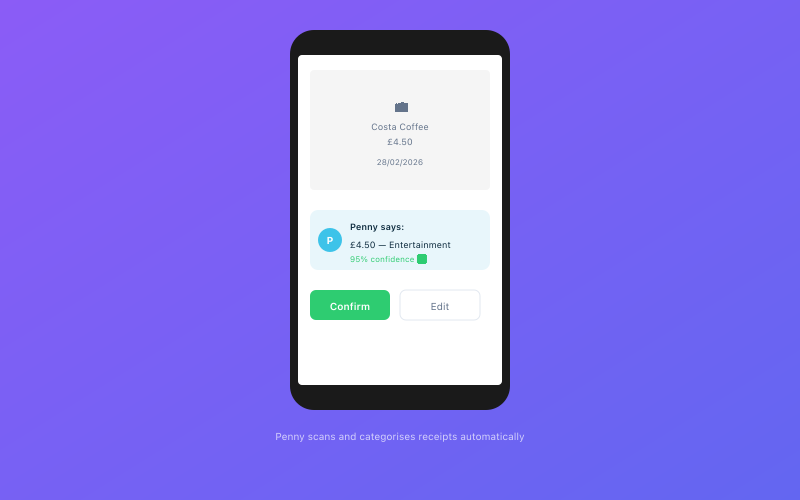 Penny scans and categorises your receipts automatically via WhatsApp
Preparing your annual accounts. If you pay an accountant to prepare your year-end accounts, calculate your profit, and produce the financial statements you need for your Self Assessment tax return, that fee is deductible. This is the most straightforward and common accountancy expense.
Filing your Self Assessment tax return. The fee your accountant charges for completing and submitting your Self Assessment return to HMRC is deductible. This includes any time they spend reviewing your records, asking you questions, and preparing the return itself.
Bookkeeping services. If you pay a bookkeeper to maintain your day-to-day financial records — recording transactions, reconciling bank statements, categorising expenses — those fees are deductible. Whether it's a monthly retainer or an hourly rate, it's an allowable business cost.
Accounting software subscriptions. The cost of software you use to manage your business finances is deductible. This includes tools like Accounted, as well as any other accounting, invoicing, or receipt-management software you subscribe to. Penny does much of the heavy lifting when it comes to categorising your transactions and keeping your books in order, and the subscription cost is fully claimable.
Tax advice related to your business. If you ask your accountant for advice on business-related tax matters — such as whether to register for VAT, how to structure a particular transaction, or how to claim a specific expense — the fee for that advice is deductible.
Payroll services. If you have employees and pay an accountant or payroll provider to process your payroll, issue payslips, and handle PAYE submissions, those costs are deductible.
VAT return preparation. If you're VAT-registered and pay someone to prepare and submit your VAT returns, that fee is deductible.
HMRC correspondence. If your accountant handles correspondence with HMRC on your behalf — responding to queries, dealing with compliance checks, or managing your tax code — the fees for this work are deductible.
What's NOT Deductible?
While most accountancy costs related to your business are deductible, there are some exceptions:
Personal tax matters unrelated to your business. If you ask your accountant to help with your personal tax affairs — such as Capital Gains Tax on selling your house, Inheritance Tax planning for your family, or tax on personal investments that aren't part of your business — those fees are not deductible as a business expense. They're personal costs, even if the same accountant handles them.
Tax investigation penalties. If HMRC investigates your tax affairs and you're found to have underpaid tax, any penalties or interest charges are not deductible. However, the professional fees you pay your accountant to represent you during the investigation are deductible — there's an important distinction between the penalties themselves and the cost of professional representation.
Fines for late filing. HMRC penalties for filing your tax return late or paying your tax late are not deductible expenses. The accountancy fees for sorting out the mess, however, are.
Setting up a limited company. If your accountant helps you incorporate a limited company, the fees for formation and initial setup are generally treated as capital expenditure rather than a revenue expense. The ongoing accountancy fees for the company's accounts are deductible, but the one-off setup costs are in a different category.
The Tax Investigation Question
Tax investigation fees deserve a closer look because they can be significant. If HMRC opens an enquiry into your Self Assessment return, your accountant (or a specialist tax investigation adviser) will charge you to handle the process — reviewing your records, preparing responses, attending meetings with HMRC, and negotiating settlements.
These professional fees are deductible as a business expense, even though the investigation itself is unpleasant. HMRC accepts that defending your tax position is a legitimate cost of running a business.
Many sole traders take out tax investigation insurance (sometimes called fee protection insurance) to cover the professional costs of dealing with an HMRC enquiry. The cost of this insurance is also deductible as a business expense.
It's worth noting that some accountancy practices include fee protection insurance as part of their annual service package. If yours does, the entire package fee is deductible — you don't need to separate out the insurance element.
How Much Can You Claim?
There's no upper limit on how much you can claim for accountancy fees, but HMRC expects the costs to be reasonable and proportionate to your business. An accountancy bill of £500-£2,000 per year for a straightforward sole trader is well within normal range. Fees of £10,000 or more might attract scrutiny unless your business is complex enough to justify them.
For context, here's what sole traders typically spend:
- Accounting software only (self-filing): £5-£30 per month (£60-£360 per year)
- Basic accountant package (accounts and tax return): £300-£800 per year
- Full-service accountant (bookkeeping, accounts, tax return, advice): £1,000-£3,000 per year
- Complex businesses (multiple income streams, VAT, employees): £2,000-£5,000+ per year
Whatever you spend, the entire business-related portion is deductible. And remember — the deduction reduces your taxable profit, which reduces both your Income Tax and National Insurance bill. If you're a basic rate taxpayer, every £100 you spend on accountancy saves you roughly £29 in tax and NI. At the higher rate, the saving is closer to £42 per £100.
DIY vs. Professional: The Real Cost Comparison
Some sole traders avoid paying for accountancy services because they think they're saving money. In many cases, they're actually costing themselves more.
Consider this. An accountant or a well-designed piece of software like Accounted doesn't just prepare your tax return. They help you:
- Claim all the expenses you're entitled to. Many sole traders miss legitimate deductions simply because they don't know they can claim them. An accountant — or Penny — will spot these.
- Structure your finances tax-efficiently. Small decisions about timing, pension contributions, and expense categorisation can make a meaningful difference to your tax bill.
- Avoid penalties. Late filing, incorrect returns, and poor record-keeping can all result in HMRC penalties that far exceed the cost of professional help.
- Save time. The hours you spend wrestling with your tax return could be spent earning money. If your hourly rate is £30 and you spend 20 hours on your accounts, that's £600 of lost earning time — potentially more than the cost of paying someone to do it properly.
The deductibility of accountancy fees makes the real cost even lower. If you pay an accountant £600 and save £180 in tax as a result (at the basic rate), the net cost is only £420. Factor in the expenses they help you claim that you'd otherwise miss, and professional help often pays for itself.
Claiming Pre-Trading Accountancy Costs
If you paid for professional advice before your business officially started trading — perhaps you consulted an accountant about the feasibility of your business idea, or you paid for advice on registering as self-employed — those costs can be claimed as pre-trading expenses.
HMRC allows you to claim costs incurred up to seven years before you start trading, provided they would have been allowable business expenses if you were already trading. Professional advice about setting up your business clearly falls into this category.
This is particularly relevant if you spent time planning your business before launching. The accountancy fees for that planning phase are not wasted — they're a deductible expense once you start trading.
Software Subscriptions: A Modern Deduction
In the past, accountancy fees meant one thing: paying an accountant. Today, many sole traders manage their finances using software, either alongside or instead of a traditional accountant. These software costs are just as deductible.
With Accounted, for example, your monthly subscription covers:
- Automated transaction categorisation through Penny
- Receipt scanning and storage
- Income and expense tracking
- Tax liability estimates
- Self Assessment preparation
- Making Tax Digital compliance
The entire subscription cost is a deductible business expense. It goes on your tax return alongside any other accountancy fees you pay, reducing your taxable profit.
If you use multiple tools — perhaps Accounted for your bookkeeping and a separate invoicing app — each subscription is individually deductible. The total cost of your financial management tools is an allowable business expense, no matter how you split it across different platforms.
Where to Put Accountancy Fees on Your Tax Return
On the Self Assessment tax return (SA103 for self-employment), accountancy fees go in the "accountancy, legal, and other professional fees" box. This is one of the specific expense categories HMRC provides, so there's no ambiguity about where it belongs.
If you file online (which you should — paper returns have an earlier deadline), the box is clearly labelled. If your accountant files on your behalf, they'll put it in the right place. And if you use Accounted to track your expenses, Penny will have already categorised your accountancy costs correctly throughout the year.
Some sole traders combine their accountancy fees with legal fees (such as contract review costs or debt recovery costs) in this box. That's fine — they all go in the same place. For the full list of expenses that HMRC allows, see our complete sole trader expenses guide.
The Bottom Line
Accountancy fees are one of the most straightforward deductions available to sole traders. If you're paying for help with your business finances — whether that's a traditional accountant, a bookkeeper, accounting software, or any combination — the cost is deductible.
Don't think of accountancy as an expense. Think of it as an investment that happens to be tax deductible. Good financial management saves you money, time, and stress. The tax deduction is just the cherry on top.
And if you're currently doing everything yourself on a spreadsheet, wondering whether it's worth paying for software or professional help — the answer is almost certainly yes. The time you save, the expenses you'll catch, and the peace of mind you'll gain are worth far more than the cost.
Accounted helps UK sole traders stay on top of their bookkeeping and tax. Start your free 30-day trial at getaccounted.co.uk.
Related reading:
- The Complete List of Sole Trader Expenses
- Your First Year of Self-Employment — A Complete Guide
- Can I Claim Working From Home Expenses?
Related Reading
- Books, Courses, and Subscriptions — What's Deductible?
- Business Use of Personal Car — The Two Methods of Claiming
Start your free trial and let Penny handle your bookkeeping automatically.
Accounted categorises your expenses automatically using AI, with confidence scores on every transaction. See how expenses work →
Tax & Compliance Specialists
Our tax specialists have decades of combined experience in UK sole trader and small business taxation, MTD compliance, and HMRC submissions. All content is reviewed against current HMRC guidance before publication and updated quarterly to reflect legislative changes.
Ready to try Accounted?
Join UK sole traders who are simplifying their bookkeeping and tax.
Start your 14-day free trial