The First Year of Self-Employment — What Nobody Tells You
There's a moment, usually a few weeks into self-employment, when the excitement fades and the reality hits. You've handed in your notice, told everyone you know, maybe even bought a new notebook to celebrate. And then Monday morning arrives, and nobody tells you what to do.
That silence is the first thing nobody warns you about. Not the tax stuff, not the invoicing — just the sheer, ringing quiet of being completely in charge of your own time.
If you're about to start your first year working for yourself — or you're already in the thick of it — this is the honest guide you need. Not the motivational fluff. The real stuff.
You Will Question Your Decision (And That's Normal)
Let's get this one out of the way early. At some point during your first year, you will lie awake at three in the morning wondering if you've made a terrible mistake. You'll see former colleagues posting about team lunches and office banter, and you'll feel a pang of something. Regret? Envy? Probably just hunger, honestly.
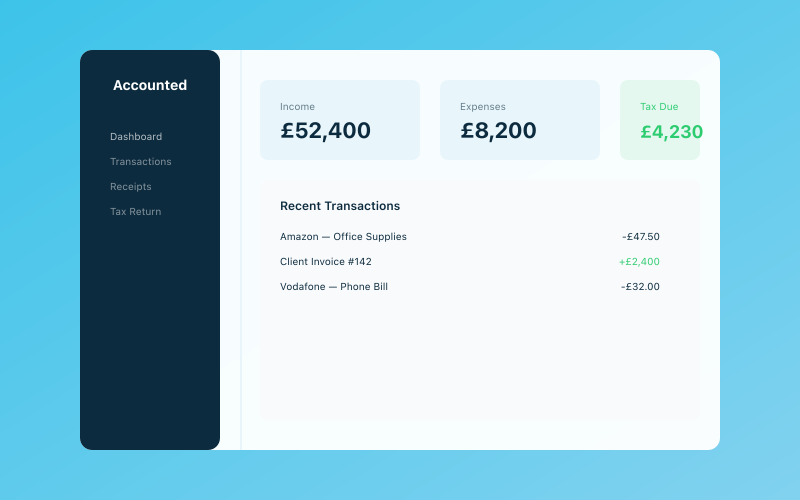 Your Accounted dashboard — income, expenses, and tax at a glance
This is completely normal. The transition from employed to self-employed isn't just a career change — it's an identity shift. For years, your routine, your social life, even your sense of purpose were wrapped up in someone else's structure. Now you have to build all of that from scratch.
The good news? That doubt tends to fade. Not all at once, but gradually, as you land your first clients, send your first invoices, and start to see your bank balance reflect your own effort rather than someone else's payroll schedule.
If the wobbles get more serious, though, don't ignore them. Have a read of our piece on the mental health cost of self-employment — it's more common than people let on, and there's no shame in finding support.
Your Income Will Be Unpredictable (Plan For It)
Here's something your employed friends won't understand: some months you'll earn twice what you used to, and other months you'll earn nothing. The feast-and-famine cycle is one of the most stressful parts of the first year, and it catches almost everyone off guard.
The trick isn't to eliminate the unpredictability — that's largely impossible when you're starting out. The trick is to plan around it.
Open a separate savings account and put aside a percentage of every payment you receive. A good rule of thumb is 25-30% for tax (more on that shortly), plus another 10-15% as an emergency buffer. It won't feel great watching money leave your account as soon as it arrives, but future you will be extremely grateful.
Also, learn to invoice promptly and chase payments without guilt. Late payments are the silent killer of small businesses. If you haven't already, check out our guide on how to register as self-employed with HMRC — getting the basics right early saves a world of pain later.
Nobody Prepares You For The Admin
When you pictured self-employment, you probably imagined doing the work you love, on your own terms. What you probably didn't picture was spending your Sunday evening trying to remember whether that Costa receipt from three weeks ago was a client meeting or just a coffee you fancied.
The admin load is genuinely one of the biggest shocks. Invoicing, bookkeeping, tax returns, chasing payments, updating your records, filing receipts — it all adds up. And because none of it feels like "real work," it's incredibly easy to let it pile up until it becomes a genuine problem.
This is exactly why we built Accounted. Our AI bookkeeper, Penny, handles the tedious stuff — categorising transactions, tracking expenses, keeping your records HMRC-ready — so you can focus on the work that actually earns you money. It's like having a bookkeeper in your pocket, minus the hourly rate.
The key lesson of the first year? Set up your systems early. Don't wait until January to sort out your books. A little bit of admin each week beats a weekend-long panic in the new year.
Tax Is Simpler Than You Think (But The Bills Are Real)
Self-assessment tax returns terrify most new sole traders, but the actual process is far less complicated than people make it sound. You add up what you earned, subtract your allowable expenses, and pay tax on the difference. That's essentially it.
What does catch people out is the size of the bill — and the timing. Your first tax bill might not arrive for over a year after you start trading, which creates a dangerous illusion that tax isn't happening. It very much is. HMRC will want their share, and they'll also want payments on account for the following year, which means your first bill could be roughly 150% of what you expected.
Start saving for tax from day one. Seriously, from your very first payment. Even if it feels premature, even if your income is modest. The habit matters more than the amount.
And with Making Tax Digital rolling out, keeping digital records isn't just good practice — it's becoming a legal requirement. Getting set up with proper bookkeeping software now means you won't be scrambling to comply later. Accounted is built specifically for UK sole traders and keeps you MTD-ready without any extra effort on your part.
Loneliness Creeps In Quietly
This is the one that really blindsides people. You don't notice it at first — you're too busy setting everything up, riding the adrenaline of something new. But after a few months, you might realise you haven't had a proper conversation with another human being since Tuesday.
Working for yourself can be isolating, especially if you work from home. There's no water cooler chat, no lunch breaks with colleagues, no someone popping by your desk to moan about the printer. Those small social moments matter more than we realise until they're gone.
Combat this actively. Join a coworking space, even if it's just one day a week. Find online communities of people in your industry. Make an effort to see friends outside of work hours, even when you're tired — especially when you're tired.
We've written more about this in our piece on loneliness in self-employment. It's worth a read, particularly if you're someone who recharged socially at work without even realising it.
You'll Learn More Than You Ever Expected
For all the challenges, the first year of self-employment is an extraordinary education. You'll learn about marketing, sales, negotiation, time management, financial planning, and resilience — all through doing, not studying.
You'll learn what kind of clients you want to work with, and more importantly, which ones you don't. You'll learn where your boundaries are and how to enforce them. You'll learn that saying no to bad work makes room for good work. (Our guide on setting boundaries with clients is a solid starting point here.)
You'll also learn uncomfortable truths about yourself. Maybe you're not as disciplined as you thought. Maybe you're more capable than you gave yourself credit for. Probably both, depending on the day.
The first year isn't about getting everything right. It's about surviving, learning, and building the foundations for something sustainable. Give yourself permission to make mistakes, ask for help, and figure things out as you go.
Practical Tips To Get Through Year One
Here are a few things that genuinely help:
Get your finances set up properly from day one. Separate bank account, bookkeeping software, a system for saving receipts. Don't wing it.
Set a routine, even a loose one. You don't need to recreate office hours, but having some structure stops the days from bleeding into each other.
Don't compare your month three to someone else's year five. Social media is a highlight reel. Everyone started somewhere.
Build relationships, not just a client list. The people you meet in year one often become your most loyal supporters down the line.
Ask for help when you need it. Whether that's an accountant, a mentor, or just a friend who'll listen while you vent about a difficult client.
Automate what you can. Your time is your most valuable resource. Anything you can hand off to technology — bookkeeping, scheduling, invoicing — frees you up for the work that matters. Penny in Accounted is brilliant for this, handling your books via WhatsApp so you barely have to think about it.
It Gets Better
The first year is the hardest. That's not a platitude — it's genuinely true. Everything is new, everything takes longer than it should, and you're learning a hundred things at once while trying to earn a living.
But by the end of that first year, you'll have something remarkable: proof that you can do this. You'll have clients, income, experience, and — if you've set things up properly — a decent set of financial records to show for it.
The second year is easier. The third year easier still. And looking back, you'll be glad you pushed through the wobbly bits.
You've got this.
Related reading:
- How to Register as Self-Employed with HMRC
- The Mental Health Cost of Being Self-Employed
- Setting Boundaries with Clients — A Complete Guide
Accounted helps UK sole traders stay on top of their bookkeeping and tax. Start your free 30-day trial at getaccounted.co.uk.
Related Reading
- Career Changers Going Freelance — A Complete Tax Starter Guide
- How to Start a Mobile Bar Business
- Starting a Pet Sitting and Dog Boarding Business
View our pricing and start your free 30-day trial today.
Starting out? Accounted is built for UK sole traders from day one — from £14/month. Get started →
Business & Operations Advisors
Our business advisors cover the practical side of running a UK sole trader business — from HMRC registration to managing growth. Content is written for real business owners in plain English, not accountants.
Ready to try Accounted?
Join UK sole traders who are simplifying their bookkeeping and tax.
Start your 14-day free trial