Career Changers Going Freelance — A Complete Tax Starter Guide
So you've decided to leave the nine-to-five behind and go freelance. Maybe you've been a marketing manager dreaming of running your own agency. Perhaps you're a project manager who's realised that clients would pay handsomely for exactly the skills your employer takes for granted. Or maybe you're in a completely different field and you've decided it's time for a fresh start.
Whatever your background, the shift from employment to freelancing is one of the most exciting — and nerve-wracking — decisions you'll ever make. The freedom is exhilarating. The tax system, less so.
This guide is designed specifically for career changers. We'll assume you've never filed a Self Assessment tax return, never worried about National Insurance classes, and never had to track a business expense in your life. By the end, you'll know exactly what you need to do, when you need to do it, and how to avoid the mistakes that trip up so many first-time freelancers.
The First Thing You Need to Do: Register
Before you start worrying about tax rates and expense categories, you need to tell HMRC that you exist as a self-employed person. You must register as self-employed within three months of starting your freelance work.
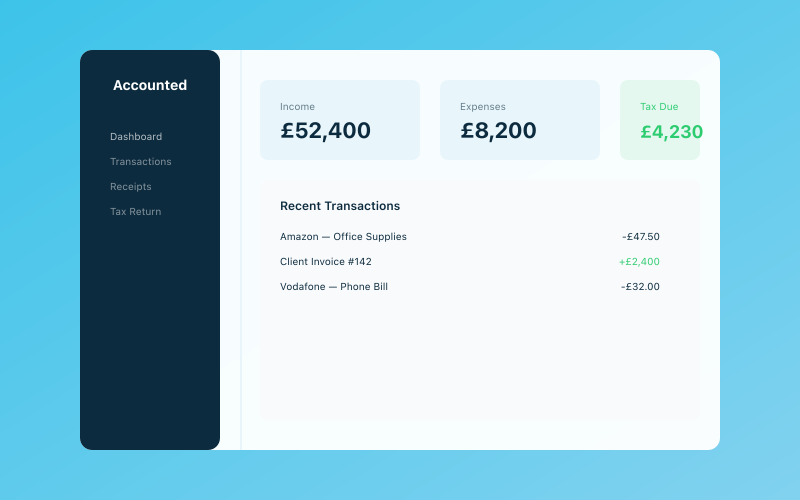 Your Accounted dashboard — income, expenses, and tax at a glance
"Starting" doesn't necessarily mean the day you land your first client. It's the date you begin actively looking for work, set up a website, or take any steps to establish your business. If you're not sure exactly when that was, pick a sensible date and stick with it.
Registration is done online through the Government Gateway. You'll need to create an account if you don't already have one, and then register for Self Assessment and Class 2 National Insurance. The process takes about ten minutes, and you'll receive a Unique Taxpayer Reference (UTR) number by post within a couple of weeks.
Don't put this off. Late registration can result in penalties, and more importantly, it's one of those things that feels like a much bigger deal than it actually is. Get it done and move on.
Understanding Income Tax as a Freelancer
When you were employed, your employer handled your tax through PAYE. The money arrived in your bank account with the tax already deducted. Those days are over.
As a freelancer, you're responsible for calculating and paying your own Income Tax. Here's how it works.
Your tax is calculated on your profits, not your total income. Profit is your income minus your allowable business expenses. So if you earn £40,000 from freelance work and have £5,000 in legitimate business expenses, your taxable profit is £35,000.
The tax bands for 2025/26 are:
- Personal allowance: £0 to £12,570 — no tax
- Basic rate: £12,571 to £50,270 — 20%
- Higher rate: £50,271 to £125,140 — 40%
- Additional rate: Over £125,140 — 45%
If you're earning other income alongside your freelance work — perhaps you're transitioning gradually and still have a part-time employed role — all your income is added together to determine which bands apply. Your personal allowance doesn't double just because you have two income sources.
The tax year runs from 6 April to 5 April, and your Self Assessment tax return for each year is due by 31 January the following year. So for the tax year ending 5 April 2026, your return and payment are due by 31 January 2027.
National Insurance: The Bit Everyone Forgets
National Insurance is the other tax that catches new freelancers off guard. As a self-employed person, you'll pay two types:
Class 2 National Insurance is a flat weekly rate — currently £3.45 per week. It's cheap, and it's important because it helps you qualify for the State Pension and certain benefits. You'll only pay it if your profits exceed the Small Profits Threshold (£6,725 for 2025/26), but you can choose to pay it voluntarily even if your profits are lower, which is often a smart move for pension purposes.
Class 4 National Insurance is charged on your profits:
- 6% on profits between £12,570 and £50,270
- 2% on profits above £50,270
Both types are calculated and paid through your Self Assessment tax return, so you don't need to set up a separate payment. But you do need to account for them when estimating how much to set aside for tax.
A reasonable rule of thumb is to put 25-30% of your freelance income into a separate savings account each time you're paid. This should cover both Income Tax and National Insurance with a bit of a buffer. Accounted can help you track this automatically so you're never caught short.
Expenses: Your New Best Friend
Here's where things get genuinely exciting — or as exciting as tax gets, anyway. As an employee, you probably didn't think much about expenses unless you were filing a claim for a train ticket. As a freelancer, every legitimate business expense reduces your taxable profit.
Common expenses for freelancers include:
- Technology — Laptop, monitor, keyboard, mouse, printer, and the software you use
- Phone and broadband — The business-use proportion of your bills
- Office supplies — Stationery, printer ink, desk accessories
- Travel — Train fares, mileage for business journeys (not your regular commute), parking, and accommodation for overnight trips
- Marketing — Website hosting, domain names, business cards, social media advertising
- Professional development — Courses, books, and conferences that maintain or update your existing skills
- Insurance — Professional indemnity, public liability
- Accounting and bookkeeping — Software subscriptions and accountant fees
- Home office — If you work from home, you can claim a proportion of your rent/mortgage interest, council tax, electricity, gas, and water, or use HMRC's simplified flat rate
The golden rule is that an expense must be incurred "wholly and exclusively" for business purposes. If something is used partly for personal and partly for business purposes — like your phone or broadband — you can claim the business proportion.
For a full rundown, see our complete list of sole trader expenses.
Payments on Account: The Nasty Surprise
If there's one thing that consistently catches new freelancers off guard, it's payments on account. Here's how they work.
If your Self Assessment tax bill exceeds £1,000 (and more than 20% of it isn't already covered by tax deducted at source), HMRC will ask you to make advance payments towards next year's tax. These are called payments on account, and they're based on the assumption that next year's income will be roughly the same as this year's.
Each payment on account is 50% of your previous year's tax bill. They're due on 31 January and 31 July.
The practical impact is that in January following your first full year of freelancing, you might owe:
- Your actual tax bill for the year just ended
- Your first payment on account for the coming year (50% of the previous bill)
That's effectively 150% of your annual tax bill in one go. In July, you'll then pay the second instalment (another 50%).
This is precisely why setting money aside throughout the year is so critical. If you're disciplined about putting 25-30% away each time you're paid, the January bill won't be a shock. Penny in Accounted can give you a running estimate of your tax liability so you always know roughly what you'll owe.
Record-Keeping: Start Strong
As an employee, you probably never thought about record-keeping. As a freelancer, it's your responsibility — and HMRC can ask to see your records at any time.
You need to keep:
- Records of all your income (invoices, bank statements)
- Records of all your expenses (receipts, bank statements)
- Details of any personal money you've put into or taken out of the business
HMRC requires you to keep these records for at least five years after the 31 January submission deadline for the relevant tax year. So records for 2025/26 (submitted by 31 January 2027) must be kept until at least 31 January 2032.
The simplest way to stay on top of this is to use accounting software from day one. Accounted is built specifically for UK sole traders and freelancers, and Penny handles much of the categorisation and organisation automatically. Photograph your receipts as you get them, log your invoices when you send them, and everything is always up to date.
The alternative — the dreaded shoebox method — inevitably leads to a stressful weekend in January where you try to reconstruct an entire year's accounts from memory. Trust us, that's not how you want to spend your time.
If You're Still Employed While Starting Out
Many career changers don't make a clean break. They start freelancing alongside their day job, building up a client base and income stream before handing in their notice. This is a perfectly sensible approach, but there are a few things to be aware of.
Check your employment contract. Many contracts have clauses about outside work, especially if your freelance work is in a similar field. You don't want to get fired before you're ready to leave.
You'll still need to register with HMRC and file a Self Assessment tax return if your freelance income exceeds £1,000 in the tax year.
Your tax situation is more complex because you'll have income from two sources. Your employed income is taxed through PAYE, and your freelance profits are taxed through Self Assessment. The two are combined to determine your overall tax position, so don't assume your freelance income starts at the bottom of the tax bands — it sits on top of your employed income.
National Insurance is calculated separately for each type of income, so you'll pay both employee NI on your salary and self-employed NI on your freelance profits.
Our first year of self-employment guide covers these overlapping situations in more detail.
Building Good Habits From Day One
The most successful freelancers we work with all have one thing in common — they built good financial habits early. Here's what that looks like:
- Separate bank accounts. Keep your business and personal finances apart. It makes everything easier.
- Invoice promptly. Send invoices as soon as the work is done. The sooner you invoice, the sooner you get paid.
- Track expenses in real time. Don't let receipts pile up. Photograph and categorise them the same day.
- Set aside tax money immediately. When a payment comes in, move your tax percentage to a savings account before you spend anything.
- Review your numbers monthly. Even a quick ten-minute review of your income and expenses each month will keep you informed and in control.
These habits take almost no time but save enormous amounts of stress. And once they're established, they become automatic.
Taking the Leap
Changing careers to go freelance is bold, and it should be. You're betting on yourself, and that takes courage. But with the right preparation — registering promptly, understanding your tax obligations, tracking your expenses, and setting money aside — the financial side of freelancing is entirely manageable.
You don't need to be a tax expert. You just need the right tools and a bit of discipline. The rest takes care of itself.
Accounted helps UK sole traders stay on top of their bookkeeping and tax. Start your free 30-day trial at getaccounted.co.uk.
Related reading:
- How to Register as Self-Employed With HMRC
- Your First Year of Self-Employment — A Complete Guide
- The Complete List of Sole Trader Expenses
Related Reading
- Famous People Who Started as Sole Traders
- How to Start a Gardening Business
- How to Start a Freelance Consulting Business
View our pricing and start your free 30-day trial today.
Starting out? Accounted is built for UK sole traders from day one — from £14/month. Get started →
Business & Operations Advisors
Our business advisors cover the practical side of running a UK sole trader business — from HMRC registration to managing growth. Content is written for real business owners in plain English, not accountants.
Ready to try Accounted?
Join UK sole traders who are simplifying their bookkeeping and tax.
Start your 14-day free trial