How to Start a Freelance Consulting Business
You've spent years building expertise in your field. You know your stuff, people come to you for advice, and you've started wondering whether you could do this on your own terms — choosing your clients, setting your hours, and keeping the profits. That's the appeal of freelance consulting, and for many professionals, it's one of the most rewarding career moves they make.
Consulting is one of the few businesses where your primary asset is your knowledge. The startup costs are minimal, the margins can be excellent, and the work is intellectually stimulating. But making the leap from employment to self-employment requires more than just expertise. You need to understand how to find clients, price your services, manage your finances, and navigate the tax system.
Here's a practical guide to starting a freelance consulting business in the UK.
Defining Your Consulting Niche
The most successful consultants are known for something specific. "Business consultant" is vague and forgettable. "Operations consultant for mid-sized manufacturing firms" is specific and memorable. The narrower your niche, the easier it is to market yourself and the more you can charge.
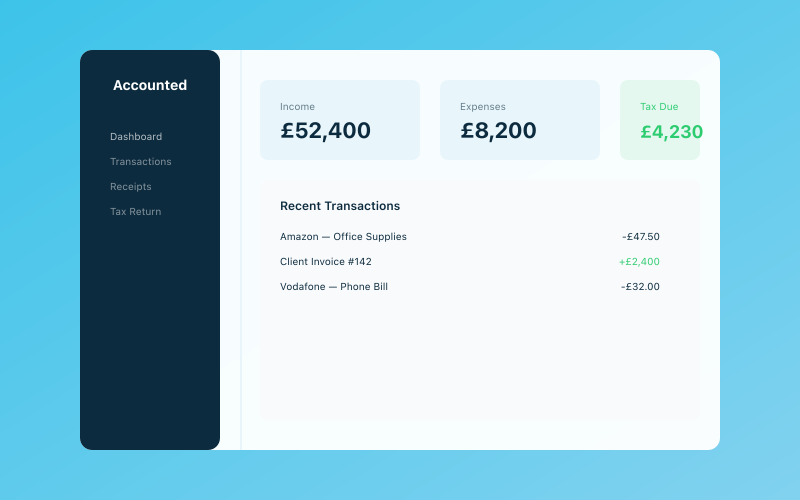 Your Accounted dashboard — income, expenses, and tax at a glance
To define your niche, consider:
Your expertise. What do you know better than most people? This might be a specific industry (healthcare, fintech, construction), a function (marketing, HR, supply chain), or a methodology (lean management, digital transformation, data analytics).
Your track record. What have you delivered in your career? Clients hire consultants for results, so think about the measurable outcomes you've achieved. Revenue growth, cost savings, efficiency improvements, successful implementations — these are the stories that win clients.
Market demand. Is there a gap in the market for what you offer? Talk to people in your network, look at job boards for consulting roles, and research what other consultants in your space are charging. If companies are hiring for the expertise you have, there's demand.
Your ideal client. Who do you want to work with? Small businesses, large corporates, startups, public sector organisations? Different client types have different procurement processes, budgets, and expectations. Choosing your target client shapes everything from your pricing to your marketing.
Don't try to be everything to everyone. The consultant who tries to serve all markets ends up competing on price. The specialist competes on value.
Setting Up Your Business
Choose your business structure. Most freelance consultants start as either a sole trader or a limited company. Each has pros and cons:
-
Sole trader — simplest to set up, lowest admin burden, and all profits are yours (after tax). You'll register with HMRC as self-employed — it's free and takes minutes. The downside is unlimited personal liability and potentially higher tax if you're earning above the higher rate threshold.
-
Limited company — more administrative work (company formation, annual accounts, corporation tax returns) but can be more tax-efficient at higher income levels. You pay yourself through a combination of salary and dividends. Corporation Tax is 25% for profits over £250,000 (19% for profits under £50,000, with marginal relief in between). For many consultants earning £50,000+, a limited company can save several thousand pounds per year in tax.
The right choice depends on your expected income, your appetite for admin, and whether your clients have preferences (some large organisations prefer to work with limited companies, and IR35 considerations may be relevant).
For this guide, we'll focus primarily on the sole trader route, as it's the simplest starting point.
Get professional indemnity insurance. This is arguably the most important insurance for a consultant. Professional indemnity (PI) insurance covers you if a client claims they suffered a financial loss due to your advice or services. Policies typically start from £150 to £500 per year depending on your turnover and the nature of your consulting work. Many clients will require you to have PI insurance before engaging you.
Public liability insurance is also worth having, especially if you visit client premises. Cover of £1 million to £5 million is standard. Our sole trader insurance guide covers the different types of business insurance.
Pricing Your Consulting Services
Pricing is one of the most critical decisions you'll make, and consultants often undercharge when starting out. Here's how to think about it:
Day rates are the most common pricing model for consulting. Typical UK rates vary enormously by industry and experience:
- Junior/entry-level consultants: £300 to £500 per day
- Mid-level consultants: £500 to £900 per day
- Senior/specialist consultants: £900 to £1,500 per day
- Executive-level or niche specialists: £1,500 to £3,000+ per day
Hourly rates work for smaller engagements or advisory work. A consultant charging £800 per day might charge £120 to £150 per hour for ad-hoc work.
Project-based pricing can be more profitable than day rates if you're efficient. Instead of charging for your time, you charge for the outcome. A project quoted at £15,000 that takes you 12 days is equivalent to £1,250 per day. Project pricing requires confidence in your ability to estimate the work involved, but it removes the awkward dynamic of clients watching the clock.
Retainer arrangements provide predictable income. A client pays a fixed monthly fee (say, £2,000 to £5,000) for an agreed number of days or scope of support. Retainers are the holy grail of consulting — they smooth out your cash flow and provide a stable foundation.
When setting your rates, work backwards from what you need to earn. Remember that as a freelancer, you need to cover:
- Your target take-home pay
- Tax and National Insurance
- Pension contributions (no employer pension here — it's all on you)
- Holiday and sick pay (you don't get paid when you're not working)
- Business expenses (insurance, software, travel, marketing)
- Non-billable time (admin, marketing, business development — typically 20-40% of your time)
Our guide to setting your rates as a freelancer goes into this in much more detail.
Finding Your First Clients
The transition from employment to consulting often starts with your existing network. Here's how to build your client base:
Tell your network. Your former colleagues, managers, industry contacts, and professional connections are your warmest leads. Let people know you're available for consulting work. Be specific about what you offer — "I help mid-sized retailers optimise their supply chain" is more actionable than "I'm now a consultant."
LinkedIn is your primary marketing channel. For B2B consulting, LinkedIn is unmatched. Optimise your profile to clearly state what you do and who you help. Post regularly about your area of expertise — insights, case studies (anonymised if needed), and industry observations. Engage with others' content. Over time, this positions you as a thought leader and generates inbound enquiries.
Referrals are your best source of new business. After every successful engagement, ask your client if they know anyone else who could benefit from similar help. Most consultants find that the majority of their work comes through referrals once they're established.
Consulting marketplaces and platforms. Sites like Expert360, Comatch, and Catalant connect consultants with clients. For interim management roles, platforms like Odgers Interim and Robert Half can be useful. These platforms take a commission but can be valuable while you build your direct client pipeline.
Content marketing. Writing articles, creating case studies, speaking at events, or running webinars demonstrates your expertise and attracts clients. It's a longer-term strategy but incredibly effective for positioning yourself as an authority.
Don't underestimate warm introductions. A single introduction from a trusted mutual contact is worth more than a hundred cold emails.
Managing Your Finances
Financial management is where many new consultants stumble. When you're used to a salary arriving on the 25th of each month, adjusting to irregular income requires discipline.
Separate your business and personal finances. Open a dedicated business bank account. This makes bookkeeping cleaner, gives you a clear picture of business performance, and simplifies your tax return.
Track everything from day one. Every invoice sent, every expense incurred, every receipt collected. Accounted is built for exactly this — it gives you a real-time view of your income, expenses, and estimated tax position so you're never caught off guard.
Set aside money for tax. A good rule of thumb is to set aside 25-30% of your gross income for income tax and National Insurance. For the 2025/26 tax year:
- Personal Allowance: £12,570
- Basic rate (20%): £12,571 to £50,270
- Higher rate (40%): £50,271 to £125,140
- Additional rate (45%): over £125,140
- Class 2 NI: £3.45 per week
- Class 4 NI: 6% on profits between £12,570 and £50,270, plus 2% above £50,270
Invoice promptly and chase late payments. Many consultants are excellent at the work but terrible at the admin. Send your invoice the moment the work is completed (or at the agreed billing milestone). Standard payment terms are 30 days, but some clients stretch this. Be polite but persistent about chasing overdue invoices. Penny inside Accounted can flag outstanding invoices and help you stay on top of your receivables.
Plan for the gaps. Even successful consultants have quiet periods between engagements. Build a financial buffer — ideally three to six months of expenses — to smooth out the peaks and troughs.
Don't forget about VAT. If your turnover exceeds £90,000 in a rolling 12-month period, you must register for VAT. For consultants, the Flat Rate Scheme can simplify VAT accounting — you charge clients 20% VAT but pay HMRC a lower flat rate percentage (which varies by business type). Whether this is beneficial depends on your specific circumstances.
Building a Sustainable Consulting Practice
The consultants who thrive long-term are those who treat their consulting work as a proper business, not just a series of projects.
Invest in professional development. Your knowledge is your product. Keep it sharp through courses, certifications, conferences, and reading. The cost is tax-deductible and the investment pays for itself many times over.
Build processes. Create templates for proposals, contracts, status reports, and invoices. Standardise your onboarding process for new clients. The more systematised your business, the more time you spend on billable work and the less on admin.
Protect your reputation. In consulting, your reputation is everything. Deliver what you promise, communicate proactively, and be honest when something isn't going to plan. One bad engagement can undo years of reputation-building.
Think about your long-term positioning. Where do you want to be in three to five years? A business plan might feel unnecessary for a solo consultant, but even a simple one-page plan helps you think about your goals, your target income, and the steps needed to get there.
Look after yourself. Consulting can be intense. The freedom and flexibility are wonderful, but the pressure to be constantly available, the feast-and-famine cycle, and the isolation of working alone can take a toll. Set boundaries, take holidays, and build a support network of fellow freelancers and consultants.
Related Reading
View our pricing and start your free 30-day trial today.
Accounted helps UK sole traders stay on top of their bookkeeping and tax. Start your free 30-day trial at getaccounted.co.uk.
Starting out? Accounted is built for UK sole traders from day one — from £14/month. Get started →
Business & Operations Advisors
Our business advisors cover the practical side of running a UK sole trader business — from HMRC registration to managing growth. Content is written for real business owners in plain English, not accountants.
Ready to try Accounted?
Join UK sole traders who are simplifying their bookkeeping and tax.
Start your 14-day free trial