Returning to Self-Employment After a Career Break
Taking a career break is more common than it used to be. Whether you stepped away to raise children, care for a family member, travel, deal with health issues, or simply because you needed a change, there comes a point when you're ready to get back to work. And if self-employment was your thing before — or if you want to try it for the first time — returning to the world of sole trading after time away can feel both exciting and daunting.
The good news is that the fundamentals haven't changed as much as you might think. The tax system still works the same way, clients still need good work done, and the skills you built before your break haven't evaporated. But there are practical steps to take, mindset hurdles to clear, and a few things that genuinely have changed. Let's work through them.
Re-Registering with HMRC
If you were previously self-employed and told HMRC you'd stopped trading (by deregistering), you'll need to register again. This is the same process as registering for the first time — you do it online through the GOV.UK website, and HMRC will issue you a new Unique Taxpayer Reference (UTR) number for Self Assessment.
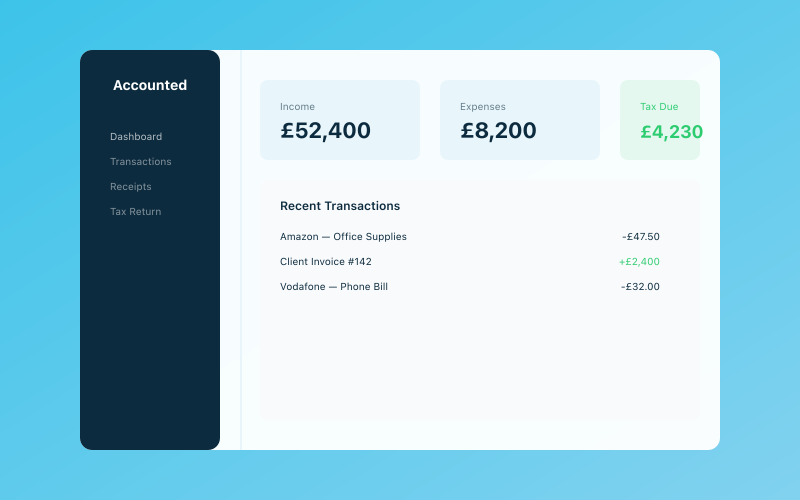 Your Accounted dashboard — income, expenses, and tax at a glance
If you didn't formally deregister but simply stopped trading and stopped filing returns, your situation might be slightly more complicated. HMRC may still have you on record as self-employed, and there could be outstanding returns or queries. It's worth checking your HMRC online account to see what your current status is before you start trading again.
You should register as self-employed as soon as you start trading — which means as soon as you start doing work with the intention of making a profit, even if you haven't earned anything yet. The deadline for registration is technically 5 October following the end of the tax year in which you started trading, but there's no reason to wait that long. For a detailed walkthrough, our guide to registering as self-employed with HMRC covers the process step by step.
Assessing What's Changed in Your Industry
Depending on how long you've been away, your industry may have evolved significantly. Technology moves fast, client expectations shift, and competitors come and go. Before you jump back in, spend some time understanding the current landscape.
Talk to people still working in your field. Former colleagues, industry contacts, and professional networks can give you a sense of what's changed. LinkedIn is useful for this — even if you haven't been active, your connections are still there.
Research current rates. If you were charging £40 per hour before your break, that rate may no longer be appropriate — it could be too low (inflation and market changes) or too high (new competitors, changed demand). Check job boards, freelancer platforms, and industry surveys to benchmark your pricing.
Update your skills if needed. Some industries move faster than others. A web developer returning after three years might find that frameworks and tools have changed substantially. A plumber or electrician might find new regulations to get up to speed on. Training courses, workshops, and online learning can bridge the gap — and the cost of training that updates your existing skills is tax-deductible.
Check your qualifications and memberships. If your work requires professional accreditation, check whether your membership has lapsed and what's needed to reinstate it. Some professional bodies offer returning-to-practice programmes specifically for this situation.
Rebuilding Your Client Base
This is often the most anxiety-inducing part of returning to self-employment. When you stopped working, your client relationships may have gone dormant. People move on, companies change, and the world doesn't stand still while you're away.
But here's the thing: restarting is almost always easier than starting from scratch. You have something that brand-new sole traders don't: experience, a track record, and (hopefully) a reputation.
Reach out to former clients. A simple, honest message — "I'm returning to freelance work after a career break and I'd love to reconnect" — is all it takes. Many former clients will be genuinely pleased to hear from you, especially if they were happy with your work before. Some may have immediate needs. Others might not, but they'll remember you when something comes up.
Update your online presence. If your website has been sitting untouched for two years, it needs refreshing. Update your portfolio, revise your services page, and make it clear that you're actively taking on work. If you don't have a website, now is the time to create one — even a simple one-page site is better than nothing.
Use social media strategically. Post about your return. Share your expertise. Engage with industry conversations. You don't need to become an influencer — just be visible and demonstrate that you're active and knowledgeable.
Network actively. Attend industry events, join local business groups, and go to meetups. In-person networking is still one of the most effective ways to find clients, and it's particularly valuable when you're re-establishing yourself.
Ask for referrals. Tell everyone you know that you're back in business. Friends, family, former clients, fellow parents at the school gate — word of mouth is powerful, and people are generally happy to recommend someone they know and trust.
For more ideas on building your client base, our first year of self-employment guide has a section on finding clients that's relevant whether you're starting fresh or restarting.
Getting Your Finances in Order
One of the most important things you can do when returning to self-employment is set up your finances properly from day one. If you had a messy relationship with bookkeeping before your break, this is your chance to start clean.
Open a separate business bank account. Even if you had one before, starting fresh with a new account gives you a clean slate. Many banks offer free business accounts for sole traders, and keeping your business and personal finances separate makes everything easier — from tracking your income to filing your tax return.
Set up your bookkeeping system. This is where tools like Accounted really shine. Rather than cobbling together spreadsheets or stuffing receipts into envelopes, you can have Penny categorise your expenses automatically, track your income, and keep your records in order as you go. Starting with a proper system from the beginning means you never have to do the dreaded "six months of backlog" catch-up.
Understand your tax position. If you've been out of the workforce, your income for the year may be relatively low, which affects your tax calculation. Remember that you have a personal allowance of £12,570 (2025/26) before you pay any income tax, and your National Insurance contributions as a self-employed person depend on your profit level. If you've had a gap in your NI record, you may want to check whether it's worth making voluntary contributions to protect your State Pension — our guide to State Pension and NI gaps explains why this matters.
Plan for tax payments. If your tax bill exceeds £1,000, HMRC will require payments on account — advance payments towards next year's tax. This can come as a surprise if you've been out of the system, so budget for it from the start.
Dealing with the Confidence Gap
Let's talk about the elephant in the room. Returning to work after a break can feel intimidating, and imposter syndrome often rears its head. You might worry that your skills are rusty, that the industry has left you behind, or that clients won't take you seriously.
These feelings are normal, and they're almost always worse than the reality. The skills you developed over years of work don't disappear during a career break. In fact, many people return from breaks with fresh perspective, renewed energy, and better priorities.
A few things that help:
Start small. You don't need to land a massive project on your first day back. Take on a smaller piece of work to rebuild your confidence and get back into the rhythm. Each completed project reinforces that you can still do this.
Acknowledge the break honestly. You don't need to hide your career break or apologise for it. Most clients don't care about gaps in your CV — they care about whether you can do good work now. A brief, matter-of-fact explanation is all that's needed: "I took a few years out to focus on my family, and I'm now back and taking on new projects."
Invest in yourself. Taking a short course, attending a conference, or reading up on industry developments can boost your confidence and demonstrate to clients that you're current. The cost is tax-deductible, so the financial impact is softened.
Connect with others in the same situation. There are online communities, networking groups, and organisations specifically for people returning to work after career breaks. Knowing you're not alone in the experience is reassuring.
Practical Checklist for Your Return
Here's a step-by-step checklist to work through as you return to self-employment:
- Check your HMRC status — are you still registered as self-employed, or do you need to re-register?
- Open a business bank account (or reactivate your old one)
- Set up your bookkeeping — Accounted is designed for exactly this, making it easy to start clean
- Review your industry — what's changed, what's stayed the same, what do you need to learn?
- Update your qualifications and memberships if applicable
- Refresh your online presence — website, LinkedIn, social media
- Contact former clients and let them know you're back
- Set your pricing based on current market rates
- Create or update your business plan — even a simple one helps you focus. Our business plan guide can help
- Sort out business insurance if your work requires it
- Check your National Insurance record and decide whether to fill any gaps
- Set aside money for tax from your first invoice
The First Few Months
The early months of your return will likely feel a bit uneven. Some weeks you'll be busy; others might be quiet. Some clients will come back quickly; others will take time to materialise. This is completely normal, and it mirrors the experience of anyone starting or restarting a business.
Give yourself six months before you judge how things are going. Most self-employed people find that it takes at least that long to rebuild momentum after a break. The clients you contact in month one might not need you until month four. The networking you do in month two might lead to a referral in month six.
During this ramp-up period, keep your overheads low, stay consistent with your marketing and outreach, and focus on delivering excellent work for every client you get. Quality work leads to repeat business and referrals, which is how most successful sole traders build sustainable income.
You've Done This Before
If you were self-employed before your break, you already know more than you think. You know how to find clients, how to manage your time, how to handle the administrative side, and how to deal with the uncertainty that comes with working for yourself. Those skills are still there.
And if you're coming to self-employment for the first time after a career break from employment, you're bringing transferable skills, professional networks, and life experience that are genuinely valuable. The mechanics of being self-employed — registering, invoicing, tracking expenses, filing tax returns — are learnable, and tools like Accounted make them far more manageable than they were even a few years ago.
Whatever your situation, returning to work after a career break is an achievement in itself. Be proud of it, be practical about it, and be patient with yourself as you find your rhythm.
Accounted helps UK sole traders stay on top of their bookkeeping and tax. Start your free 30-day trial at getaccounted.co.uk
Related reading:
- How to Register as Self-Employed with HMRC
- Your First Year of Self-Employment — A Complete Guide
- How to Write a Business Plan
Related Reading
- How to Start a Courier or Delivery Business
- Retiring From Teaching and Starting a Consultancy — Tax Guide
View our pricing and start your free 30-day trial today.
Starting out? Accounted is built for UK sole traders from day one — from £14/month. Get started →
Business & Operations Advisors
Our business advisors cover the practical side of running a UK sole trader business — from HMRC registration to managing growth. Content is written for real business owners in plain English, not accountants.
Ready to try Accounted?
Join UK sole traders who are simplifying their bookkeeping and tax.
Start your 14-day free trial