Universal Credit and Self-Employment — How Your Earnings Are Assessed
Self-Employment and Universal Credit — It's Complicated
Universal Credit (UC) and self-employment have an uneasy relationship. The benefit system was largely designed around employment — regular wages, monthly pay cycles, predictable income. Self-employment, with its irregular earnings, seasonal ups and downs, and blurred line between income and expenses, doesn't fit neatly into that framework.
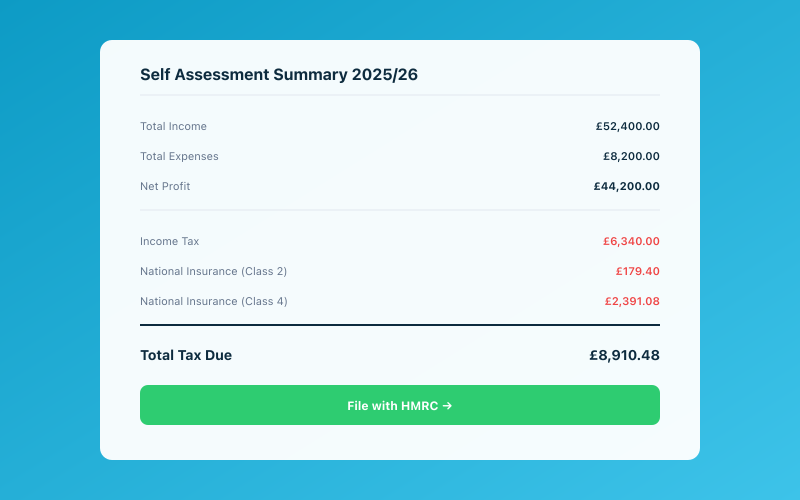 Your Accounted dashboard shows your real-time tax position
But thousands of self-employed people in the UK do claim Universal Credit, either because their business is in its early stages, their income is low, or their circumstances mean they're entitled to support. If you're one of them — or thinking about becoming self-employed while on UC — understanding how the system works is essential.
Get it wrong, and you could lose benefit income you're entitled to. Get it right, and Universal Credit can provide a genuine safety net while you build your business.
How Universal Credit Normally Works (The Quick Version)
Universal Credit is a single monthly payment that replaces several older benefits (Jobseeker's Allowance, Working Tax Credits, Housing Benefit, etc.). Your payment is based on your circumstances — housing costs, children, disabilities — minus your earnings.
For employed people, it's relatively straightforward. HMRC sends your earnings data to the Department for Work and Pensions (DWP) automatically through the PAYE system. Your UC payment adjusts accordingly each month.
For self-employed people, it's more complicated. There's no automatic earnings data, so you need to report your income yourself. And there's a particular mechanism — the Minimum Income Floor — that catches many people off guard.
The Minimum Income Floor (MIF) Explained
The Minimum Income Floor is the most important concept for self-employed UC claimants to understand. Here's how it works.
After your startup period (more on that below), the DWP assumes you earn a minimum amount from self-employment — whether you actually do or not. This assumed amount is called the Minimum Income Floor.
How It's Calculated
The MIF is based on what you'd earn working the number of hours expected of you at the National Living Wage.
For most self-employed claimants, the expected hours are 35 per week (equivalent to full-time employment). The calculation is:
35 hours × National Living Wage = Weekly MIF
In 2025/26, with the National Living Wage at £11.44 per hour (for workers aged 21+), the weekly MIF would be approximately £400, or around £1,735 per month.
From this amount, the DWP deducts a notional amount for tax and National Insurance, giving you an adjusted MIF figure.
What It Means in Practice
If your actual self-employed earnings in a given month are above the MIF, your actual earnings are used to calculate your UC.
If your actual earnings are below the MIF, the DWP uses the MIF figure instead — even though you earned less. This means your UC payment will be lower than it would be if your actual (lower) earnings were used.
Example:
Let's say the MIF for your situation is £1,500/month, and your UC would normally be reduced by 55p for every £1 you earn above your work allowance.
- Month 1: You earn £2,000. Your actual earnings are used. UC is reduced based on £2,000.
- Month 2: You earn £800. The MIF kicks in. UC is calculated as if you earned £1,500, even though you only earned £800.
- Month 3: You earn £1,500 exactly. Either way, the calculation is the same.
The MIF penalises months where your earnings are low. In a business with irregular income — which describes most self-employment — this can be a real problem.
The Startup Period
There's an important exception to the MIF: the startup period.
If you're starting a new business, you may be given a 12-month startup period during which the MIF doesn't apply. During this time, your actual earnings are used every month, no matter how low they are.
Qualifying for the Startup Period
To get a startup period, you need to demonstrate that:
- You're in gainful self-employment (see below)
- Your business is viable and likely to grow
- You've taken steps to start your business (business plan, website, marketing, etc.)
The startup period is not automatic. Your work coach at the JobCentre will assess whether your business qualifies. Being prepared with evidence of your business activities helps.
What Happens After 12 Months
Once the startup period ends, the MIF applies. If your business hasn't grown to the point where you're regularly earning above the MIF, your UC payments will drop because the DWP treats you as though you're earning the MIF amount.
This is a crucial moment. Some people find they need to increase their earnings, reduce their hours expectation, or reconsider their self-employment plans.
You can only have one startup period. If your business fails and you start a new one, you won't get another 12-month grace period.
How Monthly Earnings Are Assessed
Self-employed UC claimants must report their earnings monthly. This happens through your UC journal (the online account where you manage your claim).
What You Report
Each month, you report:
- Your total income from self-employment (gross earnings before tax)
- Your allowable expenses (costs directly related to your business)
- Your resulting profit (income minus expenses)
It's your profit figure that the DWP uses (or the MIF, whichever is higher).
When You Report
You have a specific assessment period each month (aligned with your UC payment dates). You must report your earnings for each assessment period by the deadline — typically within a few days of the period ending.
Late reporting can result in your payment being delayed or your earnings being estimated (usually not in your favour).
The Importance of Good Records
This is where proper bookkeeping becomes critical. You need to know your exact income and expenses for each monthly period. Not roughly, not approximately — exactly.
Using accounting software like Accounted makes this much easier. If Penny has been categorising your expenses all month, you can pull the exact figures you need for your UC reporting without scrambling through bank statements.
Keeping good records isn't just about HMRC — it directly affects your monthly UC payment.
What Counts as Earnings vs Expenses
The DWP's rules on what counts as self-employed income and expenses are similar to HMRC's, but not identical.
Income
Your self-employed income includes:
- All payments received for your work or products
- Cash and bank payments
- Invoiced amounts (when received, not when invoiced)
Allowable Expenses
You can deduct genuine business expenses, including:
- Materials and stock
- Business travel (not commuting)
- Marketing and advertising
- Professional fees
- Business insurance
- Equipment and tools
- A proportion of household bills if you work from home
You cannot deduct:
- Capital expenditure (buying equipment is treated differently)
- Expenses that are also for personal use (unless you can separate the business portion)
- Losses carried forward from previous months
The DWP can and does challenge expense claims that seem unreasonable. Keep receipts and records for everything. This is another area where having digital records in Accounted protects you — if the DWP questions an expense, you can pull up the receipt instantly.
The Gainful Self-Employment Test
Before you can be treated as self-employed for UC purposes, the DWP needs to determine that your self-employment is "gainful." This isn't about how much you earn — it's about whether your self-employment is genuine and organised.
The test looks at:
- Whether your work is regular and organised
- Whether you're actively seeking work or customers
- Whether you keep business records
- Whether your business could reasonably be expected to grow
- Whether you're putting in enough hours
If the DWP decides your self-employment isn't gainful, they may treat you as unemployed and require you to look for employed work instead. This is more common than you might think, and it usually comes down to a lack of evidence.
Having organised business records, a clear business plan, and evidence of marketing activity all help demonstrate gainful self-employment.
Work-Focused Interviews
As a self-employed UC claimant, you'll have regular work-focused interviews with your work coach. During these, they'll review:
- Your business progress
- Your earnings
- Your efforts to grow your income
- Whether self-employment is still the right path
These interviews can feel intrusive, but they're a standard part of the process. Being prepared — knowing your numbers, showing progress, demonstrating effort — makes them much smoother.
Working Alongside UC
Many self-employed people use UC as a top-up while they build their business. The system is designed to allow this, and there's no rule against earning money while claiming UC.
The key mechanics:
- You have a work allowance — an amount you can earn before UC starts reducing (£379/month if you get help with housing costs, £631 if you don't)
- Above the work allowance, UC reduces by 55p for every £1 you earn
- The MIF applies after your startup period
This means that growing your earnings gradually is supported — you don't lose £1 of benefit for every £1 you earn. But the MIF can create a cliff edge if your earnings dip significantly after the startup period.
How to Report Correctly
Here's a practical checklist for monthly reporting:
- Track income daily — Record every payment received, with the date
- Track expenses daily — Record every business expense, with receipts
- Calculate monthly profit — Income minus expenses for the assessment period
- Report on time — Submit your figures through your UC journal by the deadline
- Keep evidence — Store receipts and records for at least 5 years
- Be honest — HMRC and DWP share information; discrepancies get flagged
Using Penny in Accounted to keep your records organised means you always have your figures ready when reporting day comes around. No last-minute scrambling, no guessing, no gaps.
Common Pitfalls
- Forgetting to report — A missed report can result in a payment of £0
- Confusing invoiced vs received income — UC cares about when you received the money, not when you invoiced
- Not understanding the MIF — Many people are shocked when their UC drops after the startup period
- Poor record-keeping — If you can't evidence your expenses, they won't be deducted
- Mixing personal and business — Keep finances separate with a dedicated business account
The Bottom Line
Universal Credit and self-employment can work together, but only if you understand the rules. The Minimum Income Floor, monthly reporting, and the gainful self-employment test all require attention and decent record-keeping.
The single best thing you can do is keep meticulous records of your income and expenses throughout the month. This makes UC reporting accurate, protects you if questioned by the DWP, and keeps your HMRC records in order at the same time.
If the admin feels overwhelming, tools like Accounted exist specifically to make bookkeeping effortless. Penny tracks your income and expenses automatically, so when reporting day arrives, your figures are already there.
Self-employment on UC isn't easy, but with the right systems in place, it's manageable. And the support UC provides can be the difference between a business that survives its early months and one that doesn't.
Related Reading
Start your free trial and let Penny handle your bookkeeping automatically.
Accounted files your Self Assessment directly to HMRC, with your return pre-populated from your records. See Self Assessment filing →
Tax & Compliance Specialists
Our tax specialists have decades of combined experience in UK sole trader and small business taxation, MTD compliance, and HMRC submissions. All content is reviewed against current HMRC guidance before publication and updated quarterly to reflect legislative changes.
Ready to try Accounted?
Join UK sole traders who are simplifying their bookkeeping and tax.
Start your 14-day free trial