What Your Accountant Really Thinks About Your Receipts
Picture the scene. It is January. An accountant sits at their desk, surrounded by the warm glow of spreadsheets. There is a knock at the door. A client enters, smiling apologetically, carrying a Sainsbury's bag. Inside the bag is a year's worth of receipts, crumpled, faded, coffee-stained, and arranged in no discernible order whatsoever.
"Sorry it's a bit of a mess," the client says.
The accountant smiles. It is a practised smile — warm, professional, and entirely devoid of the internal scream that is currently reverberating around their skull.
If you have ever handed your accountant a pile of receipts and wondered what they were really thinking, this article is for you. We asked accountants to share their honest thoughts about client receipts — and the results are equal parts hilarious, horrifying, and genuinely instructive.
"The Carrier Bag of Doom"
Every accountant has a carrier bag story. It is a rite of passage in the profession — the moment a client arrives with their annual financial records contained entirely within a plastic bag (or, in more extreme cases, a shoebox, a biscuit tin, or once, memorably, a bin liner).
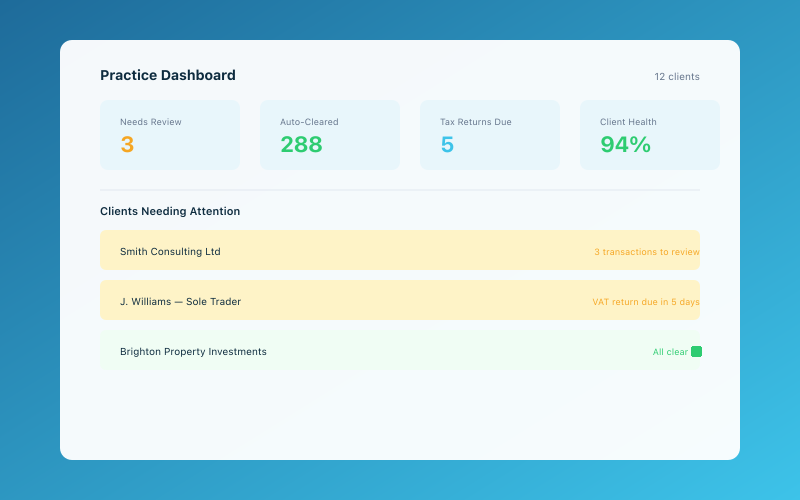 The Accounted practice dashboard — manage all your clients in one place
"I had a client who genuinely brought me their receipts in a cereal box," one accountant told us. "A Cheerios box. And they were mixed in with actual Cheerios."
The bag itself is almost always a supermarket carrier bag, and the contents share certain universal characteristics: they are not in date order, they are not separated by category, many are faded to illegibility, and at least one is actually a personal receipt that has no business being there (the Nando's receipt from a date night is a recurring classic).
The honest truth? Accountants do not judge you for the carrier bag. They judge themselves for not giving you clearer instructions earlier. But they definitely sigh internally.
"I Can't Read This. Nobody Could Read This."
Thermal receipts — the kind produced by most card machines and tills — are the bane of every accountant's existence. They fade. They fade fast. And once they are gone, they are gone.
"I once received a receipt that was essentially a blank strip of paper," an accountant shared. "The client insisted it was for £340 of materials. I had to take their word for it. Well, I had to explain that HMRC would not take their word for it."
This is a genuine problem, not just an inconvenience. HMRC requires you to keep records that support your expense claims, and a faded receipt that shows nothing but a ghostly smudge does not qualify. If your records are ever reviewed and you cannot substantiate a claim, HMRC can disallow the expense and charge penalties.
The solution? Photograph or scan your receipts as soon as you get them. Accounted's receipt scanning feature lets you do this in seconds — Penny reads the receipt, extracts the details, and matches it to the correct transaction. No fading, no carrier bags, and no archaeological expeditions through your coat pockets in January.
Our guide on automating receipt management covers this process in more detail.
"This Is Not a Business Expense"
Every accountant has stories about creative — shall we say imaginative — expense claims. The line between "business expense" and "personal purchase that I would quite like to be a business expense" is apparently rather blurry for some clients.
Common offenders include:
The family holiday. "My client went to Disneyland Paris and tried to claim it as 'market research for the entertainment industry.' They run a plumbing business."
The pet. "I had a client claim their cat's veterinary bills because the cat sometimes sits in their home office. That does not make the cat a business asset."
The gym membership. "A personal trainer tried to claim their own gym membership. On one level, I understand the logic. On another level, no."
The suspiciously expensive 'working lunch.' "If your 'working lunch' costs £120 and includes two bottles of wine, I am going to have questions."
Accountants are not trying to deny you legitimate claims. They want you to claim everything you are entitled to — it makes their job more satisfying when they can save you money. But they also need to protect you from claims that would not survive HMRC scrutiny. A good accountant is your defence against mistakes, not your adversary.
"Please, For the Love of All That Is Holy, Label Things"
A receipt that says "Amazon" and a figure tells an accountant almost nothing. Was it a business purchase or a personal one? What was the item? Which category does it belong to? Without this information, your accountant has to either guess (which they will not do), ask you (which takes time and delays your return), or leave it out (which means you miss a legitimate deduction).
"I once spent forty minutes trying to figure out what a £47.99 Amazon purchase was," one accountant told us. "I eventually had to email the client, who took three weeks to reply and then said, 'Oh, I think that was a printer cartridge. Or maybe it was a birthday present for my mum.'"
The fix is simple: write a brief note on the receipt, or — better still — use a system that lets you annotate transactions as they happen. When Penny asks you about a transaction in Accounted, a quick reply with the business purpose saves both you and your accountant from the guessing game.
"You Spent HOW MUCH on Stationery?"
Accountants notice patterns. It is literally their job. And certain patterns raise eyebrows — not necessarily because anything wrong is happening, but because they know HMRC might have questions.
"If a sole trader is claiming £3,000 a year on stationery, I want to know what they are buying," one accountant explained. "Are they a calligrapher? A stationery designer? Or are they just really, really fond of notebooks?"
Disproportionate expenses in any category can trigger an HMRC enquiry, even if every single claim is legitimate. Your accountant will often suggest restructuring or recategorising expenses to avoid this — not to hide anything, but to present your accounts in a way that accurately reflects your business and does not invite unnecessary scrutiny.
This is one of the areas where good bookkeeping makes a real difference. When your expenses are categorised correctly throughout the year, your accountant can spot potential issues early and advise you accordingly. When they are reconstructed from a carrier bag in January, there is less time to address problems.
"I Actually Love Doing This"
For all the complaints about carrier bags and faded receipts, most accountants genuinely enjoy their work. There is a deep satisfaction in taking a chaotic pile of financial information and turning it into a clear, accurate picture of a business.
"The best moment is when I can show a client that they have been overpaying tax for years," one accountant told us. "Usually because they did not know they could claim something, or because their previous records were so disorganised that legitimate expenses were being missed."
Accountants are not number-crunching automatons. They are problem-solvers who care about their clients' financial wellbeing. When you make their job easier by keeping good records, you are not just saving them time — you are enabling them to focus on the strategic, advisory work that actually adds value to your business.
What Your Accountant Actually Wants From You
After speaking with dozens of accountants, the wish list is remarkably consistent:
Regular record-keeping. Not a last-minute annual dump, but ongoing, real-time tracking of income and expenses. This is what tools like Accounted are designed for — keeping your books current so there is nothing to reconstruct later.
Legible receipts. Photograph them when you get them. Annotate them if the purpose is not obvious. Store them digitally. Our guide on automating receipt management makes this nearly effortless.
Honesty. If you are not sure whether something is a business expense, ask. Do not claim it and hope for the best, and do not hide things you are embarrassed about. Your accountant is not there to judge you — they are there to help you.
Promptness. When your accountant asks for information, respond quickly. Delayed responses delay your return, increase the risk of missing deadlines, and cost you more in fees (because your accountant has to revisit work they had already started).
Engagement. The clients accountants enjoy working with most are the ones who take an active interest in their finances. You do not need to understand double-entry bookkeeping. But understanding your profit margins, your tax obligations, and your cash flow makes you a better business owner and a much easier client.
The Receipts of the Future
The good news is that the era of the carrier bag is coming to an end. Making Tax Digital is pushing sole traders towards digital record-keeping, and tools like Accounted are making it genuinely easy.
Penny categorises your transactions as they happen, matches them to receipts you have photographed, and keeps your books in order throughout the year. By the time your accountant (or the tax return) needs your records, they are already done — no archaeology required.
This is not just better for your accountant. It is better for you. Real-time bookkeeping means you always know where you stand financially. No surprises. No panics. No carrier bags.
Your accountant will thank you. HMRC will have nothing to complain about. And the Cheerios can stay in the cereal box where they belong.
Accounted helps UK sole traders stay on top of their bookkeeping and tax. Start your free 30-day trial at getaccounted.co.uk.
Related reading:
- Automate Your Receipt Management
- What Your Accountant Wishes You Knew
- Sole Trader Expenses — The Complete List
Related Reading
Learn about our free accountant portal and how it saves your practice time.
Accounted gives accountants a free practice portal — manage all your clients, file to HMRC, and let Penny handle the routine work. See the accountant portal →
Editorial & Research
The Accounted editorial team covers software comparisons, technology, and the tools UK sole traders need to run their businesses efficiently. All software comparisons are based on independent research and publicly available pricing.
Ready to try Accounted?
Join UK sole traders who are simplifying their bookkeeping and tax.
Start your 14-day free trial