What Your Accountant Wishes You Knew
Accountants are a patient bunch. They have to be — it's part of the job description. But behind that calm, professional exterior, there's often a quiet frustration bubbling away. Not because they dislike their clients, but because the same avoidable mistakes crop up again and again.
We spoke to several accountants who work with UK sole traders and small businesses to find out what they really wish their clients understood. The answers were remarkably consistent — and surprisingly practical.
If you take even half of this advice on board, your accountant will thank you (probably silently, because that's how accountants tend to express gratitude), and you'll almost certainly save money in the process.
Your Records Are Not Optional
This was, without exception, the number one frustration every accountant mentioned. The single biggest thing they wish clients understood is that good record-keeping isn't a nice-to-have — it's a legal requirement and the foundation of everything else.
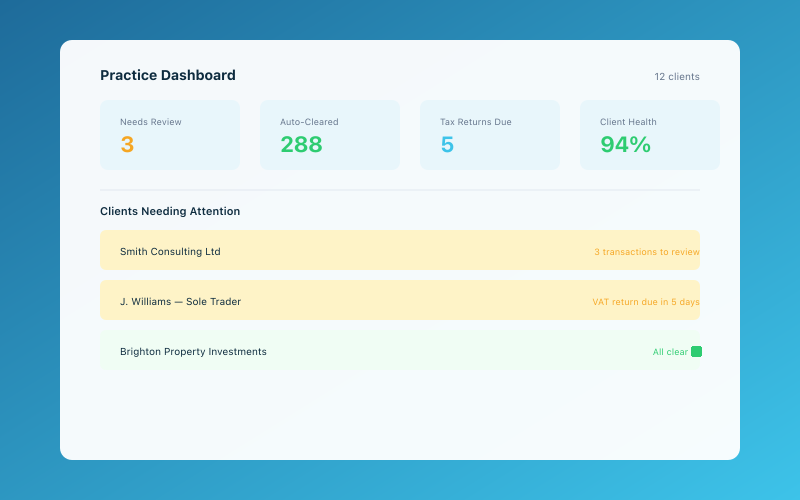 The Accounted practice dashboard — manage all your clients in one place
When you hand your accountant a shoebox of crumpled receipts in January, you're not just making their life difficult. You're making your own tax return less accurate, potentially missing legitimate expense claims, and almost certainly increasing your accountancy bill. Every hour your accountant spends sorting through chaos is an hour they're charging you for.
The good news is that this has never been easier to fix. Tools like Accounted let you snap photos of receipts as you go, and Penny categorises your transactions automatically. By the time your accountant needs your records, everything is already organised and ready. Several accountants told us that clients who use proper bookkeeping software are genuinely a pleasure to work with — and their fees reflect that.
HMRC requires you to keep records for at least five years after the 31 January submission deadline of the relevant tax year. That includes invoices, receipts, bank statements, and mileage logs. Digital records are perfectly acceptable — in fact, with Making Tax Digital, they're increasingly expected.
Tax Planning Happens Before March, Not After
Here's a scenario accountants see constantly: a client gets in touch in April or May, after the tax year has ended, asking how to reduce their tax bill. By then, most of the options have gone. The horse hasn't just bolted — it's in the next county.
Effective tax planning needs to happen during the tax year, not after it's finished. That means having conversations with your accountant well before April about things like:
- Whether to make pension contributions before the year-end
- Timing large purchases to maximise capital allowances
- Whether you're approaching the VAT registration threshold
- Planning for payments on account
- Making charitable donations tax-efficiently
A proactive accountant will initiate these conversations, but they can only do that if they have a clear picture of how your business is performing throughout the year. If your accountant only hears from you once a year, they can only be reactive.
This is another area where keeping your books up to date pays dividends. If you're using Accounted to track your income and expenses in real time, both you and your accountant can see where things stand at any point. That makes mid-year tax planning conversations much more productive.
Asking Questions Saves Money
Many sole traders are afraid to contact their accountant outside of the annual tax return cycle because they worry about being charged for every phone call. This fear often leads them to make decisions without professional input — and those decisions can be expensive.
Should I register for the Flat Rate VAT scheme? Can I claim this as an expense? Should I incorporate? These are all questions that could save or cost you hundreds or even thousands of pounds depending on the answer. A 15-minute conversation with your accountant could be the best investment you make all year.
Yes, some accountants do charge for ad-hoc queries. But many include a reasonable amount of advisory time in their fees, especially if you're on a monthly retainer. And even if there is a charge, paying £50 for advice that saves you £500 in tax is obviously worthwhile.
The key is to ask before you act, not after. Your accountant would much rather spend five minutes steering you in the right direction than five hours trying to unpick a mess after the fact.
Not Everything Is an Expense
Accountants wish their clients had a better understanding of what actually counts as an allowable business expense. The rules aren't as complicated as people think, but there are some persistent myths that cause problems.
The basic rule is that an expense must be incurred "wholly and exclusively" for the purposes of your trade. That means:
- Your daily commute — not an expense, even if you're self-employed
- Clothing — generally not deductible unless it's a uniform, protective clothing, or costumes specifically for your trade
- Client entertainment — not deductible for tax purposes, even though it's a legitimate business activity
- A laptop you also use personally — only the business proportion is deductible
On the flip side, many sole traders don't claim expenses they're perfectly entitled to. Working from home? You can claim a proportion of your household costs. Using your car for business? You can claim mileage. Professional subscriptions, training courses, insurance — all potentially deductible.
Your accountant wants you to claim everything you're entitled to — but nothing you're not. Overclaiming risks an HMRC investigation, and underclaiming means you're paying more tax than necessary. Neither is good.
If you're ever unsure whether something qualifies, just ask. That's literally what your accountant is there for. And if you're using Accounted, Penny will flag anything she's uncertain about so you can double-check before it becomes an issue.
Deadlines Are Not Suggestions
Every January, accountants across the country work evenings and weekends to deal with the flood of last-minute Self Assessment returns. Many of these returns are late not because the client forgot, but because they left it until the last minute to gather their records, leaving the accountant no time to do their job properly.
HMRC deadlines are fixed. Miss them, and you'll face penalties — £100 for being even one day late with your Self Assessment, with further penalties accumulating after that. And with Making Tax Digital introducing quarterly submissions, there are going to be more deadlines to keep track of, not fewer.
Your accountant almost certainly sends you reminders. Please read them. And please respond promptly when they ask for information. A request for your records in October is not an invitation to dig them out in January.
The best approach is to treat your accountant's deadlines as your deadlines. If they ask for your records by a certain date, have them ready. If they need you to review and approve your return, do it promptly. The earlier you get your information in, the more time your accountant has to do a thorough job — which usually means finding more legitimate ways to reduce your tax bill.
Communication Goes Both Ways
Accountants told us that one of their biggest challenges is clients who don't tell them about significant changes in their business or personal circumstances. Getting married, buying a property, starting a side hustle, taking on a business partner — all of these have tax implications, and your accountant needs to know about them.
It might not occur to you that your accountant needs to know you've started renting out a spare room, or that you've started selling on Etsy alongside your main freelance work. But these things affect your tax position, and finding out about them at year-end means your accountant is scrambling to adjust rather than planning ahead.
Make a habit of flagging anything significant to your accountant as it happens. A quick email saying "Just to let you know, I've started doing X" is all it takes. They'll tell you if it has any implications you need to be aware of, and it means there are no surprises at year-end.
The working relationship with your accountant should be a genuine two-way partnership. They bring the technical expertise; you bring the knowledge of your business. When both sides communicate well, the results are always better.
You Don't Have to Understand Everything
Finally — and this might seem counterintuitive — your accountant doesn't expect you to be a tax expert. That's their job. What they do expect is that you'll keep reasonable records, respond to communications in a timely manner, and ask when you don't understand something.
Too many sole traders nod along during conversations with their accountant, pretending to understand concepts like overlap relief or capital allowances, and then make poor decisions because they didn't actually grasp what was being discussed. A good accountant will explain things in plain English, but you have to let them know when something isn't clear.
There's no shame in saying "I don't understand that — can you explain it differently?" In fact, your accountant will respect you for it. They'd much rather spend an extra five minutes explaining something than deal with the consequences of you misunderstanding it.
At the same time, having a basic understanding of your own finances is genuinely empowering. You don't need to know the intricacies of tax law, but understanding concepts like the difference between turnover and profit, or how payments on account work, puts you in a much stronger position.
That's part of what Accounted is designed to do — give you clear visibility of your finances without requiring you to be an accounting expert. Penny handles the technical side, and you always have a clear picture of where your business stands.
Related reading:
- Do You Need an Accountant as a Sole Trader?
- Working With Your Accountant — A Practical Guide
- Accountant vs Bookkeeper — What's the Difference?
Accounted helps UK sole traders stay on top of their bookkeeping and tax. Start your free 30-day trial at getaccounted.co.uk.
Further Reading
- The Institute of Chartered Accountants in England and Wales (ICAEW) provides professional guidance for accountants.
- Stay up to date with Making Tax Digital requirements from HMRC.
- See the rules on dividends on GOV.UK.
Related Reading
Learn about our free accountant portal and how it saves your practice time.
Accounted gives accountants a free practice portal — manage all your clients, file to HMRC, and let Penny handle the routine work. See the accountant portal →
Editorial & Research
The Accounted editorial team covers software comparisons, technology, and the tools UK sole traders need to run their businesses efficiently. All software comparisons are based on independent research and publicly available pricing.
Ready to try Accounted?
Join UK sole traders who are simplifying their bookkeeping and tax.
Start your 14-day free trial