Retiring From Teaching and Starting a Consultancy — Tax Guide
After decades in the classroom, you've decided it's time for a change. Maybe you've taken early retirement, maybe you've hit your full pension age, or maybe you've simply had enough of marking on Sunday evenings. Whatever the reason, you're thinking about putting your experience to work in a different way — as a consultant.
Former teachers are in high demand. Schools need exam specialists, curriculum advisers, SEND consultants, and Ofsted preparation support. Multi-academy trusts want experienced heads and deputies to help with school improvement. EdTech companies need people who actually understand what happens in classrooms. And that's before you consider the broader world of training, coaching, and professional development.
The question isn't whether your skills are valuable — they are. The question is how to set up properly, understand the tax implications, and make sure your pension and your new business work together smoothly.
How Your Teacher's Pension Affects Your Tax
This is the big one, and it's where we need to start. Your Teachers' Pension is taxable income. It's paid to you with tax already deducted through PAYE, just like your salary was. But when you add self-employment income on top, the tax picture changes.
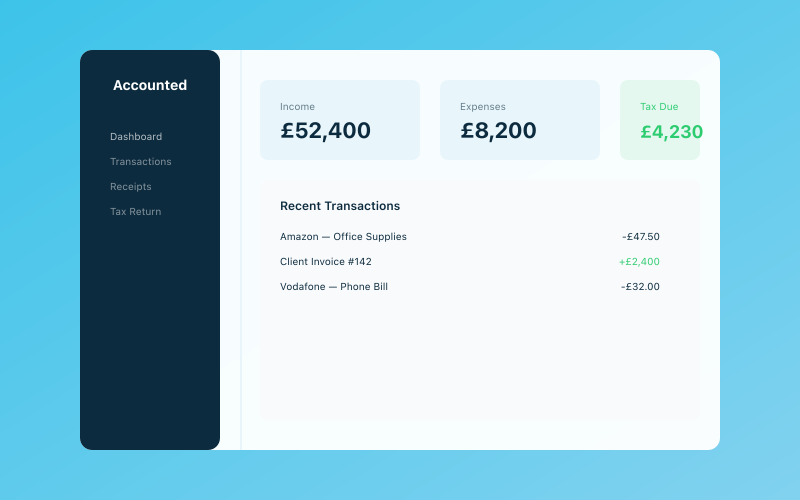 Your Accounted dashboard — income, expenses, and tax at a glance
Your pension income and your consultancy profits are combined to calculate your total taxable income. The personal allowance for 2025/26 is £12,570 — and if your pension already exceeds that, every pound of consultancy profit is taxable from the first penny.
Let's say your annual Teachers' Pension is £25,000. That's already used up your personal allowance and placed you well into the basic rate band. If your consultancy then earns £15,000 profit, that entire £15,000 is taxed at 20% — there's no second personal allowance for business income.
If your combined income pushes you past £50,270, you'll start paying 40% on the amount above that threshold. This is more common than you might think, especially if you had a long teaching career and a generous pension.
The key takeaway is this: you need to factor your pension into your tax planning from the very beginning. The consultancy income might look healthy on its own, but the tax you'll pay on it depends on what sits underneath it.
Using Accounted to track your consultancy income and expenses throughout the year means you'll always have a clear picture of your projected tax bill. No nasty surprises in January.
Registering as Self-Employed
When you start your consultancy, you need to register with HMRC as self-employed within three months. This is a simple online process that takes about ten minutes.
Most retired teachers starting consultancies operate as sole traders. It's straightforward, there's no setup cost, and the administrative burden is minimal. You'll file a Self Assessment tax return each year, declaring both your pension income and your consultancy profits.
You'll receive a Unique Taxpayer Reference (UTR) number, which you'll use when filing your return. Make a note of it and keep it somewhere safe — you'll need it every year.
One thing to be aware of: if you're receiving your pension and working in education simultaneously, there are rules about re-employment in the Teachers' Pension Scheme. Working as a self-employed consultant is generally fine, but if a school or academy employs you directly (even on a temporary contract), it could affect your pension payments. Check the Teachers' Pension Scheme rules or speak to their helpline if you're unsure.
National Insurance After State Pension Age
Here's a nice benefit of starting a consultancy later in life. If you've reached State Pension age, you don't pay National Insurance on your self-employment profits at all — neither Class 2 nor Class 4.
If you're below State Pension age (currently 66, rising to 67 between 2026 and 2028), you'll pay:
- Class 2 NI at £3.45 per week if your profits exceed £6,725
- Class 4 NI at 6% on profits between £12,570 and £50,270, and 2% above that
This can make a meaningful difference to your take-home pay. A 60-year-old earning £25,000 profit from consultancy will pay several hundred pounds more in National Insurance than a 67-year-old with the same profit. It's one of the few genuine perks of starting a business a bit later in life.
What Can You Claim as Expenses?
Education consultancy has some specific expenses that are worth understanding. As always, the expense must be incurred "wholly and exclusively" for business purposes to be deductible.
Travel and mileage. If you're visiting schools, attending meetings, or delivering training, your travel costs are deductible. This includes train fares, mileage at the approved rates (45p per mile for the first 10,000 miles, then 25p), parking, and accommodation for overnight trips. Your home is your base of operations, so travel to client sites is a business journey, not a commute.
Professional subscriptions. Membership of professional bodies — the Chartered College of Teaching, subject associations, or consultancy networks — is deductible.
Training and CPD. This is where it gets nuanced. Training that updates or maintains your existing professional skills is deductible. A course on the latest changes to the GCSE specification or new Ofsted framework would qualify. However, training for an entirely new skill unrelated to your existing expertise might not. The line can be blurry, so keep records of why the training is relevant to your consultancy work.
Technology and software. Laptop, printer, presentation equipment, and software subscriptions (Microsoft 365, Canva, project management tools) are all deductible if used for business.
Home office costs. If you work from home — and most education consultants do at least part of the time — you can claim a proportion of your household bills. You have two options: calculate the actual proportion of your home used for business and claim that percentage of your bills, or use HMRC's simplified expenses flat rate (currently £26 per month if you work from home 51-100 hours, less for fewer hours).
Insurance. Professional indemnity insurance is essential for consultants and fully deductible. Public liability insurance may also be needed depending on the nature of your work.
Marketing. Website costs, business cards, LinkedIn Premium, and any advertising you do to promote your consultancy.
Books and resources. Educational textbooks, research publications, and reference materials related to your consultancy specialism.
For a comprehensive overview, our sole trader expenses guide covers everything you can and can't claim.
Setting Your Consultancy Rates
One of the hardest things for retired teachers is figuring out what to charge. After years on a salary scale, putting a price on your expertise can feel uncomfortable.
But your experience is genuinely valuable, and you should charge accordingly. Education consultancy rates vary widely, but as a rough guide:
- Day rates for experienced education consultants typically range from £300 to £800, depending on specialism and client type.
- Ofsted preparation and school improvement specialists often command £500 to £1,000 per day.
- Training delivery rates vary from £400 to £700 per day.
- Writing and curriculum development might be charged by the project rather than the day.
Research what others in your niche are charging. Talk to consultant networks. And remember that your rate needs to cover not just your time delivering the work, but also the time you spend on marketing, administration, travel, and professional development — none of which is billable.
Don't forget to account for tax. If you're charging £500 per day and your marginal tax rate is 40%, you're keeping £300 after tax. Make sure your rates reflect this reality.
Building Your Client Base
The good news is that you already have a network. Your former colleagues, school leaders you've worked with, local authority contacts, and professional association connections are all potential clients or referral sources.
Start by letting people know what you're doing. A well-crafted LinkedIn post explaining your new venture can generate surprising interest. Personal emails to former colleagues and contacts are even more effective. People hire consultants they know and trust, and you've spent your career building those relationships.
Consider these approaches:
- Direct outreach to schools and trusts — Identify organisations that could benefit from your expertise and make contact.
- Professional associations — Many subject associations and education bodies maintain directories of consultants that schools use when looking for support.
- Online platforms — Education-specific platforms connect consultants with schools.
- Word of mouth — Deliver excellent work, and your clients will refer you. This is how most successful education consultants build their businesses.
A business plan — even a simple one — will help you clarify your target market, your pricing, and your marketing approach. It doesn't need to be elaborate, but the thinking process is valuable.
Record-Keeping and Making Tax Digital
As a sole trader, you're required to keep records of all your income and expenses. HMRC can ask to see these records at any time, and they must be kept for at least five years after the filing deadline for the relevant tax year.
With Making Tax Digital (MTD) for Income Tax rolling out, you'll also need to keep digital records and submit quarterly updates to HMRC if your qualifying income exceeds the threshold. This is another reason to start with proper accounting software from day one rather than relying on spreadsheets or paper records.
Accounted makes this straightforward. Penny tracks your income and expenses, categorises transactions, and keeps everything organised so that when it's time to file your Self Assessment — or your quarterly MTD updates — everything is ready to go.
Enjoying the Best of Both Worlds
Starting a consultancy after teaching gives you something rare — a stable pension income providing a financial floor, combined with the flexibility and earning potential of self-employment. You can choose when to work, who to work with, and how much to take on. No more performance management, no more parents' evenings (unless you want them), and no more Sunday night marking anxiety.
The tax system is manageable once you understand how your pension and business income interact. Set aside money for tax throughout the year, track your expenses diligently, and keep your records up to date. The rest is about doing what you do best — sharing your expertise and making a difference.
Accounted helps UK sole traders stay on top of their bookkeeping and tax. Start your free 30-day trial at getaccounted.co.uk.
Related reading:
- Your First Year of Self-Employment — A Complete Guide
- How to Register as Self-Employed With HMRC
- The Complete List of Sole Trader Expenses
Related Reading
View our pricing and start your free 30-day trial today.
Starting out? Accounted is built for UK sole traders from day one — from £14/month. Get started →
Business & Operations Advisors
Our business advisors cover the practical side of running a UK sole trader business — from HMRC registration to managing growth. Content is written for real business owners in plain English, not accountants.
Ready to try Accounted?
Join UK sole traders who are simplifying their bookkeeping and tax.
Start your 14-day free trial