Building an Accountancy Practice From Scratch — Year One Guide
There's a moment — usually somewhere between handing in your notice and setting up a business bank account — where the reality of starting your own accountancy practice truly hits. You've spent years qualifying, building expertise, and working for someone else. Now it's your turn.
Year one of running your own practice is exhilarating, terrifying, and everything in between. The good news? Thousands of accountants have walked this path before you, and there's a well-trodden route to follow. The even better news? You don't need to figure it all out on day one.
This guide walks you through the key milestones, decisions, and pitfalls of your first twelve months in practice.
Getting the Foundations Right
Before you take on a single client, there's groundwork to lay. It's tempting to skip ahead to the exciting bits — marketing, client meetings, choosing your office furniture — but getting the boring stuff sorted first will save you headaches later.
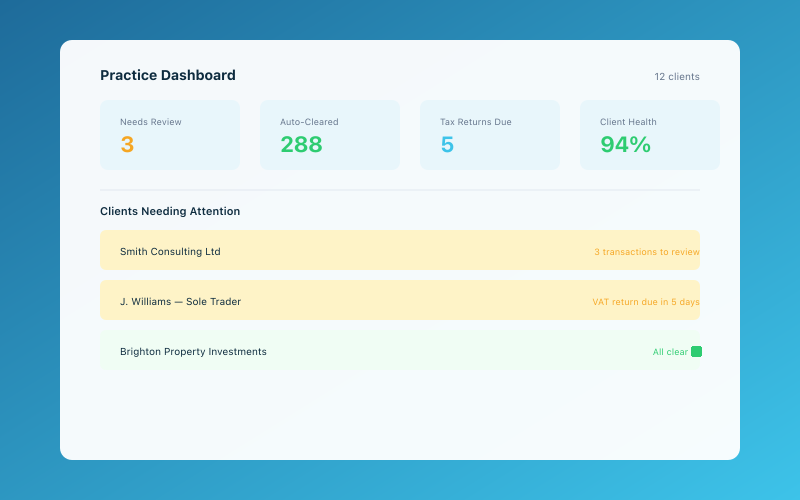 The Accounted practice dashboard — manage all your clients in one place
First up: your professional body. If you're ACCA, ICAEW, AAT, or CIMA qualified, you'll need a practising certificate. Each body has its own application process, and it can take a few weeks, so don't leave it until the last minute. You'll also need professional indemnity insurance, which is typically a condition of holding that certificate.
Then there's the regulatory side. You'll need to register for anti-money laundering (AML) supervision — either through your professional body or HMRC. This involves putting together an AML policy, carrying out risk assessments, and ensuring you have proper client identification procedures in place.
Don't forget the basics either: registering as self-employed (or incorporating, if you prefer a limited company structure), setting up a dedicated business bank account, and sorting out your own bookkeeping from day one. It sounds obvious, but you'd be amazed how many accountants neglect their own books in the early months.
If you're weighing up the leap from employment, our guide on going from employed to running your own practice covers the transition in detail.
Choosing Your Niche (or Not)
One of the biggest strategic decisions you'll face in year one is whether to specialise. Generalist practices can absolutely thrive, but there's a strong argument for carving out a niche early on.
Why? Because it makes marketing infinitely easier. "I'm an accountant" is a hard sell in a crowded market. "I'm the accountant who helps freelance designers manage their tax" is a conversation starter. It gives you a clear message, a defined audience, and — crucially — a reason for clients to choose you over the big firms.
Popular niches for new practices include construction (CIS work is complex enough to warrant specialist knowledge), property landlords, creative freelancers, and e-commerce sellers. But honestly, the best niche is one where you already have experience or connections.
That said, don't turn away good clients in year one just because they don't fit neatly into your chosen niche. Be strategic, but be pragmatic. You can always sharpen your focus as you grow.
For a deeper look at how specialisation can drive growth, have a read of our piece on building a niche accountancy practice.
Winning Your First Clients
This is the bit that keeps most new practice owners up at night. Where do the clients actually come from?
The honest answer: your first clients will almost certainly come from your existing network. Former colleagues, friends, family, people you've helped informally over the years. There's no shame in reaching out to people you know and letting them know you're open for business. In fact, it's essential.
Beyond your immediate network, here are some strategies that work well in year one:
Referral partnerships. Connect with solicitors, mortgage brokers, financial advisers, and business coaches in your area. They're regularly asked "do you know a good accountant?" and being their go-to recommendation is incredibly valuable.
Local networking. Groups like BNI, local chambers of commerce, and industry meetups can feel a bit awkward at first, but they work. The key is consistency — show up regularly, be genuinely helpful, and the referrals will follow.
Online presence. At minimum, you need a professional website and a Google Business profile. Most small business owners will Google you before getting in touch, and if they can't find you, they'll find someone else. LinkedIn is also worth investing time in — it's where business owners and other professionals hang out.
Content marketing. Writing helpful blog posts, guides, or social media content positions you as an expert. It doesn't need to be fancy — a short post explaining a common tax question can generate more enquiries than a paid advert.
Don't underestimate the power of simply being visible and available. Respond to enquiries quickly, be approachable, and make it easy for people to say yes.
Setting Your Prices
Pricing is one of the trickiest aspects of running a new practice, and getting it wrong can hold you back for years. Charge too little and you'll be overworked and resentful. Charge too much before you've built a reputation and you'll struggle to win work.
There are broadly three approaches:
Hourly billing. The traditional model. It's simple to understand and easy to implement, but it penalises efficiency and creates uncertainty for clients. Most modern practices are moving away from it.
Fixed fees. You quote a set price for a defined scope of work. Clients love the certainty, and it rewards you for being efficient. The risk is underquoting, especially when you're still learning how long things take.
Value-based pricing. You price based on the value you deliver rather than the time you spend. This works brilliantly for advisory work but requires confidence and a clear understanding of your client's situation.
In year one, fixed fees with clearly defined scopes are usually the sweet spot. Build in a buffer for the unexpected, and don't be afraid to revisit prices as you gain experience.
For a detailed comparison, check out our guide on fixed vs hourly pricing for accountancy services.
Choosing Your Tech Stack
Your choice of software will shape how you work every day, so it's worth getting right from the start. At minimum, you'll need:
- Practice management software to track clients, deadlines, and workflows
- Accounts production and tax software for preparing accounts and returns
- Cloud accounting software for client bookkeeping and MTD compliance
- Communication tools — email is a given, but many practices now use client portals or messaging platforms
The temptation is to over-invest in expensive software before you have the revenue to justify it. Be selective. Start with what you genuinely need and add tools as your practice grows.
If your clients are sole traders, tools like Accounted can simplify things enormously. Rather than wrestling with complex general-purpose accounting software, your clients get something designed specifically for their needs — which means fewer support queries landing on your desk.
Managing Your Time and Energy
Here's something nobody tells you about year one: the hardest part isn't the technical work. It's the mental load.
When you work for someone else, there's a structure. Someone assigns you work, someone else handles the marketing, someone else worries about the bills. When it's your practice, all of that falls on you — alongside the actual client work.
Time management becomes critical. Block out dedicated time for business development, admin, and client work. Protect your evenings and weekends where you can. It's easy to fall into the trap of working every hour available because the practice "needs" you, but burnout in year one is real and it's counterproductive.
Set boundaries early. Decide on your working hours and communicate them to clients. Most will respect them — and the ones who don't are usually the clients you don't want anyway.
Build in regular breaks, exercise, and time away from the business. It sounds counterintuitive when you're trying to get a practice off the ground, but you'll be more productive, more creative, and more resilient for it.
Planning for Year Two
It might seem premature to think about year two when you're still finding your feet, but the decisions you make in your first twelve months set the trajectory for everything that follows.
Keep track of key metrics from the start: how many clients you're winning (and losing), your average fee per client, your monthly revenue, and — crucially — your effective hourly rate. These numbers will tell you whether your pricing is right, whether you're taking on the right clients, and whether you're spending your time wisely.
By the end of year one, you should have a clearer picture of:
- Which types of clients are most profitable and enjoyable to work with
- Which services generate the best returns for your time
- Where your referrals are coming from
- What you'd do differently if you were starting again
Use these insights to set clear goals for year two. Maybe it's doubling your client base, hiring your first member of staff, or launching a new service line. Whatever it is, having a target gives you something to aim for.
If you're looking for strategies to accelerate growth, our guide on how to grow your accountancy practice in 2026 is packed with practical ideas.
Related Reading
Accounted helps UK sole traders stay on top of their bookkeeping and tax. Start your free 30-day trial at getaccounted.co.uk
Accounted gives accountants a free practice portal — manage all your clients, file to HMRC, and let Penny handle the routine work. See the accountant portal →
Editorial & Research
The Accounted editorial team covers software comparisons, technology, and the tools UK sole traders need to run their businesses efficiently. All software comparisons are based on independent research and publicly available pricing.
Ready to try Accounted?
Join UK sole traders who are simplifying their bookkeeping and tax.
Start your 14-day free trial