How to Transition From Employed Accountant to Running Your Own Practice
There's a moment in almost every employed accountant's career when the thought creeps in: "I could do this for myself." Maybe it happens during a particularly frustrating Monday morning meeting, or when you realise your billing rate to the firm is three times your salary, or when a client tells you they'd follow you anywhere. Whatever the trigger, the idea of running your own practice takes root and won't quite go away.
Making the leap from employment to self-employment is one of the most significant career decisions you'll ever make. It's exciting, terrifying, liberating, and stressful — sometimes all in the same afternoon. But thousands of UK accountants have done it successfully, and with proper planning, there's no reason you can't join them.
This guide walks you through the practical steps of making the transition, from the initial planning stages through to your first year of running your own show.
Before You Hand in Your Notice
The biggest mistake aspiring practice owners make is rushing. The urge to escape employment can be powerful, but taking three to six months to prepare properly will save you enormous stress down the line.
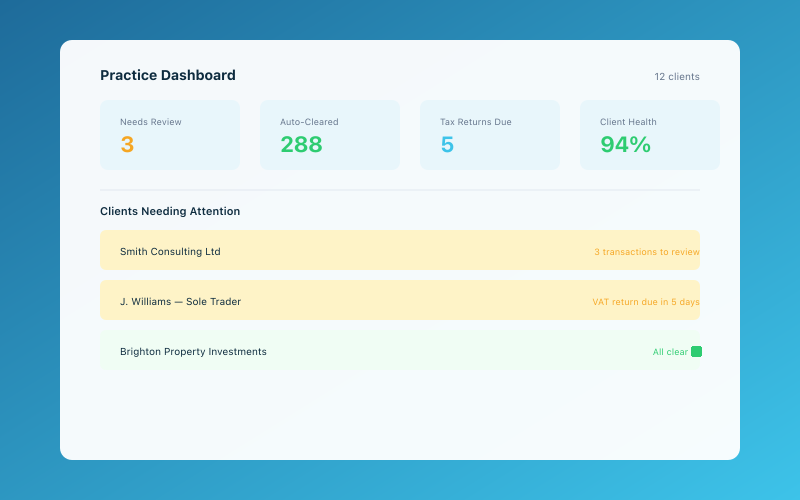 The Accounted practice dashboard — manage all your clients in one place
Check Your Contract
Before doing anything else, read your employment contract carefully. Look for:
- Restrictive covenants — Many accountancy firms include clauses preventing you from soliciting their clients for a period (typically 6-12 months) after leaving. These are generally enforceable if reasonable, so take them seriously.
- Non-compete clauses — Some contracts restrict you from practising within a certain geographic radius. Again, check whether these are reasonable and enforceable.
- Notice period — Budget for this in your timeline. Three months is common for senior accountants.
- Intellectual property — Any templates, processes, or client lists belong to your employer. You'll need to build your own from scratch.
If in doubt, get legal advice. A couple of hundred pounds spent on an employment solicitor now could save you thousands in disputes later.
Build Your Financial Runway
Starting a practice takes time to become profitable. You'll need enough savings to cover:
- Personal living expenses for at least 6 months (12 months is better)
- Practice setup costs — Insurance, software, marketing, professional body fees
- Working capital — You'll incur costs before clients start paying you
As a rough guide, having £15,000-£25,000 in accessible savings gives you a comfortable buffer. If that sounds like a lot, remember that you'll be earning from relatively early on — this is just your safety net while you build momentum.
Get Your Qualifications in Order
To run your own practice, you'll typically need:
- A practising certificate from your professional body (ICAEW, ACCA, AAT, or CIOT)
- Anti-money laundering supervision — Either through your professional body or HMRC
- Professional indemnity insurance — Required before you take on any client work
- Registration with the Information Commissioner's Office (ICO) — For data protection compliance
Start the application processes early. Practising certificates in particular can take several weeks to process, and you don't want to be sitting idle waiting for paperwork.
Planning Your Practice
Define Your Services
What will you actually offer? Be specific. Common service lines for new practices include:
- Annual accounts preparation
- Self-assessment tax returns
- Corporation tax returns
- VAT returns
- Bookkeeping and management accounts
- Payroll
- Tax planning and advisory
- Company formations and secretarial services
You don't need to offer everything from day one. In fact, starting with a focused service offering is often better. You can expand as you grow. If you're thinking about building a niche practice, now is the perfect time to make that decision.
Choose Your Target Market
Who are your ideal clients? Sole traders? Small limited companies? A specific industry? The clearer you are about this, the more effectively you can market yourself. New practices that try to serve everyone often struggle to attract anyone.
Set Your Pricing
This deserves serious thought. Many new practice owners underprice themselves out of insecurity, which is a mistake that's hard to correct later. Research what established practices in your area charge and position yourself competitively but not cheaply.
Consider whether you'll charge fixed fees or hourly rates — both have advantages and our guide on pricing accountancy services covers this in depth.
Choose Your Software Stack
You'll need:
- Accounting and tax software — For preparing client accounts and returns
- Practice management software — For managing workflows, deadlines, and client relationships
- Bookkeeping software recommendation — Something to recommend to clients for their day-to-day record-keeping (tools like Accounted work well for sole traders)
- Communication tools — Email, video conferencing, secure file sharing
- Cloud storage — For document management
Resist the temptation to over-invest in technology at the start. You can always upgrade later. Focus on the essentials and add complexity as your practice grows.
Making the Leap
Timing Your Exit
The best time to leave employment depends on your circumstances, but consider:
- Tax year timing — Starting your practice in April or May means you'll have nearly a year before your first self-assessment payment is due
- Seasonal demand — If you're leaving a practice, the period after January tax deadline season is often easiest
- Personal circumstances — Don't start a practice during other major life upheavals if you can avoid it
Leaving Professionally
However frustrated you might be with your employer, leave well. The accountancy profession in the UK is remarkably small, and your reputation follows you everywhere.
- Work your full notice period diligently
- Complete outstanding work thoroughly
- Offer to help with the handover
- Thank colleagues and managers genuinely
- Do not approach clients about following you (unless your contract clearly permits it)
The clients you want will find you eventually, especially if you've built genuine relationships. Burning bridges with your employer over a few clients isn't worth the risk.
Your First 90 Days
Week 1-2: Administration
Get the boring but essential stuff done:
- Register as self-employed with HMRC (or incorporate if going the limited company route)
- Set up a business bank account
- Activate your professional indemnity insurance
- Register for AML supervision
- Register with the ICO
- Set up your software and email
- Create a basic website (it doesn't need to be fancy — just professional and clear)
Week 3-4: Marketing Launch
Start telling people you exist:
- Update your LinkedIn profile to reflect your new practice
- Email your personal network (friends, family, former colleagues) announcing your practice
- Join local business networking groups
- Register with online directories
- Publish your first pieces of content (blog posts, LinkedIn articles)
- Contact complementary professionals (solicitors, financial advisers, mortgage brokers) about mutual referrals
Month 2-3: Client Acquisition
Your first clients will likely come from:
- Personal referrals — People who know and trust you
- Networking — Both online and in person
- Your professional network — Former colleagues, professional body contacts
- Online presence — Your website and social media
- Former clients (if permitted) — People you worked with at your previous firm who are now free to choose their own accountant
Don't be disheartened if growth is slow initially. Most new practices take 6-12 months to reach a sustainable client base. The key is consistent marketing activity every single week, even when you're busy with client work.
Common Challenges and How to Handle Them
Loneliness
This catches many new practice owners by surprise. After years of working in a team, the solitude of working alone can be difficult. Combat it by:
- Joining an accountancy peer group or mastermind
- Working from a co-working space one or two days a week
- Maintaining regular contact with professional contacts
- Attending networking events and industry conferences
Inconsistent Income
Your income will fluctuate, especially in the first year. Monthly standing orders and fixed-fee arrangements help smooth things out. Build a cash buffer and resist the temptation to spend everything you earn in a good month.
Wearing Every Hat
You're now the accountant, the marketer, the IT department, the office manager, and the receptionist. This is overwhelming at first. Focus on the activities that generate revenue (client work and marketing) and either systematise or outsource the rest as soon as you can afford to.
Imposter Syndrome
Almost every new practice owner experiences this. "Who am I to run my own firm? What if I get something wrong?" Remember: you have qualifications, experience, and professional indemnity insurance. You're not winging it. You've been doing this work for years — the only difference is whose name is on the door.
Scaling Beyond Yourself
Once your practice is established, you'll eventually face a ceiling: there are only so many hours in your day. Growth beyond that point requires either:
- Hiring staff — Typically starting with a junior accountant or bookkeeper
- Subcontracting — Working with other self-employed accountants on an overflow basis
- Automation — Using technology to handle routine tasks more efficiently
- Raising prices — Serving fewer clients at higher fees
For guidance on the broader growth journey, our guide to growing your accountancy practice covers these decisions in detail. And if retaining good staff becomes a priority as you expand, that's a whole topic in itself.
The Realities Nobody Talks About
Let's be honest about a few things:
You'll work harder than you did as an employee, at least initially. The freedom is wonderful, but there's no clocking off at 5:30 when it's your own practice. This gets better as you establish systems and boundaries, but the first year or two are intense.
Not everyone will support your decision. Family members may worry. Former colleagues may be sceptical. Some people will question why you'd leave a "safe" job. That's their concern, not yours.
You'll make mistakes. Every practice owner does. The important thing is learning from them quickly and not letting perfectionism stop you from taking action.
It's worth it. The vast majority of accountants who start their own practice say they wish they'd done it sooner. The autonomy, the direct relationship with clients, the unlimited earning potential, and the satisfaction of building something that's truly yours — these things are difficult to quantify but impossible to overstate.
Your Next Steps
If you're seriously considering the transition, here's what to do this week:
- Read your employment contract thoroughly
- Calculate your financial runway
- Start a simple business plan (even bullet points will do)
- Research practising certificate requirements from your professional body
- Begin saving aggressively if you haven't already
The gap between thinking about starting a practice and actually doing it is smaller than you think. With proper preparation and realistic expectations, there's no reason your practice can't be thriving within a year or two of launch.
Accounted helps UK sole traders stay on top of their bookkeeping and tax. Start your free 30-day trial at getaccounted.co.uk
Related reading:
- Starting a Bookkeeping Practice Guide
- Building a Niche Accountancy Practice — Why Specialising Wins
- How to Grow Your Accountancy Practice in 2026
Related Reading
Accounted gives accountants a free practice portal — manage all your clients, file to HMRC, and let Penny handle the routine work. See the accountant portal →
Editorial & Research
The Accounted editorial team covers software comparisons, technology, and the tools UK sole traders need to run their businesses efficiently. All software comparisons are based on independent research and publicly available pricing.
Ready to try Accounted?
Join UK sole traders who are simplifying their bookkeeping and tax.
Start your 14-day free trial