Bookkeepers Starting Their Own Practice — A Complete Guide
Starting your own bookkeeping practice is one of the most accessible routes into self-employment in the UK. The startup costs are low, the demand is consistent, and once you have built a solid client base, the recurring revenue model means your income becomes genuinely predictable.
But going from employed bookkeeper to running your own practice involves more than just being good with numbers. You need to think about business structure, pricing, marketing, compliance, and — ironically — your own bookkeeping and tax. This guide covers everything you need to know to get started in 2025/26.
Do You Need Qualifications to Be a Bookkeeper?
Technically, no. There is no legal requirement to hold a qualification before offering bookkeeping services in the UK. However, having recognised credentials makes a significant difference when it comes to attracting clients and building credibility.
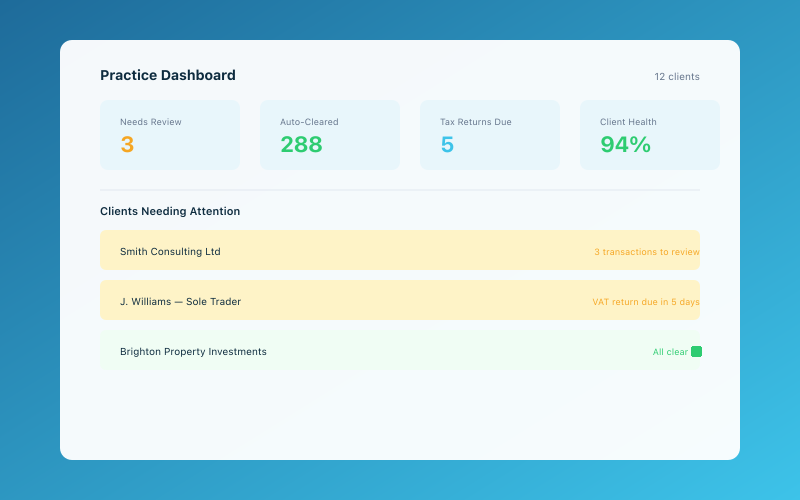 The Accounted practice dashboard — manage all your clients in one place
Professional Bodies
The two main professional bodies for bookkeepers in the UK are:
- The Institute of Certified Bookkeepers (ICB) — Offers qualifications from Level 1 through to Fellow membership. Their courses cover manual and computerised bookkeeping, payroll, VAT, and self-assessment.
- The Association of Accounting Technicians (AAT) — Provides a broader accounting qualification pathway, with bookkeeping covered at Levels 2 and 3. AAT qualifications are widely recognised and can also lead into full accountancy training.
Both bodies offer practice licences, which allow you to describe yourself as a licenced bookkeeper and use their logos in your marketing. This matters because it signals competence and professionalism to potential clients.
Anti-Money Laundering (AML) Supervision
If you provide bookkeeping services, you are legally required to register for AML supervision. You can do this through HMRC or through a professional body like ICB or AAT. Most bookkeepers choose to register through their professional body, as this also satisfies the requirement and looks more professional.
The registration involves a fee (typically £100–£300 per year depending on the body) and requires you to have documented AML policies and procedures in place.
Setting Up Your Business
Sole Trader or Limited Company?
Most new bookkeeping practices start as sole traders. It is simpler, cheaper, and involves less paperwork. You will need to register as self-employed with HMRC and file a Self Assessment tax return each year.
As a sole trader in 2025/26, your income is taxed as follows:
- Personal allowance: £12,570 tax-free
- Basic rate: 20% on income between £12,571 and £50,270
- Higher rate: 40% on income above £50,270
You will also pay Class 2 National Insurance at £3.45 per week and Class 4 NI at 6% on profits between £12,570 and £50,270. Our guide to National Insurance for sole traders explains how this works in detail.
If your practice grows and you are consistently earning above £40,000–£50,000 in profit, it may be worth considering incorporation as a limited company for tax efficiency. But in the early days, sole trader status is usually the sensible choice.
Insurance
You will need professional indemnity insurance at a minimum. This protects you if a client suffers a financial loss due to an error in your work. Policies start from around £100–£200 per year for a new practice. Public liability insurance is also worth considering if you visit clients' premises.
Software
Your choice of bookkeeping software matters — both for your own records and for the service you provide to clients. Many bookkeepers use cloud-based platforms that allow them to collaborate with clients in real time. Accounted, for instance, is built specifically for UK sole traders and small businesses, making it a natural fit if your client base is predominantly self-employed individuals and micro-businesses.
You should also be familiar with the major platforms your clients might already use, such as Xero, QuickBooks, and FreeAgent. Being multi-platform is a selling point.
Pricing Your Services
Pricing is where many new bookkeepers struggle. Charge too little and you will burn out; charge too much before you have a track record and you will struggle to win clients.
Common Pricing Models
Hourly rate: Most bookkeepers in the UK charge between £20 and £45 per hour, depending on experience, location, and the complexity of the work. London-based bookkeepers and those with specialist knowledge (construction CIS, property, VAT) can command higher rates.
Fixed monthly fee: This is increasingly popular and arguably better for both parties. Clients know exactly what they are paying, and you have predictable recurring revenue. Monthly fees typically range from £75 to £300+ per client, depending on the volume of transactions, whether you handle payroll, VAT, or Self Assessment preparation.
Per-transaction pricing: Some bookkeepers charge based on the number of transactions processed. This can work well but requires careful scoping upfront.
What to Include
Be very clear about what is and is not included in your fee. Common services include:
- Bank reconciliation
- Recording income and expenses
- VAT return preparation
- Payroll processing
- Management reports
- Year-end preparation for their accountant
Clearly define your scope in a letter of engagement to avoid misunderstandings later.
Finding Your First Clients
This is the part that feels most daunting, but the good news is that demand for reliable bookkeepers far exceeds supply in most parts of the UK.
Networking
Join local business networking groups — BNI, local chamber of commerce events, and small business meetups. Bookkeeping is a service that benefits enormously from word-of-mouth referrals, and these groups are full of sole traders and small business owners who need exactly what you offer.
Accountant Referrals
Build relationships with local accountants. Many accounting firms do not offer bookkeeping services or would prefer their clients' books to be in good order before year-end. Positioning yourself as a reliable bookkeeper who makes their job easier is a powerful referral strategy.
Online Presence
You do not need a flashy website, but you do need a professional one. Make sure it clearly explains your services, includes your qualifications and professional memberships, and has a simple way for potential clients to get in touch. Google Business Profile is also essential for local visibility.
Social Media
LinkedIn is particularly effective for bookkeepers. Share tips about record-keeping, tax deadlines, and common bookkeeping mistakes. This positions you as knowledgeable and approachable without being salesy.
Managing Your Own Tax and Finances
It is a common joke that bookkeepers are the worst at doing their own books. Do not let that be you.
Separate Your Finances
Open a dedicated business bank account from day one. This makes bookkeeping for your own practice far simpler and ensures you can clearly see your business income and expenses. Our guide on whether you need a business bank account covers the options.
Track Everything
Record all your income and expenses as they happen. Do not let receipts pile up. Use receipt scanning apps to capture expenses on the go — your future self will thank you at tax return time.
Allowable Expenses
As a self-employed bookkeeper, you can claim a wide range of expenses against your tax bill:
- Software subscriptions (accounting software, Microsoft 365, etc.)
- Professional body membership fees (ICB, AAT)
- AML supervision fees
- Professional indemnity insurance
- Home office costs (a proportion of broadband, heating, electricity)
- Travel to client sites (mileage or public transport)
- Training and CPD courses
- Marketing and advertising costs
- Stationery and office supplies
- Accountancy fees
For the full list, see our sole trader expenses guide.
VAT Registration
You must register for VAT if your turnover exceeds £90,000 in any rolling 12-month period. Most new bookkeeping practices will not hit this threshold immediately, but it is worth being aware of. If your clients are VAT-registered businesses, charging VAT will not be an issue for them as they can reclaim it. Our VAT registration guide explains the details.
Growing Your Practice
Once you have your first handful of clients and a steady workflow, thoughts will naturally turn to growth.
Specialise
Consider specialising in a particular industry or type of client. Construction (CIS), property landlords, e-commerce, and the creative industries all have specific bookkeeping needs. Becoming the go-to bookkeeper for a particular niche makes marketing easier and allows you to charge premium rates.
Systemise
Document your processes so that the work becomes repeatable and efficient. This matters if you eventually want to hire staff or subcontract work. Standard operating procedures for client onboarding, monthly bookkeeping routines, and VAT return preparation will save you enormous amounts of time.
Embrace Technology
The bookkeeping profession is evolving rapidly. Bank feeds, automated categorisation, and tools like Penny — Accounted's AI bookkeeping assistant — are changing how day-to-day bookkeeping works. Rather than seeing automation as a threat, the smartest bookkeepers are using these tools to handle the routine data entry, freeing themselves up to provide higher-value advisory services.
Making Tax Digital
With MTD for Income Tax rolling out from April 2026 for sole traders earning over £50,000, there is a growing need for bookkeepers who understand digital record-keeping and quarterly reporting. This is a genuine opportunity to position your practice as forward-thinking and to help clients navigate the transition.
Common Mistakes to Avoid
Underpricing: Do not compete on price alone. Cheap bookkeeping attracts clients who do not value your work and will haggle over every invoice.
Taking on too much too soon: It is better to serve ten clients brilliantly than twenty clients poorly. Your reputation is everything in the early years.
Neglecting your own CPD: The tax landscape changes every year. Stay current through courses, webinars, and professional body resources.
Not having a letter of engagement: Always have a written agreement with every client. It protects both parties and sets clear expectations.
Mixing personal and business finances: Keep them separate from day one. It will save you hours of headache and make your own tax return straightforward.
Your Bookkeeping Practice — Next Steps
Starting a bookkeeping practice is a genuinely achievable goal. The barriers to entry are low, the work is in demand, and the earning potential is solid once you have built a reputation. Focus on getting qualified, registering properly, pricing confidently, and delivering excellent service.
The rest — the referrals, the growth, the financial security — follows naturally from there.
Accounted helps UK sole traders stay on top of their bookkeeping and tax. Start your free 30-day trial at getaccounted.co.uk
Related reading:
- How to Register as Self-Employed with HMRC
- Sole Trader vs Limited Company — Which Is Right for You in 2026?
- The Complete List of Sole Trader Expenses You Can Claim
Related Reading
- What to Bring to Your First Meeting With an Accountant
- How to Transition From Employed Accountant to Running Your Own Practice
Learn about our free accountant portal and how it saves your practice time.
Accounted gives accountants a free practice portal — manage all your clients, file to HMRC, and let Penny handle the routine work. See the accountant portal →
Editorial & Research
The Accounted editorial team covers software comparisons, technology, and the tools UK sole traders need to run their businesses efficiently. All software comparisons are based on independent research and publicly available pricing.
Ready to try Accounted?
Join UK sole traders who are simplifying their bookkeeping and tax.
Start your 14-day free trial