What to Bring to Your First Meeting With an Accountant
Your first meeting with a new accountant is a bit like a job interview — except you're the one doing the hiring. You want to make a good impression, sure, but you also want to make sure they're the right fit for you and your business.
The difference between a productive first meeting and a wasted one usually comes down to preparation. Walk in with the right documents and the right questions, and you'll get genuine value from the conversation. Walk in with nothing, and you'll spend most of the time establishing basics that could have been covered in an email.
Here's everything you need to know to make that first meeting count.
Why Preparation Matters More Than You Think
Accountants we've spoken to say the same thing: they can tell within the first five minutes whether a potential client is going to be straightforward or hard work. And the biggest signal? How prepared they are for the initial meeting.
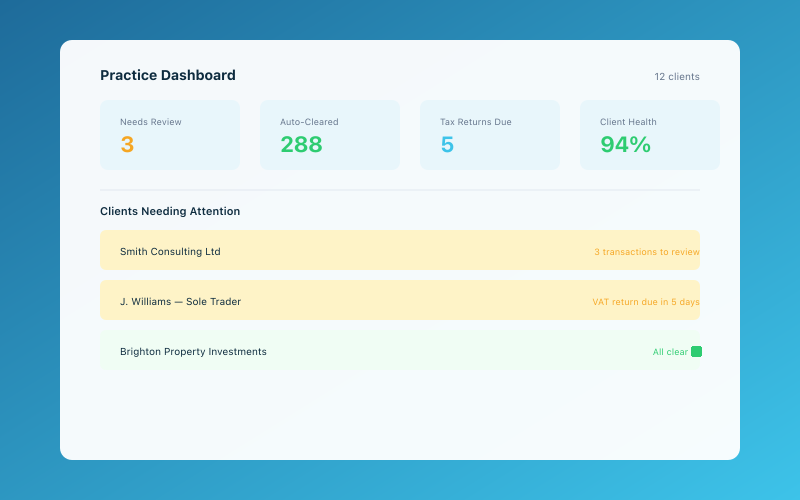 The Accounted practice dashboard — manage all your clients in one place
This isn't about impressing anyone. It's about practicality. An accountant can give you much better advice — and a more accurate quote for their services — when they can see the actual state of your finances. If you turn up with nothing, they're working blind. They'll have to ask you to provide information after the meeting, which delays everything and means the real advisory conversation gets pushed back.
Preparation also helps you. When you gather your financial information together, you often spot things you'd forgotten about or notice patterns you hadn't realised. That puts you in a much better position to have a meaningful discussion about your tax situation.
And there's a psychological benefit too. Walking into a professional meeting feeling organised and prepared does wonders for your confidence. You're more likely to ask the right questions and less likely to feel overwhelmed.
The Essential Documents to Bring
Let's get specific. Here's what you should aim to have ready for your first meeting:
Identification and personal details. Your accountant needs to verify your identity under anti-money laundering regulations. Bring photo ID (passport or driving licence) and proof of address (a recent utility bill or bank statement). They'll also need your National Insurance number and your Unique Taxpayer Reference (UTR) if you have one.
Your last tax return. If you've filed a Self Assessment before, bring a copy of your most recent return. This gives your new accountant a baseline understanding of your income, expenses, and tax position. If you can't find a copy, you can download one from your HMRC online account.
Bank statements. Ideally, bring your business bank statements for the current tax year (and the previous year if you have them). If you use a personal account for business, highlight or annotate the business transactions. This is one area where having your bookkeeping already organised in a tool like Accounted makes things significantly easier — you can simply share access or export a clean summary.
Income records. This includes invoices you've issued, records of cash payments received, and any other evidence of money coming into the business. If you have income from multiple sources (freelancing plus a rental property, for instance), bring records for all of them.
Expense records and receipts. Bring whatever you have — even if it's disorganised. Receipts, supplier invoices, subscription confirmations, mileage logs, and records of any large purchases. Your accountant will help you understand what's deductible and what's not.
Details of any assets. If you own equipment, vehicles, or other assets used in your business, bring details including purchase dates and costs. These may qualify for capital allowances.
Employment income details. If you're employed as well as self-employed, bring your P60 or recent payslips. Your accountant needs to see the full picture of your income to advise you properly.
VAT registration details. If you're VAT-registered, bring your VAT registration certificate and recent VAT returns. If you're not registered but your turnover is approaching the threshold, mention this — it's an important discussion to have.
Information About Your Business
Beyond the paperwork, your accountant will want to understand the basics of how your business works. It helps to think about these in advance:
What does your business actually do? This sounds obvious, but a clear explanation of your business model helps your accountant identify relevant tax reliefs, allowable expenses, and potential issues. "I'm a freelance web developer working from home" tells them much more than "I'm self-employed."
How long have you been trading? The answer affects everything from which expenses you can claim to whether you might have overlap relief to consider.
What's your approximate annual turnover? You don't need a precise figure, but a reasonable estimate helps your accountant assess the complexity of your affairs and quote appropriately for their services.
What are your main expense categories? Give them a sense of where your money goes. Materials, travel, software subscriptions, subcontractors — whatever is typical for your business.
Do you work from home? If so, your accountant can help you calculate the proportion of household costs you can claim as business expenses.
Do you use your car for business? The method you use to claim vehicle expenses (simplified mileage or actual costs) has implications, and your accountant should advise on which is better for your situation.
What are your business goals? Are you planning to grow? Thinking about taking on employees? Considering incorporating as a limited company? Your accountant's advice will differ based on your direction of travel.
Questions You Should Ask Them
Remember, this meeting works both ways. You're evaluating whether this accountant is right for you, and there are some important questions to raise.
What experience do you have with sole traders in my industry? An accountant who understands your sector will know the specific deductions you're entitled to and the common pitfalls to avoid.
What are your fees, and what's included? Get this nailed down upfront. Ask for a written fee proposal. Understand what's covered in the base fee and what would incur additional charges. Good accountants are transparent about this.
How will we communicate? Email? Phone? Video calls? How quickly can you expect a response? This matters more than people think. If you're someone who likes quick answers via a messaging app and your accountant only corresponds by formal letter, you're going to be frustrated.
Are you set up for Making Tax Digital? With MTD for Income Tax coming into effect, your accountant needs to be ready. Ask what software they use or recommend, and how they'll support you through the transition.
What software do you work with? If you're already using bookkeeping software — say, Accounted — check that your accountant is happy to work with it. Most modern accountants are platform-agnostic, but it's worth confirming. The handover is much smoother when your day-to-day bookkeeping tool integrates well with your accountant's workflow.
What happens if HMRC investigates? This is worth asking about upfront. Some accountants include investigation protection as part of their service; others offer it as an add-on. Either way, it's good to know where you stand.
What to Expect From the Meeting
Most initial accountant meetings last between 30 minutes and an hour. Here's a rough idea of how that time typically breaks down:
The first 10-15 minutes will usually involve your accountant asking about you and your business. They'll want to understand who you are, what you do, and what you need from them. This is where your preparation pays off — you can give clear, confident answers instead of vague approximations.
The next 15-20 minutes will involve them reviewing any documents you've brought and asking more detailed questions about your financial situation. They might spot immediate issues or opportunities — for instance, expenses you're not claiming that you should be, or a more tax-efficient way to structure something.
The final 10-15 minutes should cover next steps: what their fees would be, what they need from you to get started, how the onboarding process works, and timelines for any immediate tasks like filing an overdue return.
Don't be afraid to take notes. And don't feel pressured to commit on the spot. A good accountant will be happy for you to go away, think about it, and come back to them. If they're pushing you to sign up immediately, that's a minor red flag.
After the Meeting
Once you've had your initial meeting (or meetings, if you're seeing a few accountants), there are a few things to do:
Follow up promptly. If you've decided to go with a particular accountant, let them know quickly. The sooner you get started, the sooner they can start working on your behalf. And let any other accountants you met know you've decided to go elsewhere — it's professional courtesy.
Provide any additional documents they've requested. Don't let this slide. If they asked for something during the meeting, get it to them within a few days. This sets the tone for a responsive, professional working relationship.
Set up your bookkeeping system properly. If your new accountant has recommended specific software or processes, get those in place straight away. If you're using Accounted, Penny can have your transaction categorisation running smoothly within days. The sooner your day-to-day bookkeeping is humming along, the easier everything else becomes.
Put key dates in your diary. Your accountant will probably give you a timeline for the year — when they'll need your records, when your returns are due, when to have planning conversations. Get all of these in your calendar immediately.
One Final Thought
The best first meetings happen when both sides are prepared and honest. Don't hide problems from your accountant — if your records are a mess, say so. If you haven't filed for two years, tell them upfront. They've seen it all before, and they'd much rather know about issues from the start than discover them later.
Similarly, be upfront about your budget. If you're a sole trader with a turnover of £25,000, you don't need the same service level as a limited company turning over £500,000. A good accountant will tailor their offering to your actual needs and budget, not try to sell you services you don't need.
Go in prepared, be honest, ask good questions, and you'll be well on your way to a productive professional relationship.
Related reading:
- Working With Your Accountant — A Practical Guide
- Do You Need an Accountant as a Sole Trader?
- Making Tax Digital — The Complete Guide
Accounted helps UK sole traders stay on top of their bookkeeping and tax. Start your free 30-day trial at getaccounted.co.uk.
Related Reading
- Building an Accountancy Practice From Scratch — Year One Guide
- Tax Investigation Insurance — Should You Offer It to Clients?
Learn about our free accountant portal and how it saves your practice time.
Accounted gives accountants a free practice portal — manage all your clients, file to HMRC, and let Penny handle the routine work. See the accountant portal →
Editorial & Research
The Accounted editorial team covers software comparisons, technology, and the tools UK sole traders need to run their businesses efficiently. All software comparisons are based on independent research and publicly available pricing.
Ready to try Accounted?
Join UK sole traders who are simplifying their bookkeeping and tax.
Start your 14-day free trial