Tax Investigation Insurance — Should You Offer It to Clients?
An HMRC investigation can be one of the most stressful and expensive experiences a small business owner faces. Even when they've done nothing wrong, the process of responding to enquiries, gathering documentation, and dealing with HMRC correspondence can rack up thousands of pounds in professional fees. Tax investigation insurance — also known as fee protection insurance — covers those costs, giving clients peace of mind and ensuring your practice gets paid for the work involved.
But should your practice offer it? And if so, how do you structure and sell it? In this guide, we'll look at what tax investigation insurance actually covers, the commercial case for offering it, the different models available, and how to roll it out in your practice.
What Tax Investigation Insurance Covers
Tax investigation insurance (or fee protection) typically covers the professional fees incurred when a client is subject to an HMRC enquiry or compliance check. This includes:
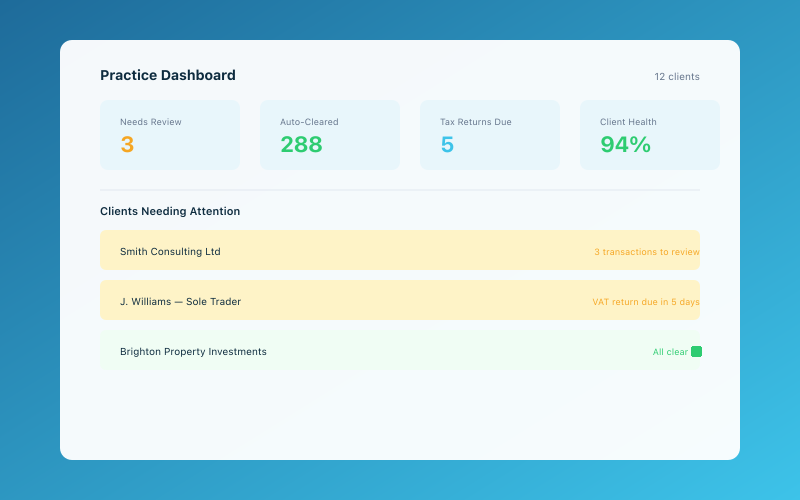 The Accounted practice dashboard — manage all your clients in one place
- Full enquiries — where HMRC opens a comprehensive investigation into a tax return
- Aspect enquiries — where HMRC looks at a specific element of a return
- VAT inspections — routine or targeted
- PAYE/NI compliance checks — for clients who employ staff
- CIS compliance checks — for construction industry clients
- IR35 investigations — increasingly common for contractors
- Employer compliance reviews
- National Minimum Wage investigations
The insurance covers your professional fees for responding to the investigation — preparing information, attending meetings with HMRC, reviewing assessments, and negotiating settlements. It doesn't cover any additional tax, penalties, or interest that HMRC might assess — that's the client's liability. It purely covers the cost of your professional time in defending the client.
Most policies also cover the cost of representation at tribunal if matters escalate, although this is relatively rare.
For background on what clients experience during an investigation, our article on what to expect from an HMRC investigation is a useful reference.
The Commercial Case for Offering It
There are several compelling reasons for accounting practices to offer tax investigation insurance:
It protects your fee income. When a client gets investigated and doesn't have insurance, one of two things happens: either they pay your fees (which can be substantial and may cause friction in the relationship) or you feel obligated to absorb some of the cost (which hurts your practice financially). Insurance eliminates this dilemma. Your fees are covered by the insurer, you get paid in full, and the client doesn't face an unexpected bill.
It strengthens client relationships. Offering insurance shows clients you're looking out for them. It positions you as a trusted adviser who anticipates problems and provides solutions, rather than just someone who files returns. When a client does get investigated, the fact that you'd already put insurance in place is a powerful demonstration of your value.
It generates additional revenue. Depending on how you structure the offering, fee protection can be a revenue line in its own right. Many practices mark up the insurance premium slightly when bundling it into their service packages, or they use it as a differentiator that justifies higher overall fees.
It reduces client anxiety. Many small business owners live with a low-level fear of HMRC investigations. Knowing they have insurance that covers the cost of professional representation removes that anxiety, which strengthens their overall satisfaction with your service.
It ensures proper representation. Without insurance, some clients try to handle HMRC enquiries themselves to save money. This almost always makes things worse. With insurance in place, there's no financial barrier to getting professional help, which leads to better outcomes for the client and less mess for you to clean up later.
The Different Models
There are several ways to structure tax investigation insurance in your practice:
Block policy. This is the most common model for accounting practices. You take out a single policy that covers all your clients (or all clients who opt in). The insurer charges a per-client premium, typically ranging from £30 to £100 per year depending on the level of cover and the client type (sole traders are generally cheaper to cover than limited companies).
The advantages of a block policy are simplicity and cost. Because the insurer is covering a portfolio of clients, the per-client cost is lower than individual policies. You manage the administration, which gives you control over the process.
Individual policies. Some providers offer individual policies that clients purchase directly. Your role is to recommend the product and perhaps facilitate the introduction. This involves less administration for your practice but also less control and less revenue opportunity.
Bundled into fees. Many practices include fee protection as part of their standard service package, building the cost into their overall fees. The client doesn't see a separate charge — they just know that investigation cover is included. This is the cleanest approach from a client experience perspective and avoids the awkward "would you like to add insurance?" conversation.
Optional add-on. Alternatively, you can offer it as an optional extra, letting clients choose whether to take it. This gives clients flexibility but typically results in lower take-up, because many clients assume "it won't happen to me" and decline.
Our recommendation is to bundle it into your standard fees wherever possible. The per-client cost is modest, and the benefits — to both you and your clients — far outweigh the cost. Making it optional means the clients who most need it (because their affairs are more complex or their records more haphazard) are often the ones who decline it.
Choosing an Insurance Provider
There are several providers in the UK market offering fee protection insurance for accounting practices. Key factors to consider:
Scope of cover. What types of investigation are covered? Some policies are narrow (covering only full HMRC enquiries into tax returns) whilst others are broad (covering VAT, PAYE, CIS, IR35, and more). Broader cover is generally better value for your clients.
Fee limits. Most policies have a maximum fee limit per claim — typically £50,000 to £150,000 for professional fees. For the vast majority of investigations, this is more than adequate. But check the small print.
Exclusions. Every policy has exclusions. Common ones include: investigations triggered by suspected fraud, enquiries where the client has been negligent, and situations where records are inadequate. Understand the exclusions so you can advise clients accurately.
Claims process. How easy is it to make a claim? The best providers have a straightforward process: notify them when an investigation starts, submit your fees as you go, and receive payment promptly. Avoid providers with onerous claims procedures that create extra work for your practice.
Support services. Some providers offer additional support during investigations — a helpline you can call for advice on handling HMRC, access to tax investigation specialists, and template letters for responding to enquiries. This can be valuable, particularly for practices that don't handle many investigations.
Reputation. Speak to other practices about their experience with different providers. A provider that's responsive and fair in handling claims is worth more than one with the cheapest premiums that fights you over every invoice.
How to Sell It to Clients
"Sell" might feel like a strong word — many accountants are uncomfortable with anything that feels like selling. But recommending tax investigation insurance isn't a hard sell; it's a genuine service that benefits the client.
Here's how to frame it:
Lead with the risk. HMRC opens hundreds of thousands of compliance checks every year. The chance of any individual client being investigated is relatively small in any given year, but over a decade of being in business, it's not unlikely. And when it happens, professional representation typically costs £3,000–£10,000 or more. Framing the insurance against those numbers makes the premium seem very reasonable.
Use real examples. If you've handled investigations in the past (without naming names), share anonymised stories. "We had a client last year who was investigated over a straightforward aspect of their return. It took three months to resolve and our fees were £4,500. Fortunately, they had insurance, so it didn't cost them a penny." Real stories are far more compelling than statistics.
Make it part of the conversation, not a separate pitch. When discussing a client's annual service package, mention investigation cover as one of the things that's included (if bundled) or available (if optional). Don't treat it as a separate sales conversation — that feels awkward for both parties.
Address objections honestly. The most common objection is "I don't need it — my affairs are straightforward." The honest response is that HMRC also opens random enquiries, and even a routine check takes time and costs money to deal with. It's like home insurance — you don't expect a flood, but you'd rather have the cover.
Our article on what triggers an HMRC enquiry can help clients understand that investigations aren't always triggered by wrongdoing — sometimes it's random.
Administration and Workflow
If you're running a block policy, you'll need to manage the administration:
- Client list. Maintain an up-to-date list of covered clients and submit it to the insurer regularly (usually annually or quarterly).
- Premium collection. If you're billing the premium separately, ensure it's collected along with your regular fees. If it's bundled, it's part of your normal billing cycle.
- Notifications. When a client receives an investigation notice, notify the insurer promptly. Most policies require notification within a set period (often 30 or 60 days) of learning about the investigation.
- Fee submissions. During an investigation, submit your fees to the insurer regularly. Keep detailed time records — insurers expect to see what work was done and how long it took.
- Renewals. Block policies typically renew annually. Review the terms each year and update your client list.
Practice management tools can help automate some of this administration. For practices using tools like Accounted for their sole trader clients, the clear digital record of the client's income and expenses can also support a smoother claims process — well-maintained records make investigations easier and cheaper to handle, which is good for everyone.
The Bottom Line
Tax investigation insurance is one of the easiest wins available to accounting practices. The cost is low, the benefit to clients is significant, and the commercial upside for your practice — in terms of protected fee income, client satisfaction, and differentiation — is real.
If you're not already offering it, there's no reason not to start. Speak to a few providers, get quotes for a block policy, and either bundle it into your service packages or offer it as a clearly communicated add-on. Your clients will thank you — especially the ones who end up needing it.
Related Reading
Learn about our free accountant portal and how it saves your practice time.
Accounted helps UK sole traders stay on top of their bookkeeping and tax. Start your free 30-day trial at getaccounted.co.uk.
Accounted gives accountants a free practice portal — manage all your clients, file to HMRC, and let Penny handle the routine work. See the accountant portal →
Editorial & Research
The Accounted editorial team covers software comparisons, technology, and the tools UK sole traders need to run their businesses efficiently. All software comparisons are based on independent research and publicly available pricing.
Ready to try Accounted?
Join UK sole traders who are simplifying their bookkeeping and tax.
Start your 14-day free trial