How to Reduce Client Churn in Your Accounting Practice
Winning new clients gets all the attention. It's exciting, it's measurable, and it feels like progress. But here's a truth that too many accountancy practices overlook: reducing client churn is almost always more profitable than acquiring new clients.
The maths is simple. Acquiring a new accountancy client costs 5-7 times more than retaining an existing one when you factor in marketing, sales time, onboarding, and the initial learning curve. An existing client who stays another year contributes pure profit — no acquisition cost, minimal onboarding effort, and established efficiency from knowing their business inside out.
Yet many practices focus almost exclusively on growth while ignoring the clients quietly slipping out the back door. If you're adding 20 new clients a year but losing 15, you're running to stand still. Fix the retention problem first, and every new client becomes genuine net growth.
Let's look at why accountancy clients leave, how to spot the warning signs, and what you can do to keep your best clients for decades.
Why Accountancy Clients Leave
Understanding the reasons behind client departures is essential. In our experience, the causes fall into several consistent categories.
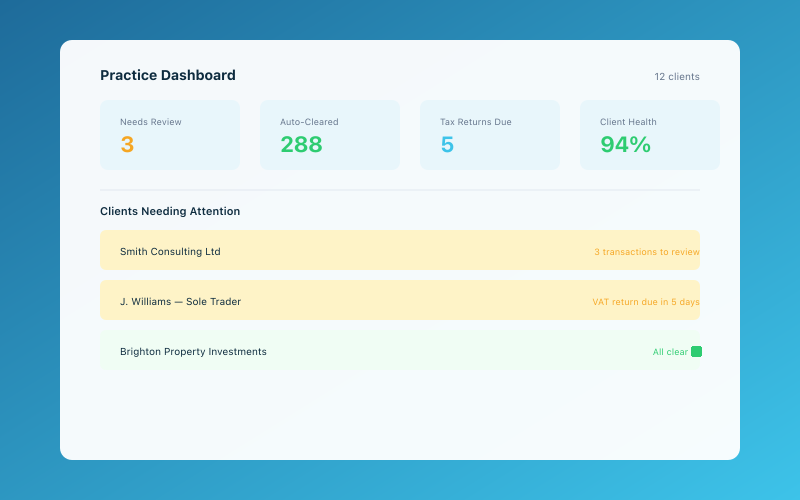 The Accounted practice dashboard — manage all your clients in one place
Poor Communication
This is the number one reason clients leave their accountant. Not bad technical work, not high fees — poor communication. Clients who feel ignored, uninformed, or unable to reach their accountant when they need them will eventually look elsewhere.
The most common complaints:
- Emails that take days or weeks to get a response
- Phone calls that go to voicemail and are never returned
- No proactive contact outside of annual compliance season
- Jargon-heavy communication that clients don't understand
- Lack of updates on the progress of work
For an in-depth look at improving this area, our guide to client communication is worth your time.
Perceived Lack of Value
When clients see their accountant as nothing more than a form-filler, they're vulnerable to any competitor offering a lower price. If the only time you contact a client is to request records and send a bill, you haven't given them any reason to see you as valuable beyond basic compliance.
Clients who receive proactive tax advice, timely business insights, and genuine strategic input rarely leave. They understand that their accountant is actively saving them money and helping their business grow. The fee feels like an investment, not a cost.
Fee Increases Without Justification
Raising prices is necessary and expected. Raising prices without explanation or context is a retention risk. Clients accept fee increases when they understand why — inflation, additional regulatory requirements, expanded scope of work. They resent increases that arrive without warning or justification.
Life and Business Changes
Some churn is natural and unavoidable. Clients retire, close their businesses, move overseas, or outgrow your services. A sole trader who becomes a £5 million limited company may genuinely need a larger firm. This type of churn is normal and shouldn't concern you unduly.
Being Poached by Competitors
Other accountants will approach your clients. Online practices with aggressive marketing will target them with promises of lower fees and better technology. This is inevitable. The best defence isn't preventing competitors from approaching your clients — it's making your clients so satisfied that they have no reason to listen.
Spotting the Warning Signs
Client departures rarely come out of nowhere. There are almost always warning signs, if you know what to look for.
Declining Engagement
A client who used to respond to emails within a day but now takes a week. A client who used to attend their annual review meeting but cancelled the last two. A client who stopped asking you questions. These are all signs of disengagement, and disengaged clients are at high risk of leaving.
Late Record Submission
When a previously punctual client starts submitting records late or not at all, something has changed. Maybe they're busy. Maybe they're disillusioned. Maybe they're already talking to another accountant. It's worth having a conversation to find out which.
Fee Sensitivity
A client who has never questioned your fees suddenly asking for a detailed breakdown, or querying specific items on an invoice, may be comparing your costs with another provider. This doesn't mean they're definitely leaving, but it's a signal to pay attention.
Reduced Scope
A client who drops services — cancelling the bookkeeping add-on, switching to annual VAT returns instead of quarterly, declining the tax planning meeting — is either cutting costs generally or reducing their commitment to your practice specifically. Either way, it's worth understanding why.
Direct Feedback
Sometimes clients tell you directly that they're unhappy, either through complaints or in response to surveys. The practices that retain clients best are the ones that treat complaints as gifts — they're free intelligence about what needs to improve.
Strategies That Actually Reduce Churn
1. Communicate Proactively and Regularly
Don't wait for clients to contact you. Reach out proactively with:
- Quarterly updates on tax deadlines and regulatory changes
- Annual review meetings to discuss their business, tax position, and plans
- Ad-hoc alerts when something relevant happens (Budget announcements, HMRC policy changes)
- Birthday or business anniversary messages — small touches that show you see them as more than a file number
The accountants with the lowest churn rates are the ones their clients hear from regularly, not just at year-end.
2. Deliver Value Beyond Compliance
Move beyond being a form-filler. Every client interaction is an opportunity to add value:
- Spot a client overpaying tax? Tell them, even if they didn't ask.
- Notice their business is growing? Suggest a planning meeting to discuss structure.
- See a relevant grant or support scheme? Forward the details.
- Identify an expense they're missing? Raise it proactively.
Each of these moments reinforces why the client pays you. Cumulatively, they make the relationship essentially unbreakable.
3. Systematise Your Client Experience
Consistency matters. Every client should receive the same standard of service, regardless of which team member is handling their work. This means:
- Standardised onboarding processes that make every new client feel valued
- Documented procedures for common client interactions
- Templates for routine communications that maintain quality while saving time
- Regular internal reviews to ensure standards are being met
4. Make Technology Work for the Relationship
Technology should enhance the client experience, not replace the human element. Use it to:
- Provide clients with real-time access to their financial data through cloud platforms
- Automate routine reminders so nothing falls through the cracks
- Offer self-service options for simple queries (client portals, FAQs)
- Free up your time from admin so you can spend more time on relationship-building
When your sole trader clients use tools like Accounted with its Penny AI assistant for day-to-day bookkeeping, they get a smoother experience and you get cleaner records — it's a win for the relationship on both sides.
5. Handle Fee Conversations With Care
When it's time to increase fees:
- Give notice — ideally 30-60 days before the increase takes effect
- Explain the reason clearly (increased costs, regulatory changes, expanded scope)
- Quantify the value you've delivered (tax saved, penalties avoided, time saved)
- Offer alternatives if the increase is significant (reduced scope at current price, phased increase)
- Time it right — don't raise fees immediately after a service failure
For a broader look at pricing strategy, our guide on fixed vs hourly pricing explores the models that tend to retain clients best.
6. Conduct Annual Client Reviews
An annual review meeting — separate from the year-end accounts review — is one of the most powerful retention tools available. Use it to:
- Review the client's current situation and future plans
- Discuss any changes to their business or personal circumstances
- Identify opportunities for tax savings or business improvement
- Confirm the scope of services for the coming year
- Address any concerns before they become reasons to leave
These meetings don't need to be long. A focused 30-minute video call is plenty for most clients. The act of proactively scheduling it sends a powerful message: we care about your business, not just your compliance.
7. Ask for Feedback (and Act on It)
You can't fix problems you don't know about. Implement a simple feedback mechanism:
- A short survey after completing major work (accounts, tax return)
- An annual satisfaction question in your review meeting
- A Net Promoter Score (NPS) survey once a year
The key is acting on what you learn. If three clients mention that phone response times are slow, fix it. If feedback is overwhelmingly positive, share it with your team as motivation.
8. Build Relationships, Not Dependencies
The strongest client relationships are based on genuine trust and mutual respect, not contractual lock-in or information asymmetry. Clients who stay because they want to are better than clients who stay because leaving feels too difficult.
This means:
- Being transparent about your processes and fees
- Sharing knowledge rather than hoarding it
- Making it easy for clients to access their own records
- Treating every interaction as an opportunity to demonstrate value
Measuring Client Churn
You can't manage what you don't measure. Track these metrics:
Churn Rate
Calculate your annual churn rate: (clients lost during the year / clients at the start of the year) x 100. For UK accountancy practices, a churn rate under 5% is excellent, 5-10% is typical, and above 10% suggests a systemic problem.
Revenue Churn
Not all clients are equal. Losing a £5,000/year client is very different from losing a £500/year client. Track revenue churn as well as client count churn to get a true picture.
Client Lifetime Value
Understanding how long clients typically stay and how much revenue they generate over that lifetime helps you make better decisions about acquisition and retention investment.
Reason Tracking
When a client does leave, understand why. Conduct a brief exit interview or send a survey. Categorise the reasons and look for patterns. If "poor communication" appears frequently, you know exactly where to invest.
When Churn Is Actually Healthy
Not all client departures are bad. Some are genuinely positive for your practice:
- Unprofitable clients leaving frees up capacity for better work
- Difficult clients departing improves your team's morale and productivity
- Clients outgrowing you is a sign that you're working with ambitious businesses
- Natural attrition (retirement, business closure) is inevitable and nothing to worry about
The churn to worry about is losing good, profitable, engaged clients to competitors or dissatisfaction. That's the churn these strategies are designed to prevent.
Building a Retention-First Culture
Client retention isn't a marketing initiative or a one-off project. It's a culture — a way of thinking about your practice that puts existing client relationships at the centre of everything you do.
This means:
- Celebrating client anniversaries and long-term relationships, not just new wins
- Including retention metrics in team performance reviews
- Investing in relationship-building activities, not just acquisition campaigns
- Training your team to spot warning signs and act on them
- Making every client feel that they matter, regardless of the size of their fee
The practices that thrive long-term are the ones that understand a simple truth: your best source of future revenue is the clients you already have. Look after them properly, and growth takes care of itself.
Accounted helps UK sole traders stay on top of their bookkeeping and tax. Start your free 30-day trial at getaccounted.co.uk
Related reading:
- Accountant Client Communication Tips
- How to Grow Your Accountancy Practice in 2026
- Pricing Your Accountancy Services — Fixed Fee vs Hourly
Further Reading
- The Institute of Chartered Accountants in England and Wales (ICAEW) provides professional guidance for accountants.
- Stay up to date with Making Tax Digital requirements from HMRC.
Related Reading
- How to Find the Right Accountant for Your Business
- When to Fire Your Accountant — Red Flags to Watch For
Accounted gives accountants a free practice portal — manage all your clients, file to HMRC, and let Penny handle the routine work. See the accountant portal →
Editorial & Research
The Accounted editorial team covers software comparisons, technology, and the tools UK sole traders need to run their businesses efficiently. All software comparisons are based on independent research and publicly available pricing.
Ready to try Accounted?
Join UK sole traders who are simplifying their bookkeeping and tax.
Start your 14-day free trial