How to Find the Right Accountant for Your Business
Finding the right accountant can feel a bit like dating. You want someone who understands you, communicates well, and — most importantly — doesn't leave you with nasty surprises down the line. Yet so many sole traders either pick the first name that pops up on Google or stick with someone who isn't quite right because switching feels like too much hassle.
The truth is, a good accountant can save you thousands of pounds and countless hours of stress. A bad one can cost you just as much. So it's worth putting in a little effort upfront to find someone who genuinely fits your business.
Let's walk through exactly how to do that.
Know What You Actually Need
Before you start searching, take a step back and think about what you actually need from an accountant. This sounds obvious, but it's a step most people skip entirely.
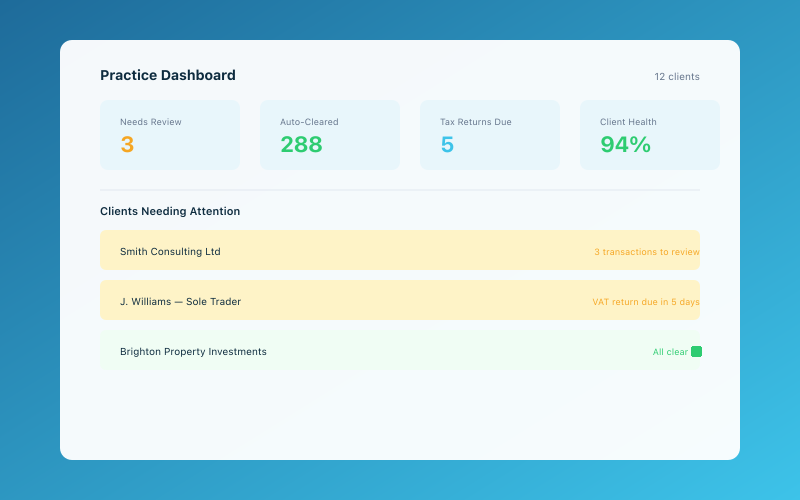 The Accounted practice dashboard — manage all your clients in one place
Are you a sole trader who just needs help filing a Self Assessment return once a year? Or are you running a growing business that needs ongoing bookkeeping, VAT returns, and strategic tax planning? The answer changes who you should be looking for.
If your needs are relatively straightforward — tracking income and expenses, staying on top of Making Tax Digital requirements, and filing your tax return — you might not need a full-service accountancy firm. A bookkeeper or a tool like Accounted, combined with occasional accountant input, could be more than enough.
On the other hand, if you're thinking about incorporating, dealing with complex tax situations, or employing staff, you'll want someone with deeper expertise. The key is to be honest about where you are right now and where you're heading in the next couple of years.
Where to Look — And Where Not To
The obvious starting point is personal recommendations. Ask other sole traders or freelancers in your industry who they use and whether they're happy. A recommendation from someone in a similar business to yours is worth ten Google reviews from strangers.
Professional directories are another solid option. The Institute of Chartered Accountants in England and Wales (ICAEW), the Association of Chartered Certified Accountants (ACCA), and the Association of Accounting Technicians (AAT) all have searchable directories. If someone is listed there, you know they've met certain professional standards.
Local business networking groups, Facebook groups for your industry, and even your local chamber of commerce can all be useful sources. Don't overlook online accountancy firms either — many now operate entirely remotely and can offer excellent service at lower prices because they don't have the overhead of a high-street office.
Where should you be cautious? Anyone who cold-calls you or sends unsolicited emails promising to slash your tax bill. Legitimate accountants don't tend to operate that way. And be wary of the cheapest option — if someone is significantly undercutting everyone else, there's usually a reason.
What Qualifications and Credentials Matter
Not everyone who calls themselves an accountant is actually qualified. In the UK, the term "accountant" isn't legally protected, which means anyone can set up shop and start offering accounting services. That's a bit alarming when you think about it.
Look for accountants who are members of recognised professional bodies. The main ones are:
- ICAEW — Institute of Chartered Accountants in England and Wales
- ACCA — Association of Chartered Certified Accountants
- CIOT — Chartered Institute of Taxation
- AAT — Association of Accounting Technicians
Members of these bodies are bound by codes of ethics and professional conduct, carry professional indemnity insurance, and are subject to regular monitoring. If something goes wrong, you have somewhere to complain.
You should also check whether they're registered with HMRC as an agent, which means they can deal with HMRC on your behalf. And if you need help with VAT, make sure they have relevant experience — not all accountants deal with VAT regularly.
Questions to Ask Before You Commit
Once you've got a shortlist, it's time to have some conversations. Most accountants offer a free initial consultation, and you should absolutely take advantage of this. Here are some questions worth asking:
"What experience do you have with businesses like mine?" An accountant who specialises in your industry will know the specific allowable expenses, common pitfalls, and tax-saving opportunities that a generalist might miss. If you're a freelance graphic designer, an accountant who mainly works with construction firms might not be the best fit.
"How do you communicate and how often?" This is hugely important and often overlooked. Some accountants are brilliant but terrible at returning calls. Others are wonderfully responsive but only communicate by post. Find out whether they use email, phone, video calls, or even messaging apps, and how quickly you can expect a response.
"What software do you use or recommend?" If you're already using a particular bookkeeping tool, you want to make sure your accountant can work with it. Many sole traders use Accounted to keep their day-to-day bookkeeping organised, with Penny handling the categorisation and receipt tracking, and then share access with their accountant at year-end. It's worth checking your accountant is happy with that setup.
"What are your fees, and how are they structured?" Get this in writing. Some accountants charge a monthly retainer, others charge per job, and some bill by the hour. Make sure you understand exactly what's included and what would incur extra charges. There's nothing worse than getting an unexpected bill because you asked a couple of extra questions.
"What happens if HMRC investigates me?" A good accountant will have a clear process for this and may offer investigation protection insurance as part of their service.
Red Flags to Watch Out For
Even during an initial meeting, there are warning signs that should make you think twice. If an accountant isn't meeting your expectations, it's better to know before you're locked in.
They guarantee specific tax savings. No ethical accountant will promise you'll save a specific amount. They can give you an idea based on experience, but tax is complex and outcomes depend on many factors.
They're vague about fees. If they can't give you a clear idea of what you'll be paying, that's a problem. You should know upfront what you're committing to.
They seem disinterested in your business. A good accountant will ask questions about what you do, how your business works, and what your goals are. If they just want to know your turnover and send you a quote, they're probably not going to provide personalised advice.
They badmouth other accountants. A bit of professional rivalry is normal, but someone who spends the whole meeting criticising competitors rather than talking about what they can do for you is showing you who they are.
They're not up to date with MTD. If your accountant isn't across Making Tax Digital requirements and the upcoming changes for income tax, that's a serious concern. The April 2026 deadline is fast approaching, and you need someone who's prepared.
Making the Final Decision
You've done your research, had your meetings, and you've got a couple of strong contenders. How do you make the final call?
Trust your gut feeling. Seriously. You're going to be sharing sensitive financial information with this person and relying on their advice for important decisions. If something feels off — even if you can't quite articulate what — pay attention to that.
Consider the practicalities too. Are they conveniently located if you prefer face-to-face meetings? Do their working hours align with yours? Are they a one-person operation (which might mean delays if they're ill or on holiday) or part of a larger team?
And think about the future. You want someone who can grow with your business. If you're planning to take on employees, register for VAT, or incorporate in the next couple of years, make sure your accountant can handle all of that without you needing to switch.
Finally, remember that this isn't a marriage. If you choose an accountant and it's not working out, you can absolutely change. It's easier than most people think, and knowing when to make that change is an important skill in itself.
Keep Your Side of the Bargain
Finding the right accountant is only half the equation. The other half is being a good client. That means keeping your records organised, responding to requests promptly, and not dumping a carrier bag full of receipts on their desk in January.
This is where good bookkeeping habits make all the difference. If you're using Accounted day to day, with Penny categorising your transactions and keeping everything tidy, your accountant's job becomes much easier — and that often means lower fees for you. It's a genuine win-win.
The best accountant-client relationships are partnerships. You bring the knowledge of your business; they bring the technical expertise. When both sides are pulling their weight, the results can be genuinely transformative.
Related reading:
- Do You Need an Accountant as a Sole Trader?
- Working With Your Accountant — A Practical Guide
- Accountant vs Bookkeeper — What's the Difference?
Accounted helps UK sole traders stay on top of their bookkeeping and tax. Start your free 30-day trial at getaccounted.co.uk.
Related Reading
- The Best CRM Systems for Accountancy Practices
- Tax Investigation Insurance — Should You Offer It to Clients?
Learn about our free accountant portal and how it saves your practice time.
Accounted gives accountants a free practice portal — manage all your clients, file to HMRC, and let Penny handle the routine work. See the accountant portal →
Editorial & Research
The Accounted editorial team covers software comparisons, technology, and the tools UK sole traders need to run their businesses efficiently. All software comparisons are based on independent research and publicly available pricing.
Ready to try Accounted?
Join UK sole traders who are simplifying their bookkeeping and tax.
Start your 14-day free trial