Pricing Your Accountancy Services — Fixed Fee vs Hourly
Few decisions affect your accountancy practice more profoundly than how you price your services. Get it right and you'll have predictable revenue, happy clients, and healthy profit margins. Get it wrong and you'll be working long hours for less than you deserve, dealing with billing disputes, and wondering where all the profit went.
The fixed fee vs hourly rate debate has raged in the accountancy profession for years, and in 2026 the conversation is more relevant than ever. Clients are increasingly expecting transparency and predictability in professional fees, while accountants are grappling with the need to value their expertise rather than just their time.
Let's look at both models honestly — the advantages, the pitfalls, and the practical considerations that should guide your decision.
The Hourly Rate Model
Hourly billing is the traditional approach. You track your time, multiply it by your rate, and invoice the client accordingly. Simple in concept, though not always in execution.
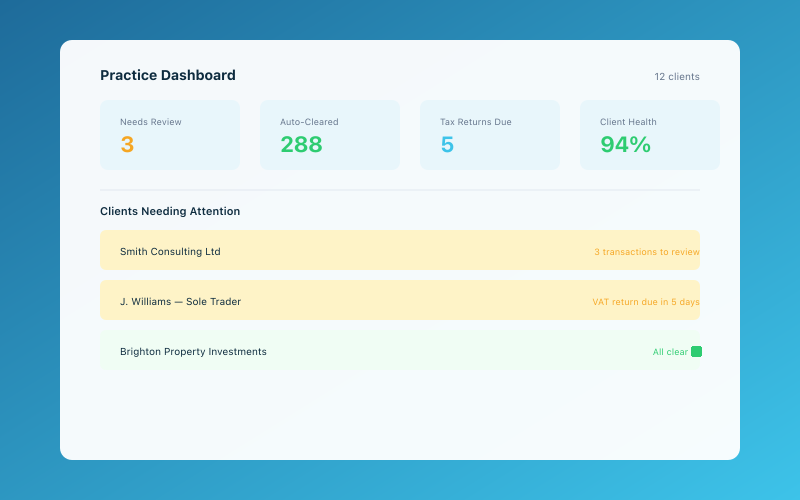 The Accounted practice dashboard — manage all your clients in one place
How It Works
You set an hourly rate (or different rates for different staff levels), record time spent on each client using timesheets, and bill periodically based on accumulated hours. Most practices bill monthly or quarterly, with some billing on completion of specific jobs.
Typical hourly rates for UK accountancy practices in 2026 range from:
- Junior/trainee staff: £40-60 per hour
- Semi-senior/experienced staff: £60-90 per hour
- Managers: £90-130 per hour
- Partners/principals: £130-250+ per hour
These vary significantly by location, specialism, and practice size. London rates are typically 20-40% higher than regional rates.
Advantages of Hourly Billing
You get paid for every hour you work. If a job takes longer than expected — perhaps the client's records are a mess, or HMRC raises queries — you're compensated for the extra time. There's no risk of underpricing a job.
It's straightforward to calculate. Time multiplied by rate equals fee. No complex scoping exercise required. No agonising over whether you've quoted correctly.
It naturally handles scope creep. When a client asks "Can you also look at this?" the answer is simply "Yes, and it will be billed at the standard rate." No need for awkward conversations about what's included.
It works well for unpredictable work. Advisory engagements, HMRC investigations, and complex tax planning projects are genuinely difficult to scope in advance. Hourly billing handles uncertainty gracefully.
Disadvantages of Hourly Billing
Clients hate it. Let's be blunt — most clients dislike hourly billing. They feel like the meter is running every time they phone you, which discourages them from seeking advice when they need it. They can't budget for professional fees because they don't know what the bill will be. And they inevitably question whether the work really took as many hours as you've recorded.
It penalises efficiency. This is the fundamental flaw. As you become better and faster at your work, you earn less per job. The partner who can complete a tax return in two hours earns half what the trainee who takes four hours earns. That's perverse.
Time recording is a burden. Accurate timesheets require discipline, and most accountants loathe filling them in. Studies consistently show that professionals fail to record 15-30% of their billable time.
It limits your revenue. There are only so many hours in a day. If your income is directly tied to hours worked, growth requires either working longer hours (unsustainable) or hiring more people (expensive and complex).
The Fixed Fee Model
Fixed fee pricing means quoting a specific price for a defined scope of work before you begin. The client knows exactly what they'll pay, and you know exactly what you'll deliver.
How It Works
You assess the client's needs, determine the scope of work, estimate the effort involved, add a margin, and quote a single price. This is typically broken down into monthly payments via standing order, making it even more predictable for both parties.
For example, a sole trader client might pay £150 per month for a package including:
- Annual accounts preparation
- Self-assessment tax return
- Quarterly VAT returns
- Basic bookkeeping support
- Ad-hoc email and phone queries
That's £1,800 per year, paid in predictable monthly instalments. The client can budget accurately, and you have reliable recurring revenue.
Advantages of Fixed Fees
Clients love predictability. Knowing that their accountancy fees will be £150 per month, no surprises, is enormously reassuring for small business owners who are managing tight budgets. It removes a source of anxiety from the relationship.
It rewards efficiency. Under fixed pricing, every minute you save through better processes, better technology, or better skills goes straight to your bottom line. If you can complete a tax return in one hour instead of two, your effective hourly rate doubles. This creates a powerful incentive to invest in efficiency and technology.
Recurring revenue is transformative. When most of your clients pay monthly by standing order, your cash flow becomes beautifully predictable. You know in January what your February revenue will be. This makes planning, hiring, and investing infinitely easier.
It encourages client communication. When clients aren't worried about being billed for every phone call, they're more likely to reach out when they have questions or problems. This means you catch issues early, provide better advice, and build stronger relationships.
It positions you as a valued adviser, not a commodity. Hourly billing implicitly says "you're paying for my time." Fixed pricing says "you're paying for my expertise and the outcomes I deliver." The latter is a much stronger professional positioning.
Disadvantages of Fixed Fees
You carry the risk of underpricing. If you quote £1,800 for a job that actually takes twice as long as expected, you've effectively halved your hourly rate. Scope creep, disorganised clients, and unexpected complications can all erode your margins.
Scoping requires skill. Accurately estimating the work involved in serving a client requires experience. New practice owners often underestimate, particularly for complex or unusual situations.
Difficult clients can be costly. The client who phones every week with questions, sends records late requiring extra chasing, and changes their mind about business decisions that affect their tax position — under fixed pricing, all of that extra work comes out of your margin.
Price increases can be awkward. Raising a fixed fee requires a conversation, whereas hourly billing naturally increases as more work arises. Annual fee reviews are necessary but can feel uncomfortable.
The Hybrid Approach
Many successful practices don't choose one model exclusively — they use a hybrid approach that plays to the strengths of each.
Fixed Fees for Compliance, Hourly for Advisory
The most common hybrid is charging fixed fees for predictable compliance work (accounts, tax returns, VAT) and hourly rates for advisory and ad-hoc work (tax planning, HMRC investigations, business advice).
This makes intuitive sense. Compliance work is highly repeatable and predictable — perfect for fixed pricing. Advisory work is variable and unpredictable — better suited to hourly billing.
Tiered Fixed Fee Packages
Another approach is offering tiered packages at different price points:
- Essential: Annual accounts and tax return only — £100/month
- Standard: Accounts, tax return, VAT, basic bookkeeping — £175/month
- Premium: Everything above plus quarterly reviews, tax planning, and unlimited queries — £300/month
This gives clients choice and allows you to capture different segments of the market. Most clients will choose the middle option (that's basic pricing psychology), and the premium tier identifies clients who value advisory services.
Fixed Fee With Adjusters
Some practices quote a fixed fee based on certain assumptions, with clear adjusters for specific circumstances:
- "Our fee is £1,500 based on receiving your records by 30 September. Records received after this date will incur a £300 surcharge."
- "Our fee assumes no more than four director changes during the year. Additional changes are billed at £75 each."
This gives clients predictability while protecting you against the most common causes of scope creep.
Getting Your Pricing Right
Whatever model you choose, underpricing is the most common and most damaging mistake.
Know Your Costs
Calculate what it actually costs to serve a client:
- Direct staff time (including employer's NI, pension, benefits)
- Software costs per client
- Insurance, premises, and overheads apportioned per client
- Your own time (including management, marketing, and admin — not just client work)
Many accountants are shocked to discover that their true cost of service delivery is much higher than they assumed, leaving far less margin than they thought.
Price Based on Value, Not Just Cost
A tax return is a tax return, but the value varies enormously depending on the client. A tax return for a sole trader earning £30,000 is routine. A tax return for a property investor with complex capital gains calculations and multiple income sources might save them thousands in tax through careful planning. The second client should absolutely pay more, not because the form takes longer to fill in, but because the expertise involved delivers more value.
Review Annually
Your costs increase every year. Software goes up, insurance goes up, salaries go up. If your fees don't increase correspondingly, your margins erode steadily. Build annual fee reviews into your process. Most clients accept reasonable annual increases without complaint — it's the practices that freeze fees for five years and then announce a 30% increase that run into trouble.
Don't Compete on Price
If you're the cheapest accountant a client can find, you're attracting the wrong clients. Price-sensitive clients tend to be the most demanding, the most likely to complain, and the quickest to leave when someone even cheaper comes along. Position your practice on value, expertise, and service quality — and price accordingly.
For sole trader clients who want to minimise their accountancy costs through better record-keeping, pointing them towards tools like Accounted can help. When clients use software with features like Penny's AI-powered transaction categorisation, they arrive at year-end with clean, organised records — which means less time and cost for everyone.
Communicating Your Pricing
How you present your fees matters almost as much as the fees themselves.
Be Transparent
Hidden charges and vague pricing destroy trust. Clients should understand exactly what they're paying for and what circumstances might lead to additional charges.
Present Options and Focus on Outcomes
Giving clients a choice of two or three options increases conversion rates and gives them a sense of control. And when describing those options, focus on outcomes rather than activities. Instead of "Preparation of self-assessment tax return," try "We'll ensure your tax return is filed accurately and on time, identifying all legitimate reliefs to minimise your tax bill." Same service, completely different perceived value.
Use Proposals, Not Quotes
A proper proposal that outlines the client's situation, recommended services, and expected outcomes is far more persuasive than a one-line quote. It demonstrates professionalism and helps justify your pricing.
Making the Transition
If you're currently billing hourly and want to move to fixed fees (or vice versa), don't try to switch everyone at once. Roll out the new pricing model for new clients first, then transition existing clients at their next annual review.
For existing clients, frame the change positively: "We're moving to a fixed monthly fee structure so you'll always know exactly what your accountancy costs will be. No surprises, no unexpected bills." Most clients will welcome this. The few who prefer hourly billing are often the ones who rarely contact you — and ironically, those are the clients you make the best margins on under fixed pricing anyway.
For a broader look at practice growth strategies, including pricing, our guide to growing your practice in 2026 puts pricing in the context of your wider business development efforts.
Accounted helps UK sole traders stay on top of their bookkeeping and tax. Start your free 30-day trial at getaccounted.co.uk
Related reading:
- How to Grow Your Accountancy Practice in 2026
- Pricing Your Accountancy Services 2026
- How to Reduce Client Churn in Your Accounting Practice
Related Reading
- CPD for Accountants — Staying Current Without Going Mad
- What Your Accountant Really Thinks About Your Receipts
Accounted gives accountants a free practice portal — manage all your clients, file to HMRC, and let Penny handle the routine work. See the accountant portal →
Editorial & Research
The Accounted editorial team covers software comparisons, technology, and the tools UK sole traders need to run their businesses efficiently. All software comparisons are based on independent research and publicly available pricing.
Ready to try Accounted?
Join UK sole traders who are simplifying their bookkeeping and tax.
Start your 14-day free trial