CPD for Accountants — Staying Current Without Going Mad
Continuing Professional Development. Three words that make most accountants sigh, roll their eyes, or reach for the biscuit tin. CPD is one of those professional obligations that everyone agrees is important in principle but that very few people genuinely enjoy in practice.
The requirements themselves aren't onerous — typically 20-40 hours per year depending on your professional body — but finding the time, choosing the right activities, and keeping proper records feels like yet another administrative burden in an already busy professional life.
Here's the thing, though: CPD doesn't have to be a box-ticking exercise. Done well, it genuinely makes you a better accountant, a more confident adviser, and a more valuable professional. Done badly, it's a waste of hours you'll never get back.
This guide is about doing it well — meeting your requirements efficiently while actually learning things that make a difference to your practice and your career.
Understanding Your CPD Requirements
Before we get into strategy, let's clarify what's actually required. The main UK professional bodies each have slightly different approaches.
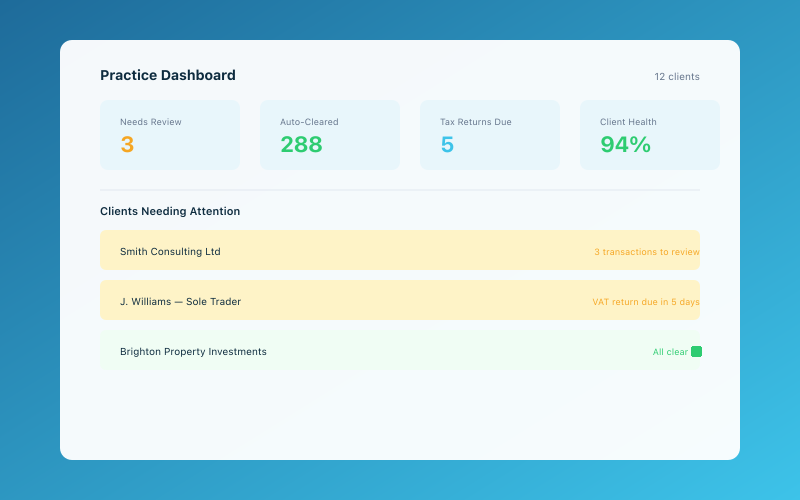 The Accounted practice dashboard — manage all your clients in one place
ICAEW
ICAEW takes a principles-based approach with no fixed hourly requirement. You reflect on development needs, plan activities, complete them, and evaluate their effectiveness. Most members aim for 20-30 hours per year.
ACCA
ACCA requires at least 40 units per year (roughly one unit per hour), of which at least 21 must be verifiable structured learning with evidence.
AAT
Licensed AAT members need a minimum of 30 hours per year, relevant to the services they provide, with records maintained for review.
CIOT/ATT
Both require at least 20 hours of structured CPD per year, relevant to your area of practice.
The Common Thread
Regardless of your professional body, the expectations are broadly similar: undertake regular, relevant learning, keep records, and demonstrate that your CPD has maintained your competence.
Making CPD Genuinely Useful
The difference between CPD that wastes your time and CPD that transforms your practice lies in how you approach it.
Start With a Needs Assessment
Before signing up for any course or webinar, ask yourself:
- What are my knowledge gaps? Where have I felt uncertain or unprepared in the past year?
- What's changing in my practice area? New legislation, new technology, new client needs?
- What skills would make the biggest difference? Not just technical skills — what about management, marketing, technology, or communication?
- What are my career or business goals? How can CPD support them?
This honest assessment prevents you from defaulting to whatever's easiest or cheapest and instead directs your time toward learning that actually matters.
Balance Technical and Non-Technical Learning
Most accountants gravitate toward technical CPD — tax updates, accounting standards changes, regulatory developments. This makes sense, but it's only half the picture.
The accountants who build the most successful practices also invest in:
- Business development — Marketing, networking, proposal writing
- Client management — Communication, difficult conversations, relationship building
- Technology — Cloud platforms, AI tools, automation
- Leadership — Team management, delegation, mentoring
- Personal effectiveness — Time management, stress management, presentation skills
A practice owner who understands the latest Finance Act changes but can't manage their team, market their services, or communicate with clients effectively is missing half the puzzle.
Apply What You Learn Immediately
The forgetting curve is real. Without reinforcement, you'll forget 70% of what you learned within 24 hours and 90% within a week. The most effective way to combat this is immediate application.
After any CPD activity, ask yourself:
- What's one thing I can implement in my practice this week?
- Which clients does this affect?
- Who on my team should I share this with?
If you attend a webinar on capital allowances changes, review your relevant client files the next day. If you complete a course on practice management, make one process change that week. Action turns learning into competence.
CPD Activities That Deliver Real Value
Webinars and Online Courses
The pandemic permanently changed CPD delivery, and online learning is now the dominant format. The advantages are obvious — no travel time, no hotel costs, and the ability to learn at your own pace.
Best for: Technical updates, tax changes, software training Watch out for: Passive webinars where you zone out after 20 minutes
Tips for getting more from online learning:
- Take notes by hand (research shows this improves retention compared to typing)
- Set aside dedicated time — don't try to multitask
- Use the chat and Q&A features to engage actively
- Watch recordings at 1.25x or 1.5x speed if the presenter is slow
- Choose providers with good production quality — poor audio and slides make learning harder
Professional Body Events and Conferences
Annual conferences and regional events from ICAEW, ACCA, AAT, and specialist bodies like the CIOT offer concentrated learning over one or two days, plus valuable networking.
Best for: Big-picture industry trends, networking, inspiration Watch out for: Expensive registration and travel costs, variable session quality
To maximise value, plan your conference schedule carefully. Skip sessions on topics you already know well and prioritise areas where you have genuine gaps. The networking is often as valuable as the formal programme.
Peer Learning and Mastermind Groups
Some of the most valuable CPD happens in conversation with other practitioners. Peer groups, mastermind sessions, and informal networks allow you to:
- Discuss real-world problems and share solutions
- Learn from others' experiences and mistakes
- Stay accountable for development goals
- Reduce the isolation of running a practice
If no suitable group exists in your area, consider starting one. Even four or five practice owners meeting quarterly over lunch can create enormous value.
Reading and Research
Technical reading counts as CPD, and it's one of the most flexible and accessible options. Sources worth following:
- HMRC guidance and updates — Essential for staying current on compliance
- Professional body journals — Accountancy Age, Taxation, AccountingWEB
- Tax and accounting blogs — Many specialists share excellent free content
- Books — On technical topics, business development, and professional skills
- Budget and Finance Act analyses — From the major firms and professional bodies
Set aside 30 minutes a week for professional reading. It adds up to over 25 hours per year — enough to make a meaningful dent in your CPD requirement while keeping you genuinely well-informed.
Teaching and Mentoring
Teaching others is one of the most effective ways to learn. If you mentor junior staff, present at professional events, or write technical articles, all of these count as CPD — and they deepen your understanding far more than passive learning.
Consider:
- Running internal training sessions for your team
- Presenting at your local professional body branch
- Writing articles for trade publications
- Mentoring a younger professional
- Creating guides or resources for clients
Software and Technology Training
Learning to use new technology effectively is both valuable CPD and a direct investment in practice efficiency. As the profession moves increasingly online, staying current with cloud platforms, AI tools, and automation is no longer optional.
Dedicate some CPD hours to:
- Learning advanced features of your existing software
- Exploring new tools that could improve efficiency
- Understanding how AI is being applied in accounting
- Getting comfortable with digital communication and collaboration tools
When you're recommending tools to clients — whether that's Accounted for sole trader bookkeeping or something else — knowing the software inside out makes your advice more credible and your support more useful.
Managing CPD Records Efficiently
Record-keeping is the administrative part of CPD that everyone dreads. But with a simple system, it takes minutes rather than hours.
Keep a Running Log
Don't wait until your annual declaration is due to compile your records. Maintain a simple spreadsheet or document that you update after each activity:
- Date
- Activity description
- Provider (if applicable)
- Duration
- Learning outcomes (what you learned and how you'll apply it)
- Evidence (certificate, notes, link to resource)
Updating this takes two minutes after each activity. Reconstructing a year's CPD from memory in December takes hours and inevitably misses things.
Save Evidence Automatically
Create a folder in your cloud storage (call it "CPD 2026" — inspired naming) and save certificates, notes, and confirmations as you go. Most professional bodies provide online CPD recording tools too — use them so your records are in the format expected if you're selected for review.
The Reflective Statement
Some professional bodies require a reflective statement. This doesn't need to be an essay — a paragraph covering what you identified as development needs, what you did about them, and what your priorities are for next year is sufficient. It's genuinely useful even when not required.
Finding Time for CPD
Time is the perennial objection. "I'm too busy with client work to spend time on CPD." This is understandable, but it's a false economy. Accountants who don't invest in their development gradually become less effective, less competitive, and less confident — which ultimately costs far more time than the CPD would have taken.
Block It in Your Diary
Treat CPD time as non-negotiable. Block out specific slots — perhaps Friday afternoons, or one morning a fortnight — and protect them as you would client meetings. If it's not in the diary, it won't happen.
Stack It With Existing Activities
Many everyday activities count as CPD if you approach them mindfully:
- Client work — Complex cases that require research and new learning
- Team discussions — Sharing knowledge and discussing technical problems
- Reading HMRC updates — Already part of your routine
- Software updates — Learning new features as they're released
- Networking events — Technical discussions with peers
You're probably doing more CPD than you realise. The trick is recognising it, recording it, and supplementing it with targeted learning in your gap areas.
Use Dead Time
Commuting, exercising, and household chores become CPD opportunities with the right podcast or audiobook. There are excellent UK-focused accounting podcasts covering everything from tax technical updates to practice management. What was dead time becomes development time without requiring any extra hours in your day.
Invest in Your Team's CPD Too
If you run a practice, your staff's development is your responsibility and your practice's competitive advantage. Practices that invest in staff development and retention consistently outperform those that don't.
Budget for team CPD, give people time to learn, and create a culture where development is valued. The payback in improved service quality, staff loyalty, and practice capability is substantial.
CPD in a Changing Profession
The accounting profession is changing faster than at any point in living memory. MTD is digitising compliance. AI is automating routine tasks. Client expectations are shifting toward real-time advice rather than annual retrospective reporting. The skills that made you successful five years ago won't necessarily be the skills that keep you successful five years from now.
CPD is your mechanism for staying relevant. The accountants who will thrive in the coming decade are the ones who view continuous learning not as a regulatory burden but as a strategic investment — in themselves, their team, and their practice.
Start by identifying one skill or knowledge area that would make the biggest difference to your practice right now. Commit to developing it over the next quarter. Record what you do. Apply what you learn. And then move on to the next thing.
That's not box-ticking. That's professional growth. And done consistently, it's the difference between a practice that merely survives and one that genuinely thrives.
Accounted helps UK sole traders stay on top of their bookkeeping and tax. Start your free 30-day trial at getaccounted.co.uk
Related reading:
- Accountant Staff Retention Tips
- Cloud Accounting — How to Move Your Practice Online
- How to Grow Your Accountancy Practice in 2026
Related Reading
- Automating Client Onboarding — A Practical Guide for Practices
- Succession Planning for Accountancy Practices
Learn about our free accountant portal and how it saves your practice time.
Accounted gives accountants a free practice portal — manage all your clients, file to HMRC, and let Penny handle the routine work. See the accountant portal →
Editorial & Research
The Accounted editorial team covers software comparisons, technology, and the tools UK sole traders need to run their businesses efficiently. All software comparisons are based on independent research and publicly available pricing.
Ready to try Accounted?
Join UK sole traders who are simplifying their bookkeeping and tax.
Start your 14-day free trial