Succession Planning for Accountancy Practices
You've spent years — perhaps decades — building your accountancy practice. You've grown the client base, developed the team, weathered recessions, adapted to new technology, and navigated more regulatory changes than you care to remember. Your practice is more than a business; it's a significant part of your identity and your financial future.
Which makes it all the more surprising how many practice owners have no succession plan at all.
Industry surveys consistently show that over 60% of accountancy practice owners don't have a documented succession plan, and many haven't even started thinking about it. This isn't just risky for the owner — it's unfair to clients who depend on continuity of service and staff who depend on continued employment.
Whether retirement is five years away or twenty, having a succession plan isn't just sensible — it's a professional responsibility. Let's explore how to approach it properly.
Why Start Planning Early?
The biggest mistake in succession planning is leaving it too late. Starting the process five to ten years before your intended exit gives you the time to:
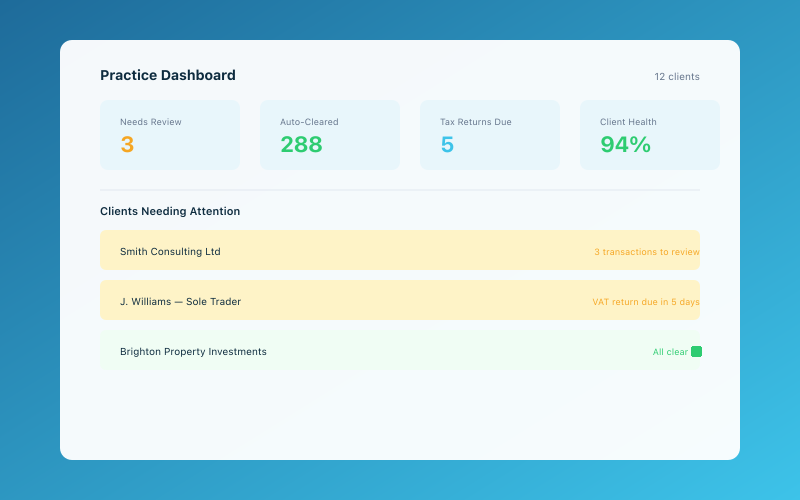 The Accounted practice dashboard — manage all your clients in one place
- Maximise practice value by addressing weaknesses that reduce sale price
- Develop internal successors who can take over gradually
- Transition client relationships smoothly rather than abruptly
- Optimise your personal tax position around the sale
- Choose the right exit route rather than taking whatever's available
A practice sold in a rush — perhaps due to ill health or sudden burnout — typically fetches 20-40% less than one sold as part of a planned transition. That difference could easily be £100,000 or more for a mid-sized practice. Starting early is literally worth money.
Understanding Your Exit Options
There are several routes out of a practice, each with different implications for price, timeline, and continuity.
External Sale to Another Practice
This is the most common exit route. You sell the practice (or a book of clients) to another firm, typically through a broker or direct approach.
Advantages:
- Clean break — you walk away with the proceeds
- Competitive bidding can maximise price
- Professional brokers handle the process
Considerations:
- Client retention post-sale is never guaranteed (buyers typically assume 10-20% attrition)
- Staff may face uncertainty or redundancy
- Cultural fit between practices matters enormously
- Non-compete clauses will restrict your future activities
Internal Succession
Selling or transitioning to an existing team member — whether a senior manager, associate, or junior partner — keeps the practice identity intact and provides the most continuity for clients and staff.
Advantages:
- Smoothest transition for clients and staff
- Successor already knows the business, clients, and systems
- Can be structured over several years for tax efficiency
- Practice culture and identity are preserved
Considerations:
- Finding a team member with both the ability and the capital to buy is challenging
- Financing the purchase may require earn-out arrangements
- The transition period requires patience and careful management
- Emotional dynamics can be complex (the founder letting go)
Merger
Merging with a complementary practice can create something greater than the sum of its parts, while allowing the retiring partner to exit gradually.
Advantages:
- Can enhance service offering and client retention
- Spreads risk across a larger entity
- Potential for genuine synergies (shared overheads, complementary skills)
- Gradual exit is more natural in a merger context
Considerations:
- Finding the right merger partner takes time
- Cultural integration is the most common point of failure
- Valuation negotiations can be contentious
- Legal and regulatory complexity
Managed Wind-Down
If the practice is small and no buyer or successor is available, a managed wind-down — transitioning clients to other practices over time — is a legitimate option.
Advantages:
- Full control over the process and timeline
- Can cherry-pick which practices receive which clients
- No need for complex sale negotiations
- Clients can be matched with appropriate new accountants
Considerations:
- No lump-sum payment — value is realised through ongoing fees until transition
- Requires careful communication with clients and staff
- Reputational considerations
- Can feel emotionally difficult
Valuing Your Practice
Understanding what your practice is worth is fundamental to succession planning. Accountancy practices in the UK are typically valued based on recurring fee income, with multipliers varying depending on several factors.
The Standard Approach
The most common valuation method is a multiple of Gross Recurring Fees (GRF). In 2026, typical multiples for UK accountancy practices are:
- 0.8-1.0x GRF for practices with older client demographics, desktop-based systems, or heavy dependence on the principal
- 1.0-1.2x GRF for well-run practices with a good client mix and reasonable systems
- 1.2-1.5x GRF for premium practices with strong growth, modern technology, young client base, and low principal dependence
So a practice with £300,000 in recurring fees might be valued anywhere from £240,000 to £450,000 depending on its characteristics.
What Increases Value
Client quality matters more than client quantity. A hundred sole traders paying £500 each is less valuable than twenty limited companies paying £2,500 each, because larger clients tend to be stickier and more profitable.
Low principal dependence is crucial. If every client relationship runs through you personally, the practice is worth less because there's significant attrition risk when you leave. Practices where clients have relationships with multiple team members are more valuable.
Modern technology and processes. A cloud-based, efficiently run practice is worth more than one running on legacy desktop software with manual processes. If your clients use modern tools like Accounted for their bookkeeping, and your practice runs on cloud-based management software, that's a positive signal to buyers. It's worth investing in moving your practice online well before you plan to sell.
Recurring revenue structure. Monthly standing order payments are more valuable than annual lump-sum billing. They demonstrate client commitment and provide predictable cash flow for the buyer.
Staff retention. A motivated, qualified team that will stay through the transition dramatically increases practice value. Our guide on staff retention is relevant here — the time to build a loyal team is years before you plan to exit.
Growth trajectory. A practice that's growing organically is worth more than one that's static or declining. Even modest growth of 5-10% per year makes a practice significantly more attractive.
What Decreases Value
- Heavy dependence on a single client (or a few large clients)
- Outdated technology and manual processes
- High client churn rates
- Ageing client base with limited new client acquisition
- Unresolved compliance issues or outstanding HMRC enquiries
- Staff who are likely to leave during transition
- Poor documentation of processes and procedures
Creating Your Succession Timeline
10 Years Before Exit
- Begin thinking about your preferred exit route
- Assess your practice's current strengths and weaknesses objectively
- Start addressing factors that reduce value (technology, processes, dependence on you)
- If considering internal succession, identify potential candidates
- Seek initial advice from a practice broker or specialist adviser
7 Years Before Exit
- Develop a formal succession plan document
- If pursuing internal succession, begin gradually increasing the successor's responsibilities
- Invest in technology upgrades and process improvements
- Start reducing your personal involvement in day-to-day client work
- Build broader client relationships across your team
5 Years Before Exit
- Commission a formal practice valuation
- If pursuing internal succession, discuss the plan openly with your chosen successor
- Begin financial planning for your retirement (pensions, investments, tax planning)
- Review and update engagement letters to ensure client contracts are transferable
- Consider taking on new clients specifically to improve the client mix
3 Years Before Exit
- Refine your succession plan based on current circumstances
- If selling externally, begin discreet conversations with potential buyers or appoint a broker
- Ensure all practice documentation, procedures, and systems are robust
- Reduce your personal client load further
- Communicate with key staff about the future (confidentially where necessary)
1 Year Before Exit
- Finalise terms with buyer/successor
- Begin client communication about the transition
- Complete legal documentation (sale agreement, non-compete clauses, earn-out terms)
- Plan handover of key client relationships
- Prepare personally for the emotional transition of leaving
The Emotional Side
Let's talk about something that succession planning guides rarely address: the emotional complexity of leaving a practice you've built.
Your practice is intertwined with your identity. For years, you've been "the accountant" to hundreds of clients. You've solved their problems, shared their successes, and supported them through difficult times. Walking away from that is genuinely hard, even when you're ready.
Common emotional challenges include:
- Loss of identity — "If I'm not an accountant, who am I?"
- Loss of purpose — The structure and meaning that work provides
- Fear of irrelevance — Worrying that the practice will thrive without you (which, ironically, is exactly what should happen)
- Difficulty letting go — Wanting to stay involved when the successor needs space to lead
- Grief — Yes, leaving a practice can trigger genuine grief, and that's completely normal
These feelings are universal and nothing to be embarrassed about. Planning for the emotional transition — developing hobbies, interests, and social connections outside of work — is just as important as the financial and legal planning.
Protecting Your Clients Through the Transition
Your clients trusted you with their financial affairs. You owe them a transition that respects that trust.
Tell clients about the transition personally — don't let them find out through the grapevine. For your most important clients, a face-to-face meeting or video call is appropriate. For others, a personal letter followed by an introduction to their new accountant works well.
Avoid announcing during the busiest compliance period — summer months are often ideal. Wherever possible, ensure that the team members clients already work with remain in place, and give clients the option to leave if they wish. Most will stay if the transition is handled well.
Getting Professional Help
Succession planning is not a DIY project. You'll benefit from:
- A specialist practice broker who understands accountancy practice valuations and knows the market
- A solicitor experienced in professional practice sales
- A tax adviser (ideally not yourself) to optimise the tax position of the sale
- A financial planner to ensure your retirement finances are in order
The cost of professional advice is modest compared to the value at stake. A broker alone can often achieve a sale price 10-20% higher than a private sale through their market knowledge and negotiation skills.
Start Today
If you've read this far and don't have a succession plan, you know what you need to do. You don't need to have every detail figured out — just start the process.
This week, ask yourself three questions:
- When do I want to stop working full-time?
- What would I like to happen to my practice when I do?
- What's the single biggest thing reducing my practice's value right now?
The answers will give you a starting point. Everything else flows from there.
The practices that achieve the best outcomes are the ones whose owners treated succession as a strategic priority, not an afterthought. Your future self — relaxing comfortably with the proceeds of a well-executed exit — will thank you for starting now.
Accounted helps UK sole traders stay on top of their bookkeeping and tax. Start your free 30-day trial at getaccounted.co.uk
Related reading:
- How to Grow Your Accountancy Practice in 2026
- Cloud Accounting — How to Move Your Practice Online
- Accountant Staff Retention Tips
Further Reading
- The Institute of Chartered Accountants in England and Wales (ICAEW) provides professional guidance for accountants.
- Stay up to date with Making Tax Digital requirements from HMRC.
Related Reading
- What to Bring to Your First Meeting With an Accountant
- Cross-Selling Services to Existing Clients — A Guide for Accountants
Learn about our free accountant portal and how it saves your practice time.
Accounted gives accountants a free practice portal — manage all your clients, file to HMRC, and let Penny handle the routine work. See the accountant portal →
Editorial & Research
The Accounted editorial team covers software comparisons, technology, and the tools UK sole traders need to run their businesses efficiently. All software comparisons are based on independent research and publicly available pricing.
Ready to try Accounted?
Join UK sole traders who are simplifying their bookkeeping and tax.
Start your 14-day free trial