Scaling Without Employees — How to Grow Using Contractors
Growth Does Not Have to Mean Becoming an Employer
There comes a point in many sole traders' journeys where the work outgrows the hours in the day. You are turning down projects, your turnaround times are slipping, or you simply cannot take on that larger contract because you are only one person.
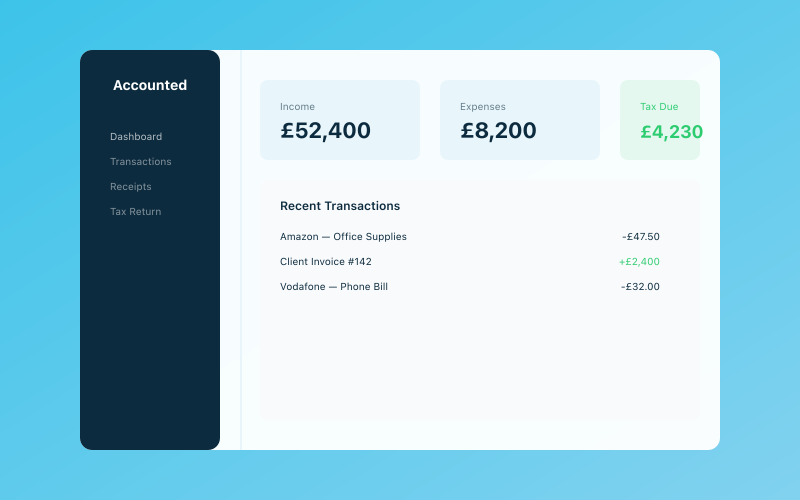 Your Accounted dashboard — income, expenses, and tax at a glance
The traditional answer is to hire employees. But for many sole traders, that leap comes with a mountain of obligations — PAYE, workplace pensions, employer's National Insurance, employment rights, HR responsibilities. It is a big step, and it is not always the right one.
The alternative? Scale using contractors and subcontractors. You get the extra capacity without the permanent overhead, and you keep the flexibility that made self-employment appealing in the first place.
Employee vs Contractor — The Critical Distinction
Before you engage anyone, you need to understand the difference between an employee and a contractor. Getting this wrong can be extremely costly.
What Makes Someone a Contractor
A genuine contractor is someone who:
- Controls how they do the work — You specify the outcome, but they decide how to achieve it
- Can send a substitute — They have the right to send someone else in their place
- Provides their own equipment — They use their own tools, software, and materials
- Takes financial risk — They bear the cost of correcting errors at their own expense
- Works for multiple clients — They are not dependent on you for all their income
- Invoices for their work — They submit invoices rather than being on a payroll
What Makes Someone an Employee
If you tell someone when to work, how to work, provide their equipment, pay them regularly, and they work exclusively for you — HMRC is likely to consider them an employee, regardless of what your contract says.
Why It Matters
If HMRC determines that your "contractor" is actually an employee, you could be liable for unpaid PAYE, employer's National Insurance (currently 13.8% on earnings above the secondary threshold), and penalties. This can be backdated for several years.
IR35 — The Rules You Must Know
IR35 is the legislation designed to catch "disguised employment" — situations where someone works like an employee but operates through an intermediary to gain tax advantages.
If your contractor works through their own limited company, IR35 becomes relevant. Since April 2021, medium and large businesses in the private sector have been responsible for determining the IR35 status of contractors they engage. However, as a sole trader or small business, the responsibility typically falls on the contractor themselves to assess their own status.
That said, you should still ensure your working arrangements genuinely reflect a contractor relationship. The substance of the relationship matters more than the paperwork.
HMRC's CEST Tool
HMRC provides a free Check Employment Status for Tax (CEST) tool online. While it is not perfect, running your arrangement through CEST gives you a documented starting point and shows HMRC that you have considered the issue.
CIS — Special Rules for Construction
If you are in the construction industry, the Construction Industry Scheme (CIS) adds another layer of obligations. Under CIS:
- You must register as a contractor with HMRC if you pay subcontractors more than £3 million per year (or in some cases, even at lower thresholds)
- You must verify each subcontractor with HMRC before paying them
- You must deduct tax at source (20% for registered subcontractors, 30% for unregistered ones) and pay it to HMRC
- You must submit monthly CIS returns
Even if you are a sole trader, if you use subcontractors in construction, you need to understand and comply with the CIS rules. The penalties for non-compliance are significant.
Finding Reliable Contractors
The quality of your contractors directly affects your reputation. Here is how to find good ones:
Your Network
The best contractors often come through personal recommendations. Ask fellow business owners, attend industry events, and build relationships before you need them urgently.
Freelance Platforms
Platforms like PeoplePerHour, Upwork, and Fiverr can be useful for finding specific skills. Look for contractors with strong reviews, verified portfolios, and clear communication. Start with a small test project before committing to larger work.
Industry-Specific Platforms
Many trades and professions have their own platforms. Bark, Checkatrade, and MyBuilder work for trades. Toptal is popular for developers. 99designs works for graphic design projects.
Social Media and LinkedIn
LinkedIn is increasingly useful for finding specialist contractors. Join industry groups, post about what you need, and check profiles carefully.
Local Business Networks
Do not overlook local networks, co-working spaces, and business groups. Local contractors can be easier to manage and often appreciate the face-to-face relationship.
Managing Remote Contractors
If your contractors work remotely — and many will — effective management becomes crucial.
Clear Briefs and Expectations
The single most important thing you can do is provide crystal-clear briefs. Specify the deliverable, the quality standard, the deadline, and the budget. Ambiguity leads to disappointment on both sides.
Communication Tools
Establish communication channels from the start. Slack, Microsoft Teams, or even WhatsApp groups work well for day-to-day communication. Email is fine for formal correspondence and documentation.
Project Management
Use tools like Trello, Asana, or Notion to track progress. These are free at the basic level and give both you and your contractors visibility of what needs doing and when.
Regular Check-ins
A brief weekly call or video chat keeps things on track without micromanaging. This is about alignment and support, not surveillance.
The Financial Side
Expenses for Contractor Payments
Payments to contractors are a legitimate business expense and reduce your taxable profit. You need to keep:
- Invoices from each contractor
- Evidence of payment
- The contract or agreement specifying the work
- Any correspondence about the engagement
Penny, the AI bookkeeper in Accounted, can help categorise contractor payments automatically, which keeps your records clean and makes your Self Assessment straightforward.
VAT Considerations
If you are VAT-registered and your contractor is also VAT-registered, you can reclaim the VAT on their invoices as input tax. If they are not VAT-registered, you cannot. Check whether your contractor charges VAT before agreeing on pricing.
Remember, if bringing on contractors pushes your total turnover above the VAT threshold of £90,000, you will need to register for VAT yourself.
Cash Flow Management
Contractors typically want paying promptly — often within 14 to 30 days. If your client pays you on 60-day terms but your contractor expects payment within 14 days, you have a cash flow gap to manage. Factor this into your pricing and cash flow planning.
Insurance Requirements
Public Liability Insurance
If your contractors work at client sites or interact with the public on your behalf, ensure they have their own public liability insurance. You should also check that your own policy covers work carried out by subcontractors on your behalf.
Professional Indemnity Insurance
For professional services, ensure your contractors have professional indemnity cover. If they make an error that affects your client, you need to know that the financial exposure is covered.
Employer's Liability Insurance
If HMRC or a court ever determines that your contractor was actually an employee, you could be in breach of employer's liability insurance requirements. This is another reason why getting the employment status right from the start is so important.
Contracts and Agreements
A written contract protects both parties. It does not need to be drafted by a solicitor — a clear, straightforward agreement will do. Include:
- Scope of work — What exactly is the contractor doing?
- Payment terms — How much, when, and how they will be paid
- Deadlines — When the work is due
- Intellectual property — Who owns the output?
- Confidentiality — Protecting your client information
- Substitution clause — The contractor's right to send a substitute (this also supports the contractor status)
- Termination — How either party can end the arrangement
Right of Substitution
Including a genuine right of substitution — where the contractor can send someone else to do the work — is one of the strongest indicators of a true contractor relationship. But it must be genuine, not just a clause that exists on paper.
When to Finally Hire
Contractors are brilliant for flexibility, but there are situations where hiring an employee becomes the better option:
- You need someone consistently full-time — If a contractor works for you five days a week, every week, the relationship starts looking like employment anyway
- You need to control how the work is done — Employees can be trained and managed more directly
- Loyalty and retention matter — Contractors may leave for better-paying work at short notice
- The cost difference narrows — When you factor in the reliability premium and recruitment costs of constantly finding new contractors, employment can work out similarly
- You want to build a team culture — Contractors are inherently transactional; employees can be part of something bigger
If you do decide to hire, you will need to set up PAYE, register as an employer with HMRC, arrange workplace pensions, and take on the full range of employment responsibilities.
Growing Smartly
Scaling with contractors gives you the best of both worlds — the capacity to take on more work without the permanent commitment of employment. It keeps your overheads variable, your structure flexible, and your administrative burden manageable.
Accounted helps you track contractor costs alongside your other expenses, giving you a clear view of your profitability and ensuring your records are ready for Making Tax Digital submissions. Because growing your business should feel exciting, not overwhelming.
Related reading
- IR35 — The Complete Guide for Contractors
- CIS Subcontractors and Deductions — Your Complete Guide
- Bootstrapping vs Funding — Why Most Sole Traders Don't Need Investors
Related Reading
Start your free trial and see how Accounted simplifies your bookkeeping.
Accounted keeps your books sorted automatically so you can focus on running your business. See Accounted →
Business & Operations Advisors
Our business advisors cover the practical side of running a UK sole trader business — from HMRC registration to managing growth. Content is written for real business owners in plain English, not accountants.
Ready to try Accounted?
Join UK sole traders who are simplifying their bookkeeping and tax.
Start your 14-day free trial