Building a Niche Accountancy Practice — Why Specialising Wins
When you're starting or growing an accountancy practice, the natural instinct is to cast the widest net possible. Take on anyone who needs an accountant. Sole traders, limited companies, charities, partnerships, landlords — the lot. More potential clients equals more revenue, right?
In theory, perhaps. In practice, generalist accountancy firms are increasingly finding themselves in a race to the bottom on price, struggling to differentiate themselves from the thousands of other practices offering exactly the same thing. Meanwhile, firms that specialise in specific industries or client types are commanding premium fees, generating referrals effortlessly, and building reputations that generalists can only dream of.
Specialisation isn't just a marketing strategy — it's a fundamentally different way of building and running an accountancy practice. Let's explore why it works and how to do it well.
The Case for Specialisation
You Become the Expert
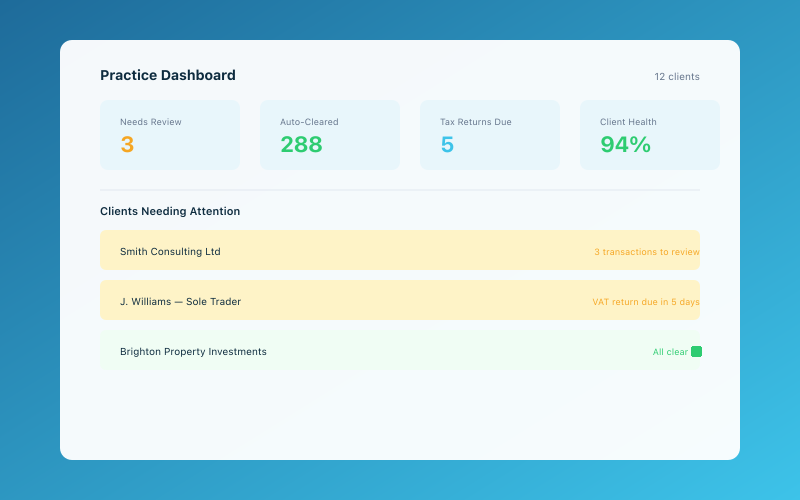 The Accounted practice dashboard — manage all your clients in one place
When you focus on a specific niche, you develop deep expertise that generalists simply can't match. You learn the industry's specific tax reliefs, regulatory requirements, common business models, and typical financial challenges. You understand the seasonal cash flow patterns, the standard benchmarks, and the pitfalls that trip people up.
This expertise makes you genuinely more valuable to clients. A landlord doesn't just want someone who can prepare their tax return — they want someone who understands Section 24 mortgage interest restrictions, capital gains tax on property disposals, furnished holiday lettings rules, and the differences between individual and company ownership structures. A generalist will get the compliance work done. A specialist will save them thousands of pounds through proactive advice.
You Can Charge More
This follows naturally from expertise. When you're known as the go-to accountant for a particular sector, you're no longer competing on price against every other practice in town. You're offering something genuinely different, and clients will pay a premium for that.
Research consistently shows that specialist professionals command fees 20-40% higher than generalists. That's not a small difference — on a practice turning over £200,000, specialisation could add £40,000 to £80,000 to your top line. And because you're working with similar clients, your processes become more efficient, so your profit margins improve too. For more on structuring your fees, our piece on pricing accountancy services covers the fundamentals.
Marketing Becomes Easier
Try marketing a generalist accountancy practice and you'll quickly discover how difficult it is. Your message is necessarily vague: "We help businesses with their accounts and tax." So does everyone else. What makes you different?
With a niche, marketing becomes laser-focused. You know exactly who you're talking to, where they hang out, what publications they read, what events they attend, and what problems keep them up at night. Your content speaks directly to their concerns. Your case studies are immediately relevant. Your referral network is concentrated and powerful.
A specialist practice serving freelance IT contractors, for instance, might write blog posts about IR35, sponsor a tech meetup, and build relationships with recruitment agencies. Every marketing pound is targeted and efficient.
Referrals Flow Naturally
In a niche market, word travels fast. When you do excellent work for one client, they tell others in the same industry. "You need to speak to Sarah — she's an accountant who really understands construction businesses." This kind of warm referral is worth more than any amount of advertising.
Generalist referrals are weaker: "My accountant's pretty good." Specialist referrals carry authority: "My accountant is THE expert in our sector."
Choosing Your Niche
This is where most accountants get stuck. How do you decide which niche to pursue?
Start With What You Know
Look at your existing client base. Is there a cluster of clients in a particular industry? If you already have eight clients in the creative industries, that's not a coincidence — it's a foundation to build on. You already have some sector knowledge, some relevant contacts, and some track record to point to.
Consider Market Size and Growth
A niche needs to be large enough to sustain your practice but small enough that you can realistically become a recognised name within it. "Restaurants" is too broad. "Michelin-starred restaurants" is too narrow. "Independent restaurants and cafes in the South East" might be just right.
Think about sectors that are growing rather than declining. In 2026, niches with strong potential include:
- E-commerce and online retail — Still growing rapidly
- Creative freelancers and content creators — An exploding market with specific tax needs
- Property investors and landlords — Complex and evolving tax landscape
- Healthcare professionals — Dentists, GPs, pharmacists, and allied health
- Technology startups — R&D tax credits, EMI schemes, investor readiness
- Trades and construction — CIS, VAT reverse charges, subcontractor issues
- Sole traders using digital tools — A growing segment who want tech-forward advice
Assess Your Passion
You're going to spend a lot of time immersed in this sector. If you find it mind-numbingly dull, you won't last. Pick something you're genuinely interested in or at least curious about. The best niche accountants are the ones who find their sector fascinating.
Evaluate the Competition
Is anyone else specialising in this niche in your area? If not, that could be an opportunity. If there's already an established specialist, you'll need to find a way to differentiate — perhaps by sub-niching further or targeting a different geographic region.
Building Your Niche Practice Step by Step
Phase 1: Research and Positioning (Months 1-3)
Don't announce your niche on day one. Start by deepening your knowledge:
- Join industry associations and attend sector events
- Subscribe to trade publications and podcasts
- Study the specific tax and regulatory issues affecting the sector
- Talk to existing clients in the niche about their challenges and needs
- Research the competition and identify gaps in the market
Simultaneously, start positioning your brand. Update your website to include sector-specific pages. Write your first few blog posts addressing niche-specific topics. Adjust your LinkedIn profile to mention the sector.
Phase 2: Content and Visibility (Months 3-6)
Now start making noise. Create content that demonstrates your sector expertise:
- Blog posts addressing specific industry tax issues
- Guides and checklists for businesses in the sector
- Case studies (with client permission) showing results you've achieved
- Social media content commenting on industry news and regulatory changes
Attend industry events — not accounting events. Your ideal clients aren't at accountancy conferences. They're at trade shows, networking groups, and sector-specific meetups.
Phase 3: Network and Referral Building (Months 6-12)
Build relationships with other professionals who serve your niche:
- Solicitors who specialise in the same sector
- Industry-specific mortgage brokers or financial advisers
- Trade association contacts
- Complementary service providers (bookkeepers, HR consultants, insurance brokers)
These relationships become mutual referral channels that compound over time.
Phase 4: Productise Your Services (Months 12-18)
Once you deeply understand your niche, create standardised service packages tailored to that sector. For example, a practice specialising in freelance IT contractors might offer:
- Contractor Compliance Package — Annual accounts, tax return, IR35 review, and quarterly VAT
- Contractor Growth Package — Everything above plus management accounts, pension advice, and tax planning
- New Contractor Setup — Company formation, VAT registration, PAYE registration, and first-year compliance
Productised services are easier to sell, easier to deliver, and easier to scale. They also make your pricing structure much cleaner.
Common Objections (and Why They're Wrong)
"I'll lose all my non-niche clients"
No, you won't — at least, not immediately. Specialising doesn't mean turning away existing clients. It means focusing your marketing and growth efforts on a specific sector. Your existing clients will stay as long as you continue to serve them well. Over time, you might naturally transition away from work that doesn't fit, but that's a choice you make when you're ready.
"What if the niche dries up?"
This is a fair concern, which is why market research matters. Choose a sector with long-term viability, and stay alert to changes. If you do need to pivot eventually, the skills and processes you've built will transfer to a new niche more easily than you'd think. The practice of specialising is itself a transferable skill.
"My area is too small for a niche practice"
Geography matters less than it used to. With cloud accounting, video calls, and digital document exchange, you can serve clients anywhere in the UK. A practice based in Exeter can specialise in serving London-based tech startups without any difficulty. Tools like Accounted make it straightforward for sole trader clients to share records digitally regardless of where they're based.
"I don't know enough about any specific sector"
You don't need to be an expert on day one. You need to be willing to learn and committed to developing expertise over time. Most accountants who've built successful niche practices started with only slightly more sector knowledge than average. What set them apart was the decision to go deep.
Real Examples of Niche Success
While we won't name specific firms, here are real models that work brilliantly in the UK:
- A Manchester firm serving only dental practices — They understand NHS pension schemes, associate contracts, and practice valuations. Dentists seek them out from across the country.
- A London sole practitioner specialising in freelance journalists and authors — Deep knowledge of creative industry tax reliefs, royalty income, and HMRC rules around trading vs hobby income.
- A Bristol practice focused on property investors — Expert in Section 24, capital allowances, CGT calculations, and company vs personal ownership structures.
- An Edinburgh firm serving tech startups — Specialists in R&D tax credits, EMI share schemes, SEIS/EIS investment rounds, and investor-ready financial reporting.
Each of these practices commands premium fees and receives the majority of new clients through referrals and organic search. They barely need to advertise. That's the power of being known for something specific.
Getting Started Today
If specialisation appeals to you, you don't need to make a dramatic overnight change. Start small:
- Analyse your current client base — where are the clusters?
- Pick the most promising sector and commit to learning more about it
- Create one piece of sector-specific content this month
- Attend one industry event this quarter
- Tell your existing niche clients that you're developing deeper expertise in their sector (they'll be delighted)
The practices that thrive in 2026 and beyond won't be the ones trying to be everything to everyone. They'll be the ones that chose their lane, committed to it, and became genuinely brilliant at serving a specific market. For broader guidance on growing your practice, that specialisation decision is often the single most impactful move you can make.
Accounted helps UK sole traders stay on top of their bookkeeping and tax. Start your free 30-day trial at getaccounted.co.uk
Related reading:
- How to Grow Your Accountancy Practice in 2026
- Pricing Your Accountancy Services — Fixed Fee vs Hourly
- Starting a Bookkeeping Practice Guide
Related Reading
- How to Handle Clients Who Won't Provide Their Records
- Training Junior Accountants — A Practice Owner's Guide
Accounted gives accountants a free practice portal — manage all your clients, file to HMRC, and let Penny handle the routine work. See the accountant portal →
Editorial & Research
The Accounted editorial team covers software comparisons, technology, and the tools UK sole traders need to run their businesses efficiently. All software comparisons are based on independent research and publicly available pricing.
Ready to try Accounted?
Join UK sole traders who are simplifying their bookkeeping and tax.
Start your 14-day free trial