How to Handle Clients Who Won't Provide Their Records
Every accountant knows the feeling. The deadline is approaching, you've sent three emails, left two voicemails, and maybe even resorted to a text message. And still — nothing. The records you need are sitting in a carrier bag somewhere, or on a laptop the client hasn't opened since January, or simply existing as a vague intention that "I'll get round to it this weekend."
Clients who won't provide their records are the single biggest source of stress in most accounting practices. It's not just inconvenient — it creates a cascade of problems. Your workflow gets disrupted, other clients' work gets delayed, your team sits idle waiting for information, and when everything finally arrives in a panicked rush, you're expected to perform miracles with compressed timescales.
The good news? While you can't force clients to be organised, there are plenty of strategies that genuinely work to improve the situation. Let's dig into them.
Understanding Why Clients Don't Provide Records
Before you can fix the problem, it helps to understand what's behind it. In our experience, clients who don't provide records typically fall into one of a few categories:
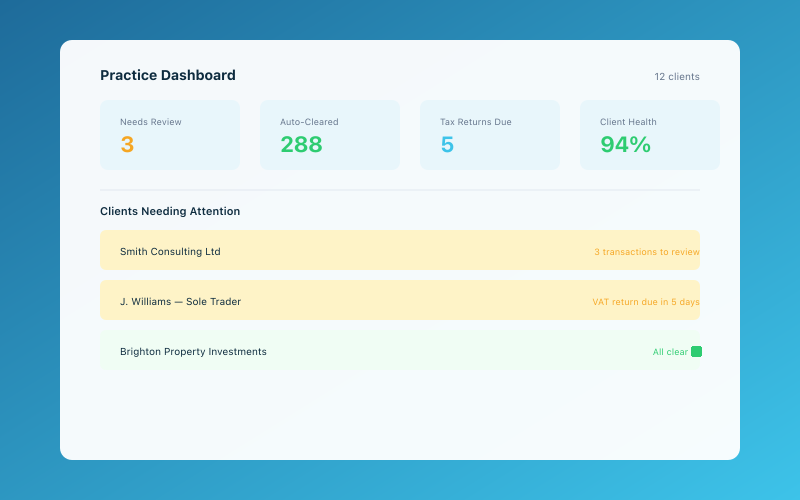 The Accounted practice dashboard — manage all your clients in one place
The Overwhelmed
These clients aren't being difficult on purpose. They're running a business, managing staff, dealing with customers, and bookkeeping falls to the bottom of an ever-growing to-do list. They know they need to send you their records. They feel guilty about not having done it. But every time they think about tackling it, something more urgent comes along.
The Disorganised
Some clients genuinely don't have a system for keeping records. Receipts are scattered across jacket pockets, glove compartments, and kitchen drawers. Bank statements arrive digitally but never get downloaded. Sales are tracked on scraps of paper that may or may not still exist.
The Avoiders
A small but significant minority of clients avoid providing records because they're worried about what the numbers will show. Perhaps they suspect they owe more tax than they can afford, or they're embarrassed about a bad year, or there are transactions they'd rather not explain. The avoidance is psychological, not logistical.
The Unbothered
Then there are clients who simply don't see the urgency. They don't understand filing deadlines, don't appreciate the consequences of late submission, and assume that because they've hired an accountant, everything will somehow sort itself out. These clients aren't malicious — they're just blissfully unaware.
Understanding which category a client falls into helps you choose the right approach. The overwhelmed need simplification. The disorganised need systems. The avoiders need reassurance. The unbothered need education.
Prevention Is Better Than Cure
The best time to address record-gathering problems is before they start — ideally during client onboarding.
Set Expectations From Day One
Your engagement letter and welcome pack should spell out exactly what records you need, in what format, and by when. Be specific. "Please provide your records in a timely manner" is meaningless. "Please provide your bank statements, sales invoices, and purchase receipts for each quarter within 30 days of the quarter end" is actionable.
Build Record-Keeping Into Your Service
If you're advising sole traders and small businesses, consider making basic bookkeeping guidance part of your onboarding. Spend 30 minutes showing a new client how to keep records properly. Recommend software that makes it easy — tools like Accounted, for example, allow sole traders to connect their bank feed and categorise transactions as they go, which means the records are essentially ready when you need them.
Create a Calendar of Deadlines
Send every client a simple calendar at the start of the year showing:
- When you need their records by
- What you need at each point
- What the statutory filing deadline is
- What happens if the deadline is missed (penalties, interest)
Pin this to the top of their client file and reference it in every reminder.
Communication Strategies That Actually Work
When prevention hasn't been enough and you're chasing records, how you communicate matters enormously. Here are approaches that consistently get better results than the standard "gentle reminder" email.
Be Specific, Not Vague
Instead of "Please send your records when you get a chance," try: "To complete your 2025/26 tax return, I need three things: your bank statements from 6 April 2025 to 5 April 2026, your mileage log, and the rental income statement from your letting agent. Could you send these by Friday 15 August?"
Specific requests feel more manageable than open-ended ones. The client knows exactly what to do and by when.
Explain the Consequences
Many clients don't respond because they don't understand the urgency. Be frank about what happens if records arrive late:
- "HMRC charges a £100 penalty if your tax return is filed after 31 January"
- "Late filing can trigger an HMRC investigation"
- "If we receive your records after 30 November, we may not be able to complete your return before the deadline and a surcharge of £X will apply"
This isn't about threatening clients — it's about making sure they have the information they need to prioritise appropriately.
Use Multiple Channels
If emails aren't getting responses, try something different:
- Phone call — Sometimes a two-minute conversation achieves what five emails couldn't
- Text message — Short, direct, and harder to ignore than email
- Client portal notification — If your practice management software has one
- Video call — Offer to walk them through what you need in a quick screen share
For more on effective client communication, our communication tips guide goes into much more detail.
The Graduated Approach
Structure your reminders with escalating urgency:
- 8 weeks before deadline — Friendly reminder with specific list of what's needed
- 6 weeks before deadline — Follow-up noting the approaching deadline
- 4 weeks before deadline — Firmer note explaining consequences of late submission
- 2 weeks before deadline — Final warning, potentially with a phone call
- 1 week before deadline — Written notice that you may not be able to meet the filing deadline
Document every communication. You need a clear trail showing that you made reasonable efforts to obtain the information.
Practical Solutions to Make Record-Gathering Easier
Sometimes the issue isn't willingness but capability. Making the process as frictionless as possible removes excuses and genuinely helps clients who are struggling.
Offer a Bookkeeping Add-On
If a client consistently fails to keep records, suggest adding basic bookkeeping to your service. Yes, this increases their fees, but it also solves the problem permanently. Frame it as a benefit: "Rather than you spending evenings sorting receipts, we can handle the bookkeeping monthly and have everything ready for year-end."
Recommend Bank Feed Software
Cloud accounting software with automatic bank feeds eliminates the most painful part of record-keeping. When transactions are pulled in automatically and the client just needs to categorise them, the barrier drops dramatically. Tools like Penny within Accounted even use AI to suggest categories, making it even simpler for sole traders.
Provide a Simple Upload Portal
Give clients a dead-simple way to send you files. A client portal where they can drag and drop documents is far better than asking them to email attachments or — heaven forbid — post things to you.
Schedule Regular Check-Ins
For problematic clients, a monthly or quarterly check-in call can work wonders. It creates a recurring commitment, prevents records from piling up, and gives you early warning of any issues.
When Nothing Works — The Difficult Conversation
Despite your best efforts, some clients will remain persistently unresponsive. At some point, you need to have a direct conversation about the situation.
Frame It as a Partnership Issue
"We want to do the best possible job for you, but we can only work with the information we have. When records arrive late, it limits our ability to find savings and plan effectively. How can we make this process easier for you?"
This avoids blame while making the impact clear.
Consider a Late Fee
Some practices charge a surcharge for records that arrive after the agreed deadline. This is perfectly reasonable — late records disrupt your workflow and often require overtime or rush work. Make sure any late fee policy is clearly stated in your engagement letter.
Know When to Let Go
This is hard, but sometimes the kindest thing for your practice is to disengage from a client who consistently won't provide records. A client who doesn't engage with the process takes up a disproportionate amount of your time and mental energy. That's time you could spend on clients who value your services and reducing churn from the ones you actually want to keep.
If you do decide to disengage, do it professionally:
- Give reasonable notice (at least three months is standard)
- Offer to help them find a new accountant
- Ensure all work up to the disengagement date is complete
- Follow your professional body's guidance on disengagement procedures
Protecting Yourself
Regardless of the strategies you employ, always protect your position:
- Document everything — Keep copies of every reminder, request, and communication
- Note conversations — Log phone calls with date, time, and summary
- Use your engagement letter — Reference the client's obligations when chasing
- File on time where possible — Even estimated returns are better than no returns in many cases (though discuss this with the client first)
- Consider professional guidance — If a situation is becoming particularly difficult, your professional body can advise
Building a Culture of Compliance
The ultimate goal is to create a practice culture where providing records on time is simply what clients do — not something they're constantly nagged about.
This takes time, but it's achievable through:
- Consistent messaging from the very first interaction
- Making the process as easy as possible with the right technology
- Celebrating clients who provide records promptly (a simple "thank you" goes a long way)
- Being firm and fair when records are late
- Building genuine relationships where clients want to stay on top of things because they respect you and value the service
The practices that crack this problem are the ones that grow most efficiently. When your workflow runs smoothly because records arrive on time, you can take on more clients, deliver better service, and actually enjoy the work.
Accounted helps UK sole traders stay on top of their bookkeeping and tax. Start your free 30-day trial at getaccounted.co.uk
Related reading:
- Accountant Client Onboarding Best Practices
- Accountant Client Communication Tips
- How to Reduce Client Churn in Your Accounting Practice
Related Reading
- Automating Client Onboarding — A Practical Guide for Practices
- Building a Referral Programme for Your Accounting Practice
Learn about our free accountant portal and how it saves your practice time.
Accounted gives accountants a free practice portal — manage all your clients, file to HMRC, and let Penny handle the routine work. See the accountant portal →
Editorial & Research
The Accounted editorial team covers software comparisons, technology, and the tools UK sole traders need to run their businesses efficiently. All software comparisons are based on independent research and publicly available pricing.
Ready to try Accounted?
Join UK sole traders who are simplifying their bookkeeping and tax.
Start your 14-day free trial