How to Handle Late-Paying Clients (Without Ruining Relationships)
It's one of the most frustrating parts of being a sole trader. You've done the work, sent the invoice, and waited patiently for payment. The due date comes and goes. Then a week passes. Then two. Meanwhile, your own bills don't stop arriving.
Late payments are a chronic problem for UK small businesses and freelancers. According to industry surveys, the average small business is owed thousands in overdue invoices at any given time. For sole traders without a financial cushion, even one late payment can cause serious cash flow stress.
The good news? There are proven strategies for getting paid on time — and for chasing overdue invoices firmly without torching valuable client relationships. Let's work through them.
Why Clients Pay Late (It's Not Always Malicious)
Before you draft that angry email, it helps to understand why payments are delayed. In most cases, it's not because the client is trying to avoid paying you. Common reasons include:
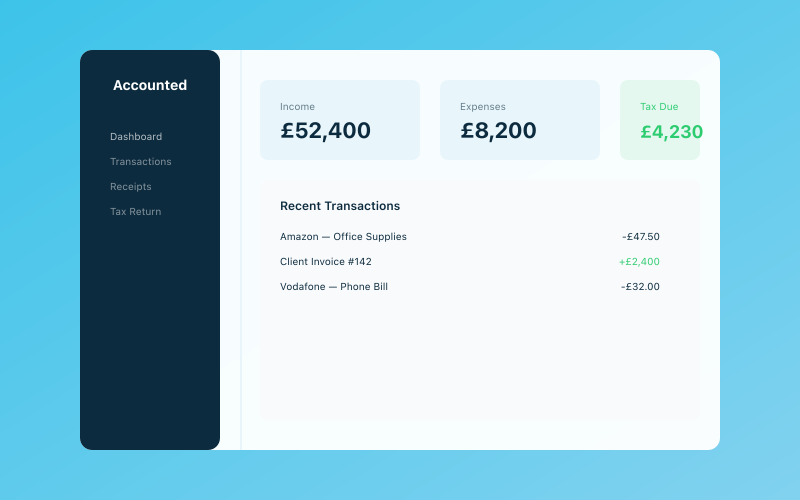 Your Accounted dashboard — income, expenses, and tax at a glance
- Disorganised accounts processes — Especially in larger companies where your invoice might sit in an approval queue
- Cash flow issues on their end — They might be waiting to get paid by their own clients
- Invoice went to the wrong person — It's sitting in someone's inbox who doesn't handle payments
- Genuinely forgot — Life happens, especially for small business clients juggling their own workload
- Dispute with the work — They're unhappy with something but haven't told you
Understanding the reason helps you choose the right response. A gentle reminder works for a forgetful client; a more structured approach is needed for someone with systemic payment issues.
Prevention: Setting the Stage for On-Time Payments
The best way to handle late payments is to prevent them in the first place. Here are strategies that significantly reduce the chances of delays:
Clear payment terms from the start
Before you begin any work, make sure your payment terms are crystal clear. Include them in your proposal, contract, and on every invoice:
- When payment is due (e.g., 14 days from invoice date)
- Accepted payment methods
- Late payment fees (if applicable)
- Any deposit or milestone payment requirements
Don't assume clients know your terms — spell them out explicitly. "Payment due within 14 days of invoice date" leaves no room for ambiguity.
Request deposits for larger projects
For any substantial piece of work, asking for a deposit upfront is entirely reasonable. Common structures include:
- 50/50 — Half upfront, half on completion
- Thirds — A third upfront, a third at midpoint, a third on completion
- Milestone-based — Payments tied to specific deliverables
Deposits reduce your financial exposure and demonstrate the client's commitment to the project. If a client refuses to pay any deposit at all, consider that a red flag.
Invoice immediately
Don't wait days or weeks after completing work to send your invoice. Invoice the same day if possible — or ideally, have your invoice ready to send the moment the work is delivered. The longer you wait, the less urgent payment feels to the client.
For detailed guidance on creating invoices that get paid, see our guide on how to invoice correctly in the UK.
Make it easy to pay you
The harder it is to pay you, the longer it takes. Include clear bank details on every invoice, and consider offering multiple payment options:
- Bank transfer (include sort code, account number, and reference)
- Online payment via a link (Stripe, GoCardless, PayPal)
- Card payment
Online payment links are particularly effective — clients can pay with a single click rather than manually entering bank details.
The Chase: A Step-by-Step Approach
Despite your best efforts, some invoices will inevitably go overdue. Here's a measured escalation approach that balances firmness with professionalism:
Day of the due date: Friendly reminder
Send a brief, polite reminder on the day the invoice falls due. Keep it light — this is a nudge, not a demand.
Example:
Hi [Name],
Just a quick note to let you know that invoice [number] for £[amount] is due today. I've attached a copy for your records. Please let me know if you have any questions or if there's anything you need from me to process payment.
Thanks!
Many clients genuinely forget, and a same-day reminder is often all it takes. Automatic payment reminders through your invoicing software can handle this without you having to think about it.
Day 7: Firmer follow-up
If a week has passed with no payment and no communication, it's time for a more direct follow-up.
Example:
Hi [Name],
I'm following up on invoice [number] for £[amount], which was due on [date]. I haven't yet received payment or heard back from my previous message. Could you let me know when I can expect this to be settled?
If there's an issue with the invoice or the work, I'm happy to discuss it.
Thanks,
The key phrase here is "could you let me know when I can expect this to be settled?" — it requests a specific commitment rather than a vague acknowledgement.
Day 14: Phone call
If emails aren't getting a response, pick up the phone. A phone call is harder to ignore than an email and often resolves the situation quickly. Keep the tone professional but direct.
Having the conversation verbally often reveals the real reason for the delay — and gives you the chance to agree a payment plan or resolve any issues face to face (or voice to voice, at least).
Day 21: Formal letter
If phone calls go unanswered, send a formal written notice. This should clearly state:
- The amount owed and original due date
- The number of previous reminders sent
- A final deadline for payment (e.g., 7 days from the date of the letter)
- The consequences of non-payment (see below)
Day 30+: Escalation
If all else fails, you have several options:
Late payment interest and compensation
Under the Late Payment of Commercial Debts (Interest) Act 1998, you have the legal right to charge interest on overdue invoices at 8% above the Bank of England base rate, plus a fixed compensation amount:
- £40 for debts up to £999.99
- £70 for debts between £1,000 and £9,999.99
- £100 for debts of £10,000 or more
You don't need to have stated this in your contract — it's a statutory right. However, mentioning it in your payment terms serves as a useful deterrent.
Mediation
For ongoing client relationships you want to preserve, mediation can help resolve payment disputes without going to court. Services like the Centre for Effective Dispute Resolution (CEDR) offer mediation for commercial disputes.
Small claims court
For debts up to £10,000, you can make a claim through the Money Claims Online service. The process is straightforward, and court fees are relatively low (starting at £35 for claims up to £300). Many debtors pay up once they receive the court papers, without the case ever reaching a hearing.
Debt collection agency
As a last resort, you can instruct a debt collection agency. They typically charge a percentage of the recovered amount (10–25%), but they handle all the chasing on your behalf.
Protecting Your Cash Flow
While you're dealing with late payers, your own bills don't stop. Here are some strategies for maintaining healthy cash flow even when payments are delayed:
Build a cash buffer
Aim to have at least one to two months of business expenses saved as a cash buffer. This gives you breathing room when payments are late and stops you from making desperate decisions.
Diversify your client base
If one client accounts for 50% or more of your income, a late payment from them can be devastating. Try to spread your income across multiple clients so that no single late payment threatens your ability to pay your own bills.
Set aside tax money immediately
When payments do arrive, transfer your tax allocation straight away. The last thing you need when chasing late payments is to discover you've spent money earmarked for HMRC. For the 2025/26 tax year, setting aside 25–30% of your profit for Income Tax and National Insurance is a sensible starting point. Remember, the personal allowance is £12,570 — you won't pay tax on earnings up to that amount — and the basic rate is 20% on income from £12,571 to £50,270.
Keep your records current
Tracking overdue invoices becomes much easier with proper bookkeeping software. With Accounted, you can see your outstanding invoices at a glance, set up automatic payment reminders, and monitor your cash flow position in real time. Penny even flags overdue invoices so nothing falls through the cracks.
Red Flags: Clients to Watch Out For
Over time, you'll develop an instinct for clients who are likely to be problematic payers. Watch out for:
- Clients who negotiate aggressively on price before work begins
- Those who are vague about payment terms or try to extend them after agreeing
- Clients who frequently dispute invoices for minor reasons
- Those who always have an excuse for delayed payment
- Clients who refuse to sign contracts or agree to written terms
Trust your gut. If something feels off about a new client, ask for full payment upfront or a substantial deposit before committing your time.
When to Walk Away
Sometimes, the right move is to stop working with a chronically late-paying client entirely. If a client consistently pays late despite your best efforts, the cost of chasing payments — in time, stress, and cash flow disruption — may outweigh the value of their business.
It's never easy to turn away income, especially when you're building your business. But replacing a problematic client with one who pays on time is almost always worth it in the long run. Your time and energy are better spent on clients who value your work enough to pay for it promptly.
Wrapping Up
Late payments are an unfortunate reality of self-employment, but they don't have to define your experience. With clear terms, prompt invoicing, systematic follow-up, and the right tools, you can significantly reduce payment delays — and handle the ones that do occur without damaging important relationships.
The key is to be proactive rather than reactive. Set expectations early, follow up promptly, and don't be afraid to enforce your terms. You've earned that money — there's nothing unreasonable about expecting to receive it on time.
Accounted helps UK sole traders stay on top of their bookkeeping and tax. Start your free 30-day trial at getaccounted.co.uk.
Related reading:
- Getting Paid Faster as a Small Business
- How to Invoice Correctly in the UK
- Cash Flow Management for Sole Traders
Related Reading
- How to Deal With Scope Creep (And Protect Your Profits)
- Sustainable Business Practices That Also Save You Money
Start your free trial and see how Accounted simplifies your bookkeeping.
Accounted keeps your books sorted automatically so you can focus on running your business. See Accounted →
Business & Operations Advisors
Our business advisors cover the practical side of running a UK sole trader business — from HMRC registration to managing growth. Content is written for real business owners in plain English, not accountants.
Ready to try Accounted?
Join UK sole traders who are simplifying their bookkeeping and tax.
Start your 14-day free trial