How to Deal With Scope Creep (And Protect Your Profits)
You know the feeling. You agreed to design a logo, and now you're also creating business cards, letterheads, social media banners, and "just a quick website mockup." You quoted for a three-page report, and now you're on version seven with a client who keeps adding "one more thing." The project that was supposed to take two weeks is entering its second month, and you're working far more hours than you're getting paid for.
That's scope creep. And if you're a freelancer or sole trader, it's one of the biggest threats to your profitability and your sanity.
In this guide, we'll look at why scope creep happens, how to spot it early, and practical strategies for dealing with it — without damaging your client relationships.
What Is Scope Creep, Exactly?
Scope creep is the gradual expansion of a project beyond its original boundaries. It happens when additional work, features, revisions, or deliverables get added to a project without a corresponding increase in time, budget, or resources.
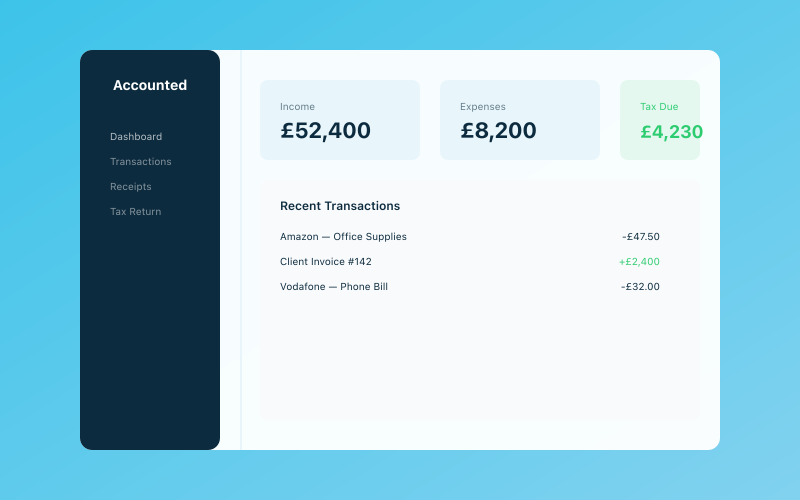 Your Accounted dashboard — income, expenses, and tax at a glance
It usually starts small. A client asks for "just a tiny tweak" or "one more page" or "a quick favour." Individually, each request seems minor — hardly worth pushing back on. But they accumulate, and before you know it, you're doing significantly more work than you originally agreed to, for the same fee.
The insidious thing about scope creep is that it often happens with the best of intentions. The client isn't trying to exploit you (usually). They're excited about the project, they have new ideas, or they didn't fully think through what they needed at the start. And you, eager to please and reluctant to seem difficult, say yes to everything.
The result? You earn less per hour than planned, the project drags on longer than expected, and you end up feeling resentful — which is bad for the client relationship you were trying to protect in the first place.
Why Does It Happen?
Understanding the root causes helps you prevent scope creep before it starts:
Vague briefs. If the project scope isn't clearly defined at the outset, there's no agreed boundary to creep beyond. When the brief is "make us a website" rather than "create a five-page website with these specific sections," anything goes.
No written agreement. If the scope, timeline, and deliverables aren't documented in a proposal or contract, it becomes very difficult to point to what was agreed. Verbal agreements are easily forgotten or reinterpreted.
Wanting to please. Freelancers are often people-pleasers by nature. We want clients to be happy, and saying no feels uncomfortable. But consistently saying yes to extras without adjusting the price doesn't make clients happy in the long run — it makes them expect free work.
Unclear change processes. If there's no agreed process for handling requests that fall outside the original scope, every "can you also..." becomes a negotiation. Having a system makes these conversations much easier.
Client uncertainty. Sometimes clients don't know exactly what they want until they see work in progress. Their feedback evolves, priorities shift, and the project morphs into something different from what was originally discussed.
How to Spot Scope Creep Early
The earlier you catch scope creep, the easier it is to manage. Watch out for these warning signs:
- "While you're at it..." — the classic scope creep phrase. The client asks you to do something extra while you're already working on the project, making it seem small and convenient.
- "Can we just..." — the word "just" is doing a lot of heavy lifting here. It minimises the request, making it seem trivial even when it isn't.
- Moving goalposts — the client changes what "done" looks like. The deliverables shift, the success criteria evolve, or the project keeps getting extended.
- Revision after revision — if you're on your fifth round of revisions and the client is still not happy, the project has almost certainly expanded beyond its original scope.
- Your hours don't match your quote — if you quoted 20 hours and you're already at 25 with no end in sight, scope creep is the likely culprit.
Track your time carefully on every project. If you don't know how long things are taking, you can't know when you're over-delivering. Time tracking doesn't have to be complicated — even a simple note in your calendar or a basic timer app will do.
Prevention: Setting the Stage
The best way to deal with scope creep is to prevent it. Here's how:
Write a Clear Proposal
Before starting any project, create a written proposal or statement of work that clearly defines:
- Deliverables — exactly what you'll produce (e.g., "one logo design in three colour variations, delivered as PNG and SVG files")
- Revisions — how many rounds of revisions are included (e.g., "two rounds of revisions included; additional revisions charged at £[X] per round")
- Timeline — when each stage will be completed and when the project will be finished
- What's not included — sometimes it's helpful to explicitly state what falls outside the scope (e.g., "this quote does not include print production, social media assets, or website implementation")
- Price — the total fee, broken down by stage or deliverable if appropriate
Get the client to agree to this in writing before you start. An email confirmation is the minimum; a signed contract is better.
Set Boundaries From Day One
Boundaries aren't about being difficult — they're about setting expectations. From the very first conversation, be clear about how you work, what's included, and what happens if the scope changes.
For more on this, our guide on setting boundaries with clients goes into much more detail.
Include a Change Request Process
Build a simple change request process into your proposal. Something like:
"Any work requested beyond the scope described in this proposal will be quoted separately. I'll provide a cost estimate for any additional work before proceeding, so there are no surprises."
This doesn't have to be formal or legalistic. It just needs to be clear. When a client asks for something extra, you can simply say: "That's a great idea — it's outside the original scope, so let me put together a quick quote for that."
Dealing With Scope Creep in Real Time
Even with the best prevention, scope creep can still happen. Here's how to handle it when it does:
Name It Early
The moment you notice a request that falls outside the original scope, flag it. Don't let it slide and hope it'll be the last one. A simple, non-confrontational approach works best:
"That sounds like a great addition. It's not something we included in the original brief, so let me have a think about what it would involve and come back to you with a cost and timeline."
This reframes the conversation from "can you do this extra thing for free?" to "here's an opportunity to extend the project." It's professional, it's fair, and most reasonable clients will appreciate the transparency.
Offer Options
When a client wants something extra, give them choices:
"I can absolutely do that. We've got a couple of options — I can add it to this project for an additional £[X] and extend the deadline by [Y], or we could keep the current scope and timeline and do it as a separate piece of work afterwards. What would you prefer?"
Giving options puts the client in control and avoids a flat "no." They can decide whether the addition is worth the extra investment, and you're not the one making that decision for them.
Keep the Conversation About Value
If a client pushes back on being charged for extras, bring the conversation back to value. You're not being greedy — you're protecting the quality of the work and making sure you can deliver your best.
"I want to make sure I give this the attention it deserves. Squeezing it into the existing budget would mean rushing it, and I don't think either of us wants that."
Document Everything
Every time the scope changes — whether the client agrees to pay extra or you agree to absorb a small addition — make a note of it. Send a quick confirmation email: "Just to confirm, we've agreed to add [X] to the project, which brings the total to £[Y] with delivery by [DATE]."
This paper trail protects both of you and prevents disagreements later.
Protecting Your Profits
Scope creep doesn't just cost you time — it costs you money. Every hour you spend on uncompensated extra work is an hour you're not spending on billable work for another client, on marketing, or on growing your business.
Keep a close eye on your project profitability. Track the actual hours you spend against your original estimate, and review this at the end of every project. If you consistently underquote, you need to either improve your scoping process or build a bigger buffer into your quotes.
Accounted can help you see the bigger picture. By tracking your income and expenses in real time, you can spot patterns — like whether certain types of projects or certain clients are less profitable than others. Penny, the AI assistant, keeps your financial records up to date automatically, so you always know where you stand.
If you find that a particular client is consistently expanding scope without wanting to pay for it, that's a data point. It might be time to adjust your pricing for that client, change how you structure your proposals, or, in extreme cases, part ways.
It's Not About Being Difficult
One of the biggest fears freelancers have about pushing back on scope creep is that they'll seem difficult or unprofessional. But the opposite is true. Clients who are worth working with respect clear communication, fair pricing, and professional boundaries.
Setting limits on scope isn't about being rigid — it's about running a sustainable business. Every time you do extra work for free, you're telling the client (and yourself) that your time isn't worth paying for. That's not a healthy dynamic for anyone.
The freelancers who thrive long-term are the ones who charge fairly, communicate clearly, and protect their time. Scope creep is inevitable, but it doesn't have to eat your profits — not if you've got the right systems and the confidence to enforce them.
Related Reading
-
Running a Business in Rural Areas — Challenges and Tax Benefits
-
Sole Trader vs Partnership — Which Structure Is Right for You?
Accounted helps UK sole traders stay on top of their bookkeeping and tax. Start your free 30-day trial at getaccounted.co.uk
Accounted keeps your books sorted automatically so you can focus on running your business. See Accounted →
Business & Operations Advisors
Our business advisors cover the practical side of running a UK sole trader business — from HMRC registration to managing growth. Content is written for real business owners in plain English, not accountants.
Ready to try Accounted?
Join UK sole traders who are simplifying their bookkeeping and tax.
Start your 14-day free trial