Running a Business in Rural Areas — Challenges and Tax Benefits
Running a business in a rural area is a different experience from operating in a city. The customer base is smaller, broadband can be unreliable, and getting supplies delivered sometimes feels like an expedition. But there are genuine advantages too — lower property costs, a strong sense of community, and some tax reliefs and grants that are specifically designed for rural businesses.
Whether you're a farmer diversifying into holiday lets, a tradesperson covering a wide area, or a freelancer who's swapped the city for a cottage with a view, this guide covers the practical realities of running a rural business in the UK.
The Real Challenges of Rural Business
Let's be honest about the difficulties first, because going in with realistic expectations matters.
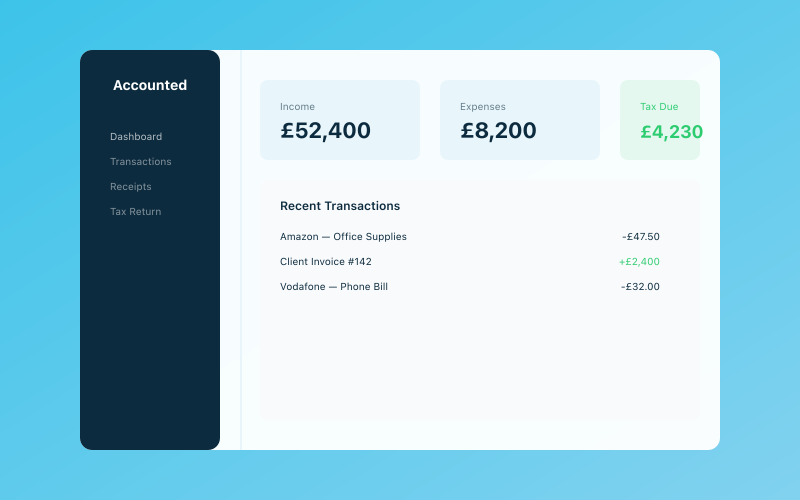 Your Accounted dashboard — income, expenses, and tax at a glance
Broadband and connectivity remain a significant issue in many rural areas. While the UK Government's Project Gigabit aims to bring fast broadband to hard-to-reach areas, many rural businesses still deal with download speeds that would make a city dweller weep. If your business relies on video calls, cloud software, or uploading large files, check the actual broadband speeds at your location before committing. Mobile signal can also be patchy — some rural areas still have no 4G coverage, let alone 5G.
That said, things are improving. Community fibre schemes, satellite broadband services like Starlink, and 4G/5G home broadband routers can bridge the gap. Some of these costs are claimable as business expenses.
Transport and logistics are another challenge. If you need to visit clients, attend meetings, or receive deliveries, the distances involved can be significant. Fuel costs add up, and public transport in rural areas is often limited or non-existent.
The silver lining is that travel expenses are fully claimable. If you use your own car for business journeys, you can claim HMRC's mileage allowance — 45p per mile for the first 10,000 miles, and 25p per mile after that. For a rural business owner driving 15,000 business miles a year, that's a £5,750 deduction from your taxable profits. Make sure you're logging every business journey. Accounted makes mileage tracking straightforward — Penny can remind you to log trips so nothing gets missed.
Finding and retaining staff can be harder in rural areas, simply because the local population is smaller. If you need specialist skills, you may need to offer remote working arrangements or be prepared for longer recruitment processes.
Customer reach is naturally more limited if you're selling locally. But many rural businesses find success by combining local trade with an online presence. A craft business in the Cotswolds might sell to a global audience through its website, while also doing well at local markets and fairs.
Tax Benefits and Reliefs for Rural Businesses
Now for the good news. There are several tax reliefs and support schemes that can benefit rural businesses.
Rural Rate Relief is available for businesses in designated rural settlements (generally those with a population of 3,000 or less). If your business is the only general store, post office, or food shop in a rural settlement, and your rateable value is below £8,500, you can get 100% mandatory rate relief. Sole pubs and petrol stations with a rateable value below £12,500 can also qualify. Other rural businesses may be eligible for discretionary rate relief from their local council.
This is on top of the standard Small Business Rates Relief, which provides 100% relief for properties with a rateable value of £12,000 or less, and tapered relief up to £15,000. Many rural business premises fall within these thresholds because property values are lower outside urban areas.
Agricultural Property Relief (APR) applies to the agricultural value of farmland and farm buildings for Inheritance Tax purposes. If you're farming, this can reduce or eliminate the IHT liability on qualifying agricultural property. The relief is currently 100% for owner-occupied farmland and 50% for let farmland, though recent changes announced in the Autumn Budget 2024 will cap APR at £1 million from April 2026, with the excess taxed at an effective rate of 20%.
Business Property Relief (BPR) is similar but applies to business assets more broadly. A sole trader's business assets can qualify for 100% BPR, potentially reducing the IHT bill to zero on those assets — again subject to the new £1 million combined cap with APR from April 2026.
Capital allowances work the same way in rural and urban areas, but they're particularly relevant for rural businesses that need expensive equipment. The Annual Investment Allowance lets you deduct up to £1,000,000 of qualifying plant and machinery from your profits in the year of purchase. For a farming business investing in a new tractor, or a rural workshop buying specialist tools, this can make a significant dent in the tax bill.
Enterprise Zones exist in some rural areas and offer enhanced capital allowances or business rates discounts. Check whether your location falls within one — the benefits can be substantial.
Grants and Funding for Rural Businesses
Beyond tax reliefs, there are grants and funding programmes specifically targeting rural businesses.
The Rural England Prosperity Fund provides capital grants for small businesses in rural areas. Grants are typically administered through local councils and can cover things like equipment, renovations to business premises, and tourism infrastructure.
Countryside Stewardship and related schemes offer payments to landowners for environmental management. If you're a farmer or landowner, these payments are a legitimate income stream, though they are taxable.
Local Enterprise Partnerships (LEPs) and local councils often run their own grant schemes for rural businesses. These change frequently, so it's worth checking what's currently available in your area. The Business Support Helpline (0800 998 1098) can point you in the right direction.
If you're in Scotland, Highlands and Islands Enterprise offers specific support for businesses in remote areas. Welsh Government rural development programmes similarly target businesses in rural Wales.
Working From Home in a Rural Setting
Many rural business owners work from home, and the tax implications are worth understanding properly.
You can claim a proportion of your household running costs — heating, electricity, water, broadband, council tax, insurance, and mortgage interest or rent — based on the proportion of your home used for business and the time spent working.
HMRC's simplified expenses method offers fixed rates based on hours worked per month:
- 25-50 hours: £10 per month
- 51-100 hours: £18 per month
- 101+ hours: £26 per month
For most home-based businesses, calculating actual costs will give you a higher deduction, but the simplified method is easier to administer. Our guide on work-from-home expenses covers both approaches in detail.
If you've converted an outbuilding — a barn, stable, or shed — into a workspace, you may be able to claim the full running costs of that building as a business expense, since it's wholly used for business. You might also be able to claim capital allowances on the cost of fitting it out. Just be aware that creating a separate business premises on your property could trigger business rates liability, and might affect your Capital Gains Tax position when you sell the property.
Diversification — A Rural Business Strategy
Many rural businesses, particularly farms, are diversifying to supplement traditional income streams. Common diversification activities include:
- Holiday lets and glamping — converting barns or land into tourist accommodation
- Farm shops and direct sales — selling produce directly to consumers
- Event venues — hosting weddings, conferences, or festivals
- Renewable energy — installing solar panels or wind turbines and selling excess electricity
- Educational visits — farm tours, foraging experiences, and outdoor education
Each of these has its own tax implications. Holiday lets, for example, used to qualify as Furnished Holiday Lettings with favourable tax treatment, but this special regime is being abolished from April 2025. Going forward, holiday lets will be taxed in the same way as other rental income, which means you'll lose some allowances like capital allowances on furniture and the ability to use profits for pension contribution calculations.
Renewable energy income is taxable, but you can claim capital allowances on the installation costs. The Smart Export Guarantee means you get paid for excess electricity exported to the grid — this is trading income and needs to be declared.
If you're diversifying, keep careful records of each income stream separately. This makes your Self Assessment return much simpler and ensures you're claiming all the expenses attributable to each activity.
Practical Tips for Rural Business Success
Embrace online sales and marketing. A strong website and social media presence can extend your reach far beyond the local area. Many rural businesses do the majority of their sales online.
Build local relationships. Word of mouth is incredibly powerful in rural communities. Being known and trusted locally can provide a steady base of customers and referrals.
Plan for seasonal variation. Many rural businesses — tourism, agriculture, outdoor activities — have pronounced seasonal patterns. Build a cash flow forecast that accounts for quiet periods, and set money aside during busy months to cover the lean ones. Our guide on tax planning for seasonal businesses covers this in detail.
Keep meticulous records. With potentially complex income streams, diverse expenses, and various reliefs to claim, good record-keeping is essential. Using Accounted to track everything in real time means you always know your financial position and you're ready for Making Tax Digital quarterly updates.
Claim every legitimate expense. Rural businesses often have higher travel and transport costs, equipment needs, and property-related expenses. Make sure you're claiming everything you're entitled to — check our complete expenses list to make sure nothing slips through.
Get proper insurance. Rural businesses face specific risks — livestock, weather damage, remote locations with longer emergency response times. Make sure your insurance covers the realities of your situation.
Running a business in the countryside has its challenges, but it also has rewards — both financial and personal — that can make it deeply worthwhile. The key is to go in with clear-eyed awareness of the difficulties and a solid understanding of the support and reliefs available to you.
Related Reading
Start your free trial and see how Accounted simplifies your bookkeeping.
Accounted helps UK sole traders stay on top of their bookkeeping and tax. Start your free 30-day trial at getaccounted.co.uk.
Accounted keeps your books sorted automatically so you can focus on running your business. See Accounted →
Business & Operations Advisors
Our business advisors cover the practical side of running a UK sole trader business — from HMRC registration to managing growth. Content is written for real business owners in plain English, not accountants.
Ready to try Accounted?
Join UK sole traders who are simplifying their bookkeeping and tax.
Start your 14-day free trial