Running a UK Business From Spain — Tax Residency Rules
Spain has long been one of the most popular destinations for British people looking to escape the weather, enjoy a lower cost of living, or simply fancy a change of scenery. And with remote working now firmly established as the norm for many sole traders and freelancers, the idea of running your UK business from a Spanish apartment is more realistic than ever.
But — and there's always a but — the tax implications of working from Spain are significant, and getting them wrong can leave you facing unexpected bills from two different tax authorities. In this guide, we'll walk through how tax residency works when you're splitting your time between the UK and Spain, what each country expects from you, and how to keep everything above board.
Are You UK Tax Resident, Spanish Tax Resident, or Both?
This is the fundamental question, and the answer determines almost everything else.
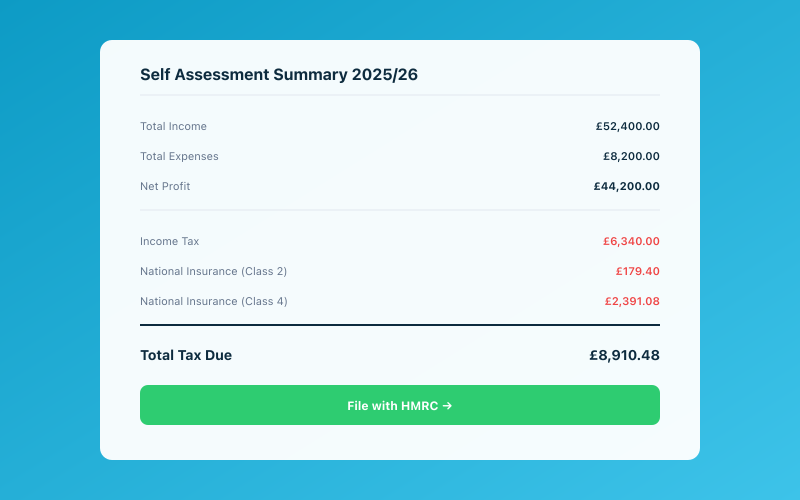 Your Accounted dashboard shows your real-time tax position
UK tax residency is determined by the Statutory Residence Test (SRT). In simple terms, you're automatically UK resident if you spend 183 days or more in the UK during the tax year, or if your only home is in the UK. If neither automatic test applies, HMRC looks at your ties to the UK (family, accommodation, work, etc.) and the number of days you spend here.
Spanish tax residency kicks in if you spend more than 183 days in Spain during a calendar year, or if Spain is the centre of your economic interests (i.e., where you earn most of your money or have most of your assets). Spain also has a presumption of residency if your spouse and dependent children live there, even if you personally spend less than 183 days in the country.
Here's the uncomfortable truth: it's entirely possible to be considered tax resident in both countries simultaneously. The UK tax year runs from 6 April to 5 April; the Spanish tax year follows the calendar year (January to December). Because the periods don't align, you could meet the residency criteria in both.
When this happens, the UK-Spain Double Taxation Agreement (DTA) contains "tie-breaker" rules to determine which country has the primary right to tax you. The tie-breaker looks at factors like where your permanent home is, where your personal and economic relations are closer (your "centre of vital interests"), where you habitually live, and your nationality.
For a broader explanation of how the 183-day rule works across different countries, see our guide to the 183-day rule and tax residency.
What Spain Expects From You
If you become Spanish tax resident, Spain taxes you on your worldwide income — not just the money you earn from Spanish clients or while physically in Spain. This includes your UK business profits, any UK rental income, savings interest, dividends, and anything else.
Spanish income tax rates are progressive and vary by autonomous community (region), but they generally range from 19% to 47% for the 2025/26 tax year. That's potentially higher than what you'd pay in the UK, especially at the upper end.
You'd also need to:
- File a Spanish tax return (declaración de la renta) each year, typically between April and June
- Register with the Spanish tax authorities (Agencia Tributaria) and obtain a NIE (Número de Identidad de Extranjero) if you don't already have one
- Declare overseas assets — Spain has a controversial but still-active requirement (Modelo 720) to declare assets held outside Spain worth more than €50,000 in any category (bank accounts, property, investments)
- Pay Spanish social security contributions if you're self-employed (autónomo) in Spain, which start at around €230 per month under the current system
The social security point catches a lot of people off guard. If you're living and working in Spain, the Spanish authorities may expect you to register as autónomo and contribute to their social security system, even if you're still paying UK National Insurance. The UK-Spain social security agreement means you shouldn't have to pay into both systems simultaneously, but you'll need a certificate (A1 form) from HMRC to prove you're covered under the UK system if that's the case.
What HMRC Expects From You
If you remain UK tax resident, HMRC expects you to declare your worldwide income on your Self Assessment tax return and pay UK tax on it. If you're also paying tax in Spain, the DTA should prevent double taxation — but you may need to claim relief, either in the UK or in Spain, depending on your circumstances.
If you become non-UK resident under the SRT, you generally won't pay UK tax on your business profits (assuming the business is carried out wholly abroad). However, any UK-source income — such as rental income from a UK property — would still be taxable in the UK.
Even if you leave the UK, you should:
- Notify HMRC of your change of circumstances
- File a final Self Assessment return for the tax year you leave (and possibly part of the following year, depending on timing)
- Consider National Insurance — you may want to pay voluntary Class 2 NI contributions to maintain your UK State Pension entitlement
It's also important to understand that becoming non-UK resident doesn't happen overnight. You need to meet the SRT criteria for a full tax year, and HMRC can look back at your ties to check whether you genuinely left.
The Beckham Law — Spain's Special Tax Regime
Spain offers a special tax regime informally known as the "Beckham Law" (named after a certain footballer who benefited from it). Under this regime, people who move to Spain for work can elect to be taxed as non-residents for up to six years, meaning they'd pay a flat rate of 24% on Spanish-source income up to €600,000, rather than the progressive rates.
To qualify, you must not have been Spanish tax resident in the five years prior to moving, and your move must be triggered by an employment contract or, since recent reforms, by certain other qualifying activities.
For sole traders, the Beckham Law has historically been less accessible because it was designed for employees. However, recent changes have broadened eligibility in some circumstances, particularly for entrepreneurs and digital nomads. It's worth investigating whether you qualify, as the tax savings can be substantial.
Spain also introduced a digital nomad visa in 2023, which allows non-EU remote workers to live in Spain while working for companies or clients outside Spain. The visa comes with a favourable tax regime similar to the Beckham Law. If you're a UK sole trader whose clients are primarily in the UK, this could be an option worth exploring post-Brexit.
Practical Scenarios
Let's look at a few common situations:
Scenario 1: You spend winters in Spain (4-5 months) and the rest of the year in the UK. You're almost certainly still UK tax resident, and probably not Spanish tax resident (assuming you're under 183 days in Spain per calendar year). Your tax position hasn't really changed — you file your Self Assessment in the UK as normal. However, if you're doing any work while in Spain, technically the Spanish authorities could argue you owe them something. In practice, short stays like this rarely trigger Spanish tax obligations, but it's not a guarantee.
Scenario 2: You move to Spain full-time and run your UK business remotely. You'll likely become Spanish tax resident and will need to pay Spanish income tax on your worldwide income. You may cease to be UK tax resident if you meet the SRT criteria. You'll need to register as autónomo in Spain (or obtain an A1 certificate from HMRC to stay in the UK social security system) and file a Spanish tax return.
Scenario 3: You split your time roughly 50/50 between the UK and Spain. This is the trickiest situation. You might be tax resident in both countries, and the DTA tie-breaker rules will determine your primary residence. The outcome depends on factors like where your permanent home is, where your family lives, and where your economic interests are centred. Professional advice is strongly recommended in this scenario.
Keeping Your Records Straight
Wherever you end up being tax resident, your record-keeping needs to be impeccable. Both HMRC and the Agencia Tributaria can request evidence of your income, expenses, and days spent in each country.
Track the following meticulously:
- Days in each country — keep a diary or log, supported by flight bookings, boarding passes, and passport stamps
- Business income and expenses — categorised and recorded in real time, not reconstructed from memory months later
- Bank statements — for all accounts, in all countries
- Tax correspondence — from both HMRC and the Spanish authorities
Using Accounted makes the income and expenses side much simpler. Penny can categorise your transactions as they happen, so you always have a clear picture of your business finances regardless of which country you're sitting in. When you're dealing with two tax systems, having clean books isn't a luxury — it's a necessity.
Social Security and Healthcare
This deserves its own section because it's a frequent source of confusion.
If you move to Spain, you'll need health cover. Post-Brexit, UK nationals don't automatically have access to the Spanish public healthcare system. You'll generally need either private health insurance or to be registered and contributing to Spanish social security (which grants access to public healthcare).
As mentioned earlier, the UK-Spain social security agreement prevents you from paying into both systems at once. If you're temporarily posted to Spain (for up to two years), you can apply for an A1 certificate from HMRC to stay in the UK system. If you're permanently moving, you'll transition to the Spanish system.
Your UK State Pension entitlement depends on your National Insurance record. If you stop paying UK NI, your record will have gaps that could reduce your pension. You can pay voluntary contributions from abroad to fill these gaps — it's often worth doing, as Class 2 voluntary contributions are relatively cheap.
Get Professional Advice
We've said it elsewhere in this guide, but it bears repeating: if you're planning to run a UK business from Spain, professional tax advice is not optional. The interaction between UK and Spanish tax rules, social security systems, and the DTA is genuinely complex, and the cost of getting it wrong can be substantial.
Look for an adviser who specialises in UK-Spain tax matters — there are several firms that focus specifically on this niche, given how many British people live in or retire to Spain.
And whatever you do, don't rely on advice from Facebook groups or expat forums. The people sharing tips there mean well, but tax rules change frequently and individual circumstances vary enormously. What worked for someone else might not work for you.
Related reading:
- The 183-Day Rule — How Tax Residency Works
- Working Abroad Temporarily — UK Tax
- Digital Nomad Tax Rules — Working Abroad as a UK Sole Trader
Accounted helps UK sole traders stay on top of their bookkeeping and tax. Start your free 30-day trial at getaccounted.co.uk.
Related Reading
Start your free trial and let Penny handle your bookkeeping automatically.
Penny, your AI bookkeeper, tracks your tax position in real time and flags opportunities to reduce your bill. Meet Penny →
Tax & Compliance Specialists
Our tax specialists have decades of combined experience in UK sole trader and small business taxation, MTD compliance, and HMRC submissions. All content is reviewed against current HMRC guidance before publication and updated quarterly to reflect legislative changes.
Ready to try Accounted?
Join UK sole traders who are simplifying their bookkeeping and tax.
Start your 14-day free trial