The 183-Day Rule — How Tax Residency Works
If you've ever thought about working abroad, splitting your time between countries, or becoming a digital nomad, chances are someone has mentioned "the 183-day rule" to you. It's one of those bits of tax knowledge that gets passed around freely — often incorrectly — in pub conversations, online forums, and WhatsApp groups.
The basic idea sounds simple: spend fewer than 183 days in a country and you won't be tax resident there. Easy, right?
Not quite. The reality is considerably more nuanced than that, and misunderstanding how the 183-day rule actually works has tripped up more than a few sole traders over the years. In this guide, we'll explain what the rule really means, how it fits into the UK's Statutory Residence Test, and what you actually need to know to get your tax residency right.
What Is the 183-Day Rule?
The 183-day rule is a commonly used threshold in international tax. In its simplest form, it says that if you spend 183 days or more in a country during a tax year (or calendar year, depending on the country), you're generally considered tax resident there.
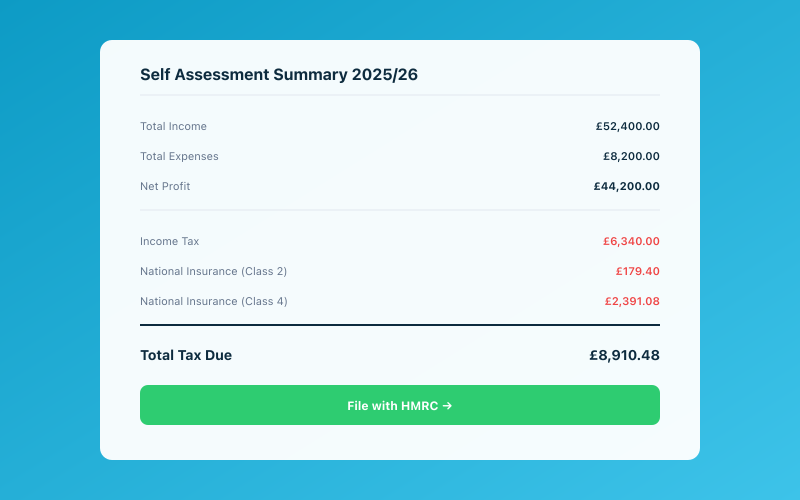 Your Accounted dashboard shows your real-time tax position
183 days is just over half a year — six months and a day or two, depending on the month. The logic is straightforward: if you're spending more than half the year somewhere, that's your primary base and you should pay tax there.
Many countries use this threshold, including most EU member states and many countries that have Double Taxation Agreements with the UK. However, the way different countries count days, define residency, and apply exceptions varies enormously.
In the UK, the 183-day threshold is just one part of a much larger framework called the Statutory Residence Test.
The Statutory Residence Test — The Full Picture
The UK doesn't rely on the 183-day rule alone. Since April 2013, tax residency has been determined by the Statutory Residence Test (SRT), which is a three-part framework:
Part 1: The Automatic Overseas Tests
You're automatically non-UK resident if you meet any of these:
- You were UK resident in one or more of the previous three tax years and you spend fewer than 16 days in the UK in the current tax year
- You weren't UK resident in any of the previous three tax years and you spend fewer than 46 days in the UK
- You work full-time overseas with no significant breaks and spend fewer than 91 days in the UK (with no more than 30 of those being working days)
Part 2: The Automatic UK Tests
You're automatically UK resident if you meet any of these:
- You spend 183 days or more in the UK during the tax year
- Your only home is in the UK (and you've had it for at least 91 consecutive days, with at least 30 of those days falling in the tax year in question)
- You work full-time in the UK for a period of 365 days, with no significant break
Part 3: The Sufficient Ties Test
If neither the automatic overseas tests nor the automatic UK tests give a definitive answer, you move on to the sufficient ties test. This looks at five connecting factors:
- Family tie — Your spouse, civil partner, or minor children live in the UK
- Accommodation tie — You have a place to live in the UK that's available to you for a continuous period of 91 days or more, and you actually stay there at least once during the tax year
- Work tie — You do substantive work in the UK (40 or more days in the tax year)
- 90-day tie — You've spent 90 or more days in the UK in either of the two preceding tax years
- Country tie (only for leavers) — The country where you spend the most time is the UK
The number of ties you have is then combined with the number of days you spend in the UK to reach a conclusion. The more ties you have, the fewer days you can spend in the UK before being classed as resident.
For example, if you were UK resident in one or more of the previous three tax years and you have four UK ties, you'd be considered UK resident if you spend just 16 days or more in the UK. With only one tie, you'd need to spend 121 days or more before becoming resident.
This is why the 183-day figure, while important, is far from the whole story.
How Days Are Counted
This seems like it should be simple, but it's caught out more than a few people.
HMRC counts a day as being "in the UK" if you are physically present here at midnight (the end of the day). So if you arrive at Heathrow at 11 pm and leave the next morning, that first day counts but the second doesn't — assuming you've left by midnight.
There are limited exceptions. Transit passengers who don't pass through immigration control don't count as being present. And in certain circumstances, days can be disregarded if you're in the UK due to exceptional circumstances beyond your control (illness, natural disaster, civil unrest, etc.) — but this is capped at 60 days per tax year.
It's crucial to keep a precise record of your travel. HMRC can check passport stamps, flight records, and other evidence to verify how many days you've spent in the UK. We've heard of cases where people's recollections differed from what their records showed — and HMRC went with the records.
The 183-Day Rule in Other Countries
While the UK has its comprehensive SRT, many other countries do rely more heavily on the straightforward 183-day test. However, even then, there are important differences:
Which 183 days? Some countries count 183 days within a calendar year (January to December). Others use a rolling 12-month period. The UK uses the tax year (6 April to 5 April). This matters because you could be under 183 days in one measurement period but over in another.
What triggers residency besides days? Many countries — Spain, for instance — can declare you resident based on where your economic interests are centred, not just how many days you spend there. Having your main business, your primary bank accounts, or your family in a country could make you resident even if you're under 183 days.
How are days counted? Some countries count any partial day as a full day. Others, like the UK, look at midnight presence. The method can make a difference of several days over the course of a year.
If you're splitting time between the UK and another specific country, such as Spain, it's worth understanding both sets of rules. Our guide on running a UK business from Spain covers the Spanish side in detail.
Double Taxation Agreements
When you could be considered tax resident in two countries simultaneously, Double Taxation Agreements (DTAs) step in to prevent you from being taxed twice on the same income.
The UK has DTAs with over 130 countries. Each agreement contains "tie-breaker" rules that determine which country gets the primary taxing right. These typically look at:
- Where your permanent home is
- Where your personal and economic relations are closest (centre of vital interests)
- Where you habitually live
- Your nationality
The tie-breaker is applied in order — if the first criterion gives a clear answer, you stop there. If not, you move to the next.
It's important to understand that a DTA doesn't automatically exempt you from filing a tax return in the second country. You might still need to file and claim relief under the agreement.
Common Misconceptions
Let's clear up some of the most widespread misunderstandings:
"If I spend fewer than 183 days in the UK, I'm not UK tax resident." Not necessarily. The SRT considers multiple factors. You could be UK resident with as few as 16 days in the country if you have enough ties.
"I just need to count my days and I'll know my status." Day counting is important, but it's only one part of the picture. Your ties to the UK — family, property, work — matter just as much.
"The 183-day rule is the same everywhere." It varies significantly. Different countries use different measurement periods, different counting methods, and different additional criteria.
"If I'm not UK resident, I don't need to tell HMRC anything." You should still notify HMRC of your change in circumstances. And if you have UK-source income (rental income, for example), you may still have UK tax obligations.
Practical Steps for Sole Traders
If you're a sole trader thinking about spending significant time abroad, here's what to do:
1. Run the numbers before you go. Work through the SRT to understand how many days you can spend in the UK and still be non-resident, given your personal ties.
2. Keep meticulous records. Track every day in every country. Use a calendar, a spreadsheet, or an app — whatever works for you, as long as it's consistent and accurate.
3. Understand the other country's rules. Don't just look at the UK side. Research the tax residency rules of wherever you're going.
4. Keep your business records clean. Whichever country you end up being tax resident in, you'll need to file a tax return. Having organised, up-to-date records makes this infinitely easier. Accounted is built for exactly this — Penny keeps your bookkeeping tidy in real time, so when it's time to file, everything is already in order.
5. Get professional advice. If your situation involves multiple countries, significant income, or complex ties, invest in advice from a tax professional who specialises in international matters. The cost is trivial compared to the potential penalties for getting it wrong.
6. Don't forget National Insurance. Even if you become non-UK resident, you might want to pay voluntary NI contributions to protect your State Pension. This is especially important if you plan to return to the UK eventually.
When the Rules Get Complicated
There are situations where even the SRT doesn't give clean answers. People with homes in multiple countries or business interests spread across borders can find the rules particularly challenging. In these grey areas, the tie-breaker rules in the relevant DTA become critical.
For those working from mobile setups — narrowboats, campervans, or simply living out of a suitcase — the question of where your "permanent home" is becomes even more interesting. We've explored this in our article on narrowboat, van and digital nomad tax.
The Bottom Line
The 183-day rule is a useful starting point, but it's not the full picture. UK tax residency is determined by the Statutory Residence Test, which takes into account your days in the UK, your ties, and your circumstances as a whole.
If you're planning to spend extended periods abroad, take the time to understand the SRT properly, keep immaculate records, and get professional advice if your situation is anything other than straightforward. The stakes — potentially paying tax in two countries, or facing penalties for getting it wrong — are too high to wing it.
Related reading:
- Digital Nomad Tax Rules — Working Abroad as a UK Sole Trader
- Running a UK Business From Spain — Tax Residency Rules
- Working Abroad Temporarily — UK Tax
Accounted helps UK sole traders stay on top of their bookkeeping and tax. Start your free 30-day trial at getaccounted.co.uk.
Related Reading
Start your free trial and let Penny handle your bookkeeping automatically.
Penny, your AI bookkeeper, tracks your tax position in real time and flags opportunities to reduce your bill. Meet Penny →
Tax & Compliance Specialists
Our tax specialists have decades of combined experience in UK sole trader and small business taxation, MTD compliance, and HMRC submissions. All content is reviewed against current HMRC guidance before publication and updated quarterly to reflect legislative changes.
Ready to try Accounted?
Join UK sole traders who are simplifying their bookkeeping and tax.
Start your 14-day free trial