Working From a Narrowboat or Van — The Digital Nomad Tax Rules
The idea of working from a narrowboat drifting through the English countryside, or a converted campervan parked up overlooking the Welsh coast, has a powerful appeal. No commute, no office politics, no fixed address — just you, your laptop, and the open water or road.
And it's not just a fantasy. Thousands of people in the UK genuinely work this way — freelancers, consultants, designers, writers, programmers, and other self-employed people who've traded a fixed home for a mobile one. The lifestyle is entirely legal and perfectly compatible with running a legitimate business. But it does raise some practical questions about tax, expenses, and how HMRC views your situation.
Let's work through the details.
Are You Still a UK Taxpayer?
First things first: if you're living and working on a narrowboat or in a van within the UK, you're a UK tax resident. Full stop. The fact that you don't have a fixed postal address doesn't change this. You're physically present in the UK, you're earning income here, and HMRC expects you to pay tax here.
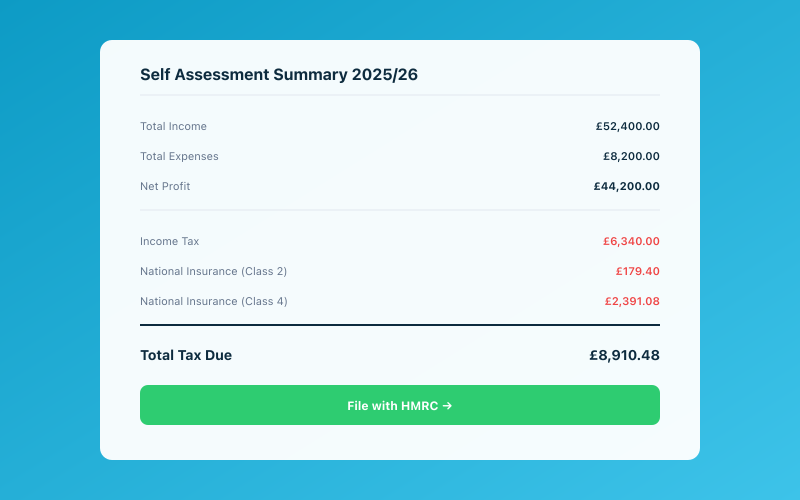 Your Accounted dashboard shows your real-time tax position
UK tax residency is determined by the Statutory Residence Test. If you're living on a canal or in a van park in the UK, you easily meet the criteria. All the normal rules apply:
- You need to register as self-employed with HMRC
- You must file a Self Assessment tax return each year
- You pay income tax and National Insurance on your profits
- Making Tax Digital requirements apply based on your income level
For 2025/26, the tax rates are the standard UK rates:
- Personal Allowance: £12,570 (tax-free)
- Basic rate: 20% on profits from £12,570 to £50,270
- Higher rate: 40% on profits from £50,270 to £125,140
- Additional rate: 45% above £125,140
National Insurance: Class 2 at £3.45/week and Class 4 at 6%/2% on profits above £12,570.
If you travel abroad in your van (France, Spain, Portugal are popular routes for UK van-lifers), your tax residency could become more complex. The key test is how many days you spend in the UK versus abroad. If you spend more than 183 days in the UK in a tax year, you're almost certainly UK resident. If you spend significant time abroad, you might need professional advice on your residency status.
Your Address — What to Tell HMRC
HMRC needs an address for you. They'll send correspondence there, and it's used to determine things like which tax region you're in (relevant for Scottish or Welsh taxpayers).
If you don't have a permanent fixed address, you have several options:
A family member's address. The most common solution. Use a parent's, sibling's, or friend's address for HMRC correspondence. This is perfectly acceptable as long as you can reliably receive mail there.
A mail forwarding service. Companies offer virtual addresses and mail forwarding for a monthly fee (typically £10-30/month). They receive your post and either forward it to wherever you are or scan it and email it to you. This is a legitimate business expense.
A marina or site address. If your narrowboat has a permanent mooring with a postal address, or your van is registered at a permanent site, you can use that address.
A PO Box. HMRC does accept PO Box addresses in some circumstances, though a physical address is generally preferred.
Whichever option you choose, make sure HMRC has a current, working address. Missing important correspondence — like a notice of investigation or a penalty notice — because you didn't update your address is a problem you can avoid.
For narrowboaters, it's worth noting that your boat licence (from the Canal & River Trust or other navigation authority) requires you to provide a home mooring address or, if you're a continuous cruiser, a contact address. This can be the same address you use for HMRC.
Claiming Expenses — Boat or Van as Your Home and Office
This is where things get genuinely interesting. If your narrowboat or van is both your home and your workplace, which expenses can you claim?
The general principle is the same as working from home in a house: you can claim the proportion of your running costs that relate to business use. But the specifics are different because a boat or van has different cost structures.
Narrowboat expenses that may be partially claimable:
- Mooring fees — if you have a mooring that serves as your home and office, the business proportion is claimable
- Fuel — diesel for the engine (if you move the boat) and for heating/electricity generation. The business proportion depends on how much of your time aboard is spent working versus living
- Licence fees — the Canal & River Trust licence or river navigation licence. The business proportion is claimable
- Boat insurance — the business proportion
- Maintenance and repairs — hull blacking, engine servicing, plumbing repairs. Again, the business proportion
- Internet connectivity — mobile broadband, Wi-Fi dongles, or satellite internet used for work. If it's used solely for business, it's fully claimable. If mixed use, claim the business proportion
- Electricity — if you pay for shore power at a marina, or the cost of running a generator or solar system. The business proportion applies
Van/campervan expenses that may be partially claimable:
- Campsite fees and parking — the business proportion if the van is your home and office
- Fuel for the vehicle — this gets complicated. If the van is both your home and your transport to client meetings, you need to separate domestic use (moving to a new campsite to live) from business travel (driving to meet a client). Only business travel is claimable
- Insurance — the business proportion, but remember you need appropriate commercial vehicle insurance if you're using it for business
- Maintenance and MOT — the business proportion
- Internet and phone — business proportion of mobile data, phone contract, etc.
Using HMRC's simplified expenses for working from home is an option. The flat rates (£10/month for 25-50 hours worked, £18/month for 51-100 hours, £26/month for 101+ hours) can be used regardless of whether your "home" is a house, boat, or van. However, for most mobile dwellers, the actual costs of running the vessel or vehicle are high enough that calculating actual proportional costs gives a much better deduction.
The key is keeping records. You need to be able to justify the split between business and personal use. A simple approach is to track the hours you spend working versus not working, and use that percentage. If you work eight hours a day, five days a week, that's roughly 33% of your waking hours — which gives you a reasonable basis for claiming about a third of your running costs.
For the full picture on working-from-home expense claims, see our guide on home working expenses.
Travel Expenses — Where Is "Home"?
One of the quirks of the nomadic lifestyle is defining "home" for travel expense purposes. Normally, commuting between your home and a regular place of work isn't a claimable expense. But business travel to temporary workplaces — client sites, meetings, conferences — is claimable.
If you don't have a fixed home or a regular place of work, arguably every journey is to a temporary workplace. In practice, HMRC would likely consider your boat or van to be your home and your regular workplace (since you work from it), so travelling from your current mooring or campsite to a client's office would be business travel.
What wouldn't be claimable is moving your boat or van from one mooring to another purely for lifestyle reasons — that's a personal cost, equivalent to moving house.
If you drive a separate vehicle for business meetings (not your live-in van), the mileage allowance of 45p per mile for the first 10,000 miles and 25p per mile thereafter applies, as it would for any sole trader.
Council Tax and Business Rates
Narrowboaters generally don't pay council tax. Council tax applies to domestic dwellings, and a boat that moves regularly (a continuous cruiser) typically doesn't meet the definition. However, if your boat is permanently moored at a residential mooring, the mooring may attract council tax. The rules vary — check with your local authority.
Van dwellers don't pay council tax on the van itself, but if you're parked on a site that charges council tax as part of the pitch fee, you're effectively paying it indirectly.
Neither situation normally triggers business rates, as you're not occupying a separate business premises. Your boat or van is your home, and you're simply working from home — just like millions of other people. The fact that your home floats or has wheels doesn't change the principle.
Practical Considerations
Broadband and connectivity. This is the biggest practical challenge. Mobile coverage is patchy in rural locations — exactly where narrowboats and vans tend to go. Solutions include multiple SIM cards, external antennas, and Starlink satellite internet (around £75/month plus hardware). The costs of connectivity solutions used for business are claimable expenses.
Banking and record-keeping. Online-only banks work well for mobile lifestyles. Keeping organised financial records is even more important when you're mobile, because the business/personal split requires careful documentation. Using Accounted means your records are in the cloud, accessible anywhere. Penny can categorise your transactions as they come in, which is much easier than trying to remember what that £47 payment at a marina three months ago was for.
Insurance. Make sure your boat or van insurance covers living aboard and working from it. Standard leisure insurance may not cover commercial use — be upfront with your insurer.
What About Capital Gains Tax?
If you sell your narrowboat or van, is there a Capital Gains Tax liability? For a boat or van that's your main residence, Principal Private Residence Relief may apply — but this is a grey area. HMRC's position is that a houseboat can qualify as a residence for CGT purposes if it's your main home, but each case is assessed individually.
If you've been claiming a proportion of costs as business expenses, the business proportion of any gain on sale could be subject to CGT. Get professional advice before selling if significant amounts are involved.
Keeping HMRC Happy
The key to a stress-free relationship with HMRC as a mobile worker is transparency and good records. There's nothing inherently suspicious about working from a narrowboat or van — it's simply a lifestyle choice. But because the expense claims can look unusual (mooring fees, diesel for heating, marina electricity), clear documentation is important.
Keep a record of:
- Your working hours (to justify the business/personal split)
- All business income and expenses (with receipts)
- Business mileage (if you use a vehicle for client visits)
- Your movements (a simple log of where you were moored or parked each week)
This last point isn't a legal requirement, but it's helpful if HMRC ever queries your expense claims. Being able to show that you were moored at a specific marina on the day you claimed shore power costs adds credibility.
The nomadic working lifestyle is growing, and HMRC is increasingly familiar with it. As long as you're honest, keep good records, and pay the right amount of tax, there's no reason it should cause any problems.
Related Reading
Start your free trial and let Penny handle your bookkeeping automatically.
Accounted helps UK sole traders stay on top of their bookkeeping and tax. Start your free 30-day trial at getaccounted.co.uk.
Penny, your AI bookkeeper, tracks your tax position in real time and flags opportunities to reduce your bill. Meet Penny →
Tax & Compliance Specialists
Our tax specialists have decades of combined experience in UK sole trader and small business taxation, MTD compliance, and HMRC submissions. All content is reviewed against current HMRC guidance before publication and updated quarterly to reflect legislative changes.
Ready to try Accounted?
Join UK sole traders who are simplifying their bookkeeping and tax.
Start your 14-day free trial