Tax Year End Checklist — 15 Things to Do Before 5 April
The tax year doesn't end with a bang — it tends to creep up quietly, usually while you're busy doing the actual work that keeps your business running. Before you know it, 5 April has arrived and you're left scrambling, wondering whether you've missed something important.
The good news? A bit of forward planning goes a long way. Whether you're wrapping up your first year as a sole trader or you've been at it for a decade, this checklist will help you tie up loose ends, claim everything you're entitled to, and start the new tax year on solid ground.
Here are 15 things to do before the 2025/26 tax year closes on 5 April 2026.
1–3: Get Your Records in Order
1. Reconcile your bank accounts. Log into your business bank account and compare every transaction against your bookkeeping records. If you've been using Accounted or Penny, our AI assistant, throughout the year, this should be fairly painless — most of the categorisation will already be done. If not, now's the time to catch up.
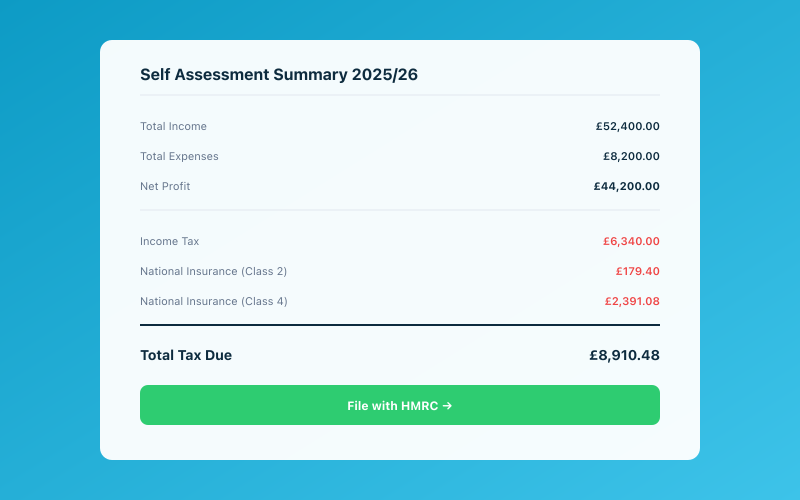 Your Accounted dashboard shows your real-time tax position
2. Chase outstanding invoices. Any income you've earned but haven't yet received still counts as income for the 2025/26 tax year if you're using traditional accounting (which most sole traders do). Chase up any unpaid invoices before 5 April so you know exactly where you stand.
3. Gather all your receipts. Whether they're stuffed in a drawer, saved in your email, or snapped on your phone, round up every business receipt from the year. HMRC expects you to keep records for at least five years, and you'll need them if you're ever asked to justify a claim. Digital copies are perfectly acceptable — in fact, they're preferable.
4–6: Review Your Income and Expenses
4. Check your total income. Add up everything you've earned from self-employment during the tax year. This includes cash payments, bank transfers, and any bartered goods or services. If your total income has crossed the £1,000 trading allowance, you'll need to file a Self Assessment return.
5. Claim all allowable expenses. This is where many sole traders leave money on the table. Common expenses include:
- Office supplies and equipment
- Travel costs (fuel, public transport, parking)
- Professional subscriptions and memberships
- Software and tools (including your Accounted subscription)
- A proportion of household bills if you work from home
- Phone and internet costs
- Professional development and training
If you're not sure whether something qualifies, HMRC's guidance on allowable expenses is worth a read — or simply ask Penny for a quick check.
6. Consider the £1,000 trading allowance. If your gross trading income is under £1,000, you may not need to report it at all. If it's slightly above, you can choose to deduct the £1,000 allowance instead of claiming actual expenses, whichever works out better for you.
7–9: Make the Most of Tax Reliefs
7. Use your personal allowance wisely. For 2025/26, the personal allowance remains at £12,570. If your income is close to this threshold, consider whether it makes sense to defer any invoicing or bring forward expenses to stay within it.
8. Contribute to your pension. Pension contributions receive tax relief at your marginal rate. For basic rate taxpayers, this means the government effectively tops up every £80 you contribute to £100. You can contribute up to £60,000 per year (or your total earnings, whichever is lower) and carry forward unused allowance from the previous three years.
9. Use your ISA allowance. While ISAs don't reduce your tax bill directly, they shelter future investment growth from tax. The annual ISA allowance for 2025/26 is £20,000, and it's a use-it-or-lose-it deal — you can't carry it forward.
10–12: Sort Out Payments and Registrations
10. Check your payments on account. If you owe more than £1,000 in tax for 2025/26 and less than 80% of your tax is collected at source, HMRC will ask you to make payments on account for the following year. These are due on 31 January and 31 July. Make sure you've budgeted for them.
11. Review your tax code (if applicable). If you have employment income alongside your self-employment, check that your tax code is correct. Errors can mean you've overpaid or underpaid tax throughout the year.
12. Register for Self Assessment if you haven't already. If this is your first year of self-employment, you need to register with HMRC by 5 October following the end of the tax year. However, there's no harm in doing it early. You'll need your Unique Taxpayer Reference (UTR) number to file your return.
13–14: Plan Ahead
13. Set aside money for your tax bill. A common rule of thumb is to put aside 25–30% of your profits for tax and National Insurance. If you haven't been doing this throughout the year, work out roughly what you'll owe and start setting it aside now. Accounted's tax estimates can give you a running figure so there are no nasty surprises come January. Open a separate savings account specifically for tax — it removes the temptation to dip into that money for other things, and the interest (however modest) is a small bonus.
14. Review your pricing and rates. The end of the tax year is a natural time to review what you charge. Have your costs gone up? Has your workload increased? If you haven't raised your rates in a while, April is a sensible time to do it — clients expect some annual adjustment. Even a modest 5% increase can make a significant difference over the course of a year, and it ensures your earnings keep pace with inflation and rising business costs.
15: Start Fresh
15. Set up your systems for the new tax year. A clean start makes everything easier. Set up a new folder structure for receipts, update your bookkeeping categories if needed, and make sure your software is ready to go. If you're using Accounted, your new tax year will roll over automatically — one less thing to worry about.
Consider this a chance to tidy up your processes more broadly. Are there subscriptions you're paying for but not using? Templates that need refreshing? Contracts that are out of date? A spring clean of your business admin at the start of a new tax year sets the tone for the months ahead.
For a deeper dive into year-end planning, have a look at our tax year end planning guide and our year-end tax checklist for 2025/26.
A Final Word
The tax year end doesn't have to be stressful. Most of what's on this list takes minutes rather than hours, especially if you've been keeping on top of things throughout the year. The key is not to leave it all until 4 April.
If you've fallen behind, don't panic — just start from the top and work your way down. Even ticking off half of these items will put you in a much stronger position than doing nothing at all.
And if there's one habit worth building for next year, it's this: keep your records up to date as you go. Fifteen minutes a week throughout the year is worth more than a frantic weekend in March. Penny can automate much of the categorisation and reconciliation for you, so the year-end process becomes a quick review rather than a major undertaking. Future you will be grateful.
Related reading:
Accounted helps UK sole traders stay on top of their bookkeeping and tax. Start your free 30-day trial at getaccounted.co.uk.
Related Reading
Start your free trial and let Penny handle your bookkeeping automatically.
Penny, your AI bookkeeper, tracks your tax position in real time and flags opportunities to reduce your bill. Meet Penny →
Tax & Compliance Specialists
Our tax specialists have decades of combined experience in UK sole trader and small business taxation, MTD compliance, and HMRC submissions. All content is reviewed against current HMRC guidance before publication and updated quarterly to reflect legislative changes.
Ready to try Accounted?
Join UK sole traders who are simplifying their bookkeeping and tax.
Start your 14-day free trial