Self-Employed in Scotland — What's Different About Scottish Tax?
If you're self-employed and living in Scotland, your tax situation isn't quite the same as someone doing the same work in England, Wales, or Northern Ireland. Scotland has its own income tax rates and bands, set by the Scottish Parliament, and they're noticeably different from the rest of the UK.
The good news is that most other aspects of being self-employed — registering with HMRC, claiming expenses, National Insurance, VAT — work exactly the same way. But the income tax differences can mean you pay more (or occasionally less) than someone with identical profits south of the border.
Here's what you need to know.
How Scottish Income Tax Works
Since April 2017, the Scottish Parliament has had the power to set its own income tax rates and bands for earned income. This is called Scottish Income Tax, and it applies to anyone who is a "Scottish taxpayer."
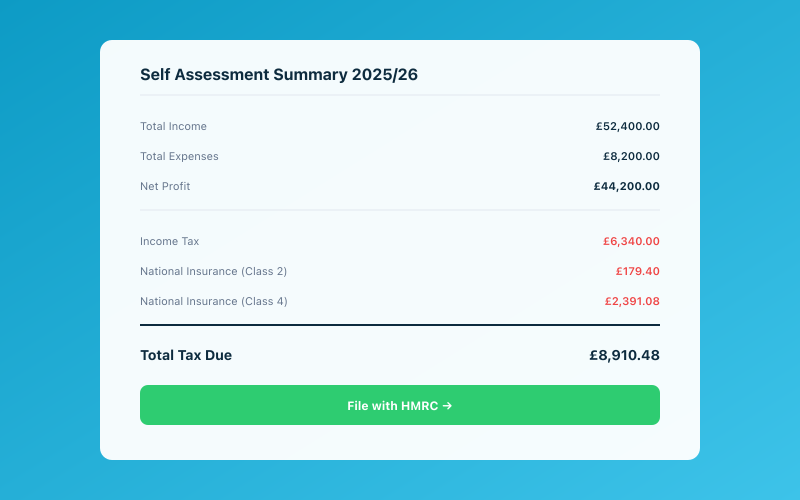 Your Accounted dashboard shows your real-time tax position
You're a Scottish taxpayer if Scotland is where you live — more specifically, where your "main place of residence" is. It doesn't matter where your clients are based, where your business is registered, or where the work is carried out. If you live in Edinburgh but all your clients are in London, you pay Scottish rates.
HMRC determines your taxpayer status based on your address. If you've registered as self-employed, your address on file with HMRC is what counts. If you move between Scotland and the rest of the UK during the tax year, HMRC uses a set of tests to determine which country you're considered resident in for that year.
Your tax code will start with an "S" if HMRC considers you a Scottish taxpayer — for example, S1257L instead of 1257L. If you think your tax code is wrong, contact HMRC to get it corrected.
Scottish Income Tax Rates and Bands for 2025/26
Here's where things get interesting. Scotland has six income tax bands, compared to three in the rest of the UK. For the 2025/26 tax year, the Scottish rates are:
| Band | Taxable Income | Rate | |------|---------------|------| | Personal Allowance | Up to £12,570 | 0% | | Starter rate | £12,571 to £14,876 | 19% | | Scottish basic rate | £14,877 to £26,561 | 20% | | Intermediate rate | £26,562 to £43,662 | 21% | | Higher rate | £43,663 to £75,000 | 42% | | Advanced rate | £75,001 to £125,140 | 45% | | Top rate | Above £125,140 | 48% |
Compare that to the rest of the UK:
| Band | Taxable Income | Rate | |------|---------------|------| | Personal Allowance | Up to £12,570 | 0% | | Basic rate | £12,571 to £50,270 | 20% | | Higher rate | £50,271 to £125,140 | 40% | | Additional rate | Above £125,140 | 45% |
The Personal Allowance of £12,570 is the same across the whole UK — the Scottish Parliament doesn't have the power to change that.
What This Actually Means for Your Tax Bill
Let's run through some examples to show the real-world difference.
If your taxable profits are £30,000:
In the rest of the UK, you'd pay:
- 20% on £17,430 (£30,000 minus £12,570) = £3,486
In Scotland, you'd pay:
- 19% on £2,306 (£12,571 to £14,876) = £438.14
- 20% on £11,685 (£14,877 to £26,561) = £2,337
- 21% on £3,439 (£26,562 to £30,000) = £722.19
- Total: £3,497.33
That's about £11 more in Scotland. Not a huge difference at this level.
If your taxable profits are £50,000:
In the rest of the UK: £7,486 In Scotland: approximately £8,275
Now the gap is more noticeable — roughly £789 more in Scotland, mainly because the higher rate kicks in at £43,663 rather than £50,271.
If your taxable profits are £80,000:
In the rest of the UK: approximately £19,432 In Scotland: approximately £21,662
At higher income levels, the difference becomes more significant, partly because Scotland's higher and advanced rates are steeper.
The pattern is clear: if you earn under about £28,000, you'll pay slightly less in Scotland (thanks to the 19% starter rate). Above that, you'll generally pay more, and the gap widens as your income increases.
National Insurance — No Difference
Here's something that catches people out: National Insurance is not devolved to Scotland. It's set by the UK Government, and the rates are identical across the whole of the UK.
For 2025/26, self-employed National Insurance is:
- Class 2 NI: £3.45 per week if profits are above £12,570
- Class 4 NI: 6% on profits between £12,570 and £50,270, plus 2% on profits above £50,270
So while your income tax bill might differ, your NI contributions will be the same as someone in England with identical profits.
VAT, Expenses, and Everything Else
VAT is also a UK-wide tax, not devolved. The registration threshold is £90,000 across the whole UK, and the rules for charging, reclaiming, and reporting VAT are identical regardless of where you're based.
Allowable expenses are the same too. You can claim the same costs against your profits — travel, equipment, office costs, professional subscriptions, and so on. Our complete list of sole trader expenses covers everything in detail.
Making Tax Digital for Income Tax applies equally in Scotland. From April 2026, sole traders with income over £50,000 will need to keep digital records and submit quarterly updates to HMRC. The threshold drops to £30,000 from April 2027. This is a UK-wide requirement — there's no Scottish exemption.
Self Assessment works the same way too. You file one tax return covering all your income, and HMRC calculates your tax using the Scottish rates if you're a Scottish taxpayer. There's no separate Scottish tax return.
Tax Planning for Scottish Self-Employed
Because the tax bands are different in Scotland, some tax planning strategies work slightly differently.
Pension contributions are particularly valuable for Scottish taxpayers earning above £43,663, because you get relief at 42% (or higher) rather than the 40% you'd get in the rest of the UK at comparable income levels. Every £1,000 you put into a pension effectively costs you only £580 if you're in the Scottish higher rate band — compared to £600 at the 40% rate elsewhere. If you're not already paying into a pension, it's worth thinking about. Our guide on how much tax you'll pay as a sole trader explains how pension contributions interact with your overall tax position.
Timing your income matters if you're near a band threshold. Because Scotland has more bands, there are more thresholds to be aware of. If you can legitimately shift income between tax years — for example, by timing when you invoice clients — you might be able to keep more of your earnings in a lower band.
Claiming all your expenses is always important, but it's particularly impactful in Scotland where marginal rates are higher. An expense that saves you 42% in tax is worth more than one that saves you 40%. Make sure you're claiming everything you're entitled to — tools like Accounted make it straightforward to track expenses throughout the year. Penny can help flag categories you might be missing, so you're not leaving money on the table.
Council Tax and Business Rates
Council tax is devolved to Scotland, and while it works on a similar banded system, the valuation bands and amounts differ from England. This matters if you're working from home and claiming a proportion of household costs as a business expense.
Business rates in Scotland also work differently. The Small Business Bonus Scheme in Scotland is generally more generous than the equivalent relief in England. Properties with a rateable value up to £12,000 are fully exempt from business rates, and there's tapering relief for properties up to £35,000. This can make a real difference if you're considering taking on commercial premises.
Scottish Enterprise and Business Support
Scotland has its own business support ecosystem. Scottish Enterprise and Highlands and Islands Enterprise offer advice, funding, and support programmes that aren't available in the rest of the UK. Business Gateway provides free workshops, one-to-one advice, and access to funding databases.
These resources are well worth exploring, especially if you're just starting out. Some programmes offer grants or subsidised loans that can help with setup costs.
Keeping on Top of It All
The Scottish tax system adds an extra layer of complexity, but it's manageable if you stay organised. The key things to remember are:
- Check your tax code. Make sure it starts with "S" if you live in Scotland.
- Use the Scottish rates when estimating your tax. Don't rely on generic UK tax calculators — make sure they account for Scottish bands.
- Set aside enough for your tax bill. Because Scottish rates are slightly higher for most earners, you may need to put away a bit more than the commonly quoted 25-30%.
- Keep accurate records. This is true everywhere, but getting your bookkeeping right from the start means no nasty surprises when you file your return.
Accounted is designed to handle Scottish tax calculations automatically, so you always know where you stand. Whether you're a freelance developer in Glasgow or a tradesperson in the Highlands, keeping your finances in order shouldn't feel like a second job.
Related Reading
Start your free trial and let Penny handle your bookkeeping automatically.
Accounted helps UK sole traders stay on top of their bookkeeping and tax. Start your free 30-day trial at getaccounted.co.uk.
Penny, your AI bookkeeper, tracks your tax position in real time and flags opportunities to reduce your bill. Meet Penny →
Tax & Compliance Specialists
Our tax specialists have decades of combined experience in UK sole trader and small business taxation, MTD compliance, and HMRC submissions. All content is reviewed against current HMRC guidance before publication and updated quarterly to reflect legislative changes.
Ready to try Accounted?
Join UK sole traders who are simplifying their bookkeeping and tax.
Start your 14-day free trial