Tax on Redundancy If You Also Run a Business
Being made redundant is stressful enough on its own. When you also run a business on the side — or you're planning to go full-time self-employed after redundancy — the tax picture gets considerably more complicated. You've suddenly got employment income, a redundancy payment, and self-employment income all landing in the same tax year, and HMRC expects you to get the sums right.
Let's untangle how it all works, what's taxable, what isn't, and how to avoid the pitfalls that catch people out.
How Redundancy Pay Is Taxed
First, the basics. Genuine redundancy payments in the UK benefit from a £30,000 tax-free exemption. The first £30,000 of your redundancy payout — provided it's a genuine termination payment and not disguised salary — is completely free of income tax and employee National Insurance.
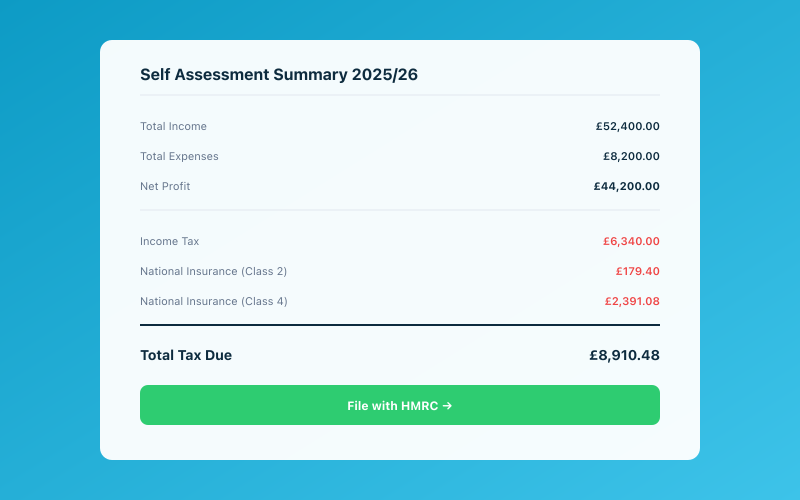 Your Accounted dashboard shows your real-time tax position
Anything above £30,000 is taxed as income at your marginal rate. So if you're a basic rate taxpayer, you'll pay 20% on the excess. If you're a higher rate taxpayer, it's 40%.
But here's where having a business matters: your redundancy payment doesn't exist in isolation. It gets stacked on top of all your other income for the tax year. And that includes your self-employment profits.
How Self-Employment Income Affects Your Tax Band
When you're employed and self-employed at the same time, HMRC adds all your income together to work out your tax liability for the year. This means:
- Your employment salary (up to the date of redundancy)
- Any taxable redundancy pay (the amount above £30,000)
- Your self-employment profits for the year
All of this is combined to determine which tax band you fall into.
Let's say you earned £25,000 in salary before being made redundant, received a £45,000 redundancy payment (of which £15,000 is taxable after the £30,000 exemption), and your side business made £20,000 profit in the same tax year. Your total taxable income would be £60,000 — well into higher rate territory.
That means some of your self-employment income that might normally have been taxed at 20% could end up being taxed at 40%, purely because the taxable portion of your redundancy payment has pushed you into a higher band.
This is a scenario we've explored in more detail in our guide to tax when employed and self-employed, which is worth reading alongside this article.
Payments on Account — The Cash Flow Trap
If you've been running your business while employed, you may already be making payments on account through Self Assessment. But if your employment income was previously your main source and your self-employment income was relatively small, your payments on account might be modest.
The year you're made redundant, everything can change. If your total tax liability jumps significantly — because of the taxable redundancy pay stacked on top of your business income — you could face a nasty surprise. Not only will you owe a bigger balancing payment in January, but HMRC will also set your payments on account for the following year based on this inflated figure.
You can apply to reduce your payments on account if you believe next year's income will be lower (for example, if the redundancy was a one-off event). But be careful — if you reduce them too much and your actual income turns out to be higher, HMRC will charge interest on the underpayment.
Keeping a close eye on your cash flow during this transition period is essential. Using Accounted to track your business income in real time can help you forecast what you'll owe and avoid nasty surprises. Penny can flag when your income is trending higher than expected, giving you time to set more aside.
What Counts as "Genuine" Redundancy?
HMRC is particular about what qualifies for the £30,000 exemption. The payment must be a genuine termination payment — compensation for losing your job, not a reward for past service or a contractual entitlement.
The following are taxed as normal earnings and do not qualify for the £30,000 exemption:
- Pay in lieu of notice (PILON) — this is taxable even if your contract doesn't specifically mention it. Since April 2018, all PILONs are treated as taxable earnings.
- Unused holiday pay — this is a contractual entitlement, so it's taxed through PAYE as normal.
- Bonuses — even if paid at the same time as your redundancy, any bonus you were contractually entitled to is taxed as earnings.
- Restrictive covenant payments — compensation for agreeing not to compete with your former employer. These are taxable in full.
Only the genuine "ex gratia" element — the amount that goes beyond what you were contractually owed — qualifies for the £30,000 exemption. Your employer should break this down on your P45, but it's worth checking the figures yourself.
National Insurance Considerations
The National Insurance picture when you're employed and self-employed simultaneously has its own quirks.
As an employee, you pay Class 1 NI on your salary (and your employer pays their share). As a self-employed person, you pay Class 4 NI on your business profits and Class 2 NI as a flat weekly amount.
When HMRC calculates your total NI for the year, they take into account what you've already paid through employment. If you've paid a lot of Class 1 NI through your salary, your Class 4 liability may be reduced. This is handled automatically through your Self Assessment return, but it's worth understanding so you're not alarmed when the numbers look different from what you might expect.
On the redundancy payment itself, you don't pay employee NI on the first £30,000. Your employer, however, does pay employer NI on any amount above £30,000 — that's their problem, not yours, but it's useful context.
Using Redundancy Money to Invest in Your Business
Many people see redundancy as an opportunity to invest in their business and go full-time. That's a perfectly reasonable strategy, but there are a few tax points to bear in mind.
Money you invest in your business from your redundancy payout doesn't reduce your tax liability on the redundancy itself. The £30,000 exemption is fixed — you can't increase it by reinvesting the money. The taxable portion remains taxable regardless of what you do with it.
However, if you use the money to buy equipment, tools, or technology for your business, those purchases may qualify for capital allowances. The Annual Investment Allowance (AIA) lets you deduct the full cost of qualifying capital expenditure from your taxable business profits. So whilst you can't offset the purchase against your redundancy pay, you can offset it against your self-employment income.
For instance, if you use some of your redundancy money to buy a new laptop, professional equipment, or a vehicle for business use, the capital allowance deduction reduces your self-employment profits, which in turn reduces your overall tax bill. Our guide to tax on selling business assets covers the flip side of this — what happens when you dispose of assets you've claimed allowances on.
Timing Matters — Which Tax Year Does the Redundancy Fall In?
Your redundancy payment is taxable in the year you receive it, not the year you were made redundant (though usually these are the same). If your redundancy straddles the end of the tax year — say you're given notice in February and the payment is made in May — the tax year the money lands in affects your overall position.
If you have any flexibility in timing (some settlement agreements allow for deferred payments), it may be worth considering which tax year gives you the better result. For example, if your self-employment income is expected to be lower next year, deferring part of the payment could mean a lower marginal rate.
This is genuinely a situation where a bit of planning can save real money. It's not about avoidance — it's about making sensible decisions within the rules.
Practical Steps When You're Made Redundant
Here's a checklist of things to do if you're made redundant whilst running a business:
- Get the breakdown of your redundancy payment — make sure you know what's taxable and what falls under the £30,000 exemption.
- Check your P45 — the tax code and cumulative figures should reflect your earnings and tax paid up to your leaving date.
- Update your Self Assessment records — you'll need to report both your employment income and your self-employment income on your return. Accounted makes the self-employment side straightforward, and you can add employment details when filing.
- Review your payments on account — if the redundancy pushes your tax bill up significantly, consider whether you need to adjust future payments on account.
- Set money aside for tax — with no employer to handle PAYE for you going forward, you're responsible for your entire tax bill. A good rule of thumb is to set aside 25-30% of everything you earn.
- Consider pension contributions — if you have spare cash from the redundancy and want to reduce your tax bill, pension contributions are one of the most tax-efficient options. You get tax relief at your marginal rate.
Don't Forget About Benefits
If your business income is low whilst you're building it up, you may be eligible for certain benefits or tax credits after redundancy. Universal Credit, for example, takes self-employment income into account, but there are reporting requirements and a minimum income floor that applies after a start-up period.
This is a separate topic entirely, but worth flagging so you don't leave money on the table.
Related Reading
Start your free trial and let Penny handle your bookkeeping automatically.
Accounted helps UK sole traders stay on top of their bookkeeping and tax. Start your free 30-day trial at getaccounted.co.uk.
Penny, your AI bookkeeper, tracks your tax position in real time and flags opportunities to reduce your bill. Meet Penny →
Tax & Compliance Specialists
Our tax specialists have decades of combined experience in UK sole trader and small business taxation, MTD compliance, and HMRC submissions. All content is reviewed against current HMRC guidance before publication and updated quarterly to reflect legislative changes.
Ready to try Accounted?
Join UK sole traders who are simplifying their bookkeeping and tax.
Start your 14-day free trial