Starting a Business After Redundancy — A Tax and Planning Guide
Redundancy is never the news you want to hear. Whether you saw it coming or it blindsided you on a Tuesday morning, the emotional weight of losing your job can be enormous. But here's the thing — for a surprising number of people, redundancy turns out to be the push they needed to finally go it alone.
If you're sitting at home with a redundancy payment in your bank account and a half-formed business idea in your head, this guide is for you. We'll walk through the tax implications of your redundancy pay, the practical steps for setting up a business, and how to make sure HMRC doesn't catch you off guard in your first year.
Is Your Redundancy Pay Taxable?
Let's start with the money that's already in your pocket — or soon will be.
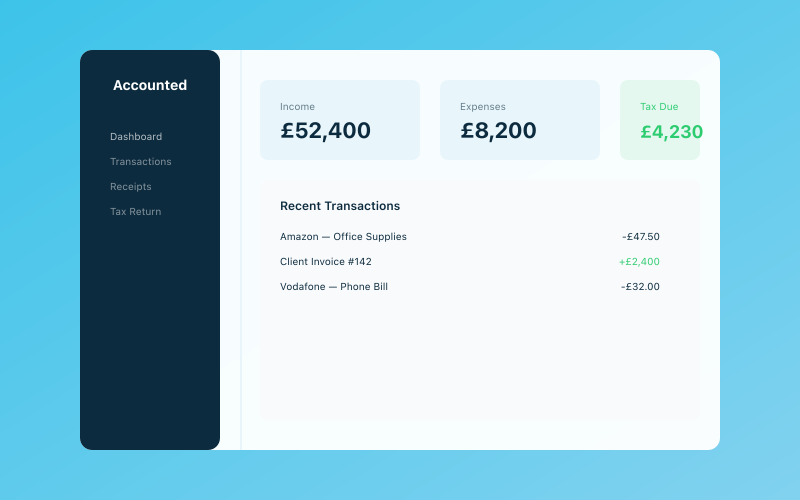 Your Accounted dashboard — income, expenses, and tax at a glance
The good news is that statutory redundancy pay is tax-free up to £30,000. This applies to the lump sum your employer pays you based on your length of service. You won't pay Income Tax or National Insurance on it, provided it stays within that threshold.
However, things get a bit more complicated if your total redundancy package exceeds £30,000. Anything above that figure is taxable as earnings, and your employer should deduct the tax through PAYE before paying you. It's worth checking your payslip carefully to make sure the right amount has been deducted.
There are a few other bits that are always taxable regardless of the £30,000 limit:
- Pay in lieu of notice (PILON) — If your contract entitles you to a notice period but your employer pays you off instead, that money is taxed as normal earnings.
- Holiday pay — Any accrued but untaken holiday pay is taxed through PAYE.
- Bonuses — Outstanding bonuses owed to you are treated as regular income.
Understanding this distinction matters because it affects how much capital you actually have to invest in your new venture. A lot of people assume their entire package is tax-free, then get a nasty surprise when their Self Assessment bill arrives.
Should You Use Your Redundancy Payment to Fund Your Business?
This is one of the most important decisions you'll make, and there's no one-size-fits-all answer.
Your redundancy payment might feel like a golden opportunity to invest in equipment, stock, or marketing. And it can be — but you need to be strategic about it. The first rule is to separate your personal safety net from your business capital.
Most financial advisers suggest keeping at least three to six months' worth of living expenses in a savings account before you put a single penny into your business. Self-employment income is unpredictable, especially in the early months, and you don't want to be choosing between paying your mortgage and buying stock.
Once you've set aside your personal buffer, consider how much you actually need to get started. Many service-based businesses can launch with very little upfront investment — a laptop, some software subscriptions, and a basic website might be all you need. If you're starting a business that requires significant capital, look into start-up loans and grants before dipping into your redundancy pay.
It's also worth noting that money you spend setting up your business before you officially start trading can often be claimed as pre-trading expenses. HMRC allows you to claim costs incurred up to seven years before you begin trading, provided they would have been allowable as a business expense if you were already trading. That includes things like market research, training courses, and professional advice.
Registering With HMRC and Choosing Your Structure
If you're going to work for yourself, HMRC needs to know about it. You must register as self-employed within three months of starting your business, though doing it sooner is always better.
The simplest structure for most people starting out is a sole trader. It's free to set up, the paperwork is minimal, and you keep complete control of your business. You'll pay Income Tax on your profits and Class 2 and Class 4 National Insurance contributions.
Some people jump straight to setting up a limited company, thinking it will save them tax. While that can be true once you're earning above a certain level, it also comes with more administrative burden — annual accounts, Corporation Tax returns, and Companies House filings. For most new businesses, starting as a sole trader and reviewing the position after a year or two makes far more sense.
When you register, you'll receive a Unique Taxpayer Reference (UTR) number, which you'll need for your Self Assessment tax return. You'll also be enrolled for Class 2 National Insurance, which is worth paying even if your profits are low because it protects your State Pension entitlement.
Writing a Business Plan (Even a Simple One)
You don't need a 50-page document with fancy charts. But sitting down and working through the basics of your business plan is genuinely useful, even if nobody else ever reads it.
At a minimum, your plan should cover:
- What you're selling — Be specific. "Consultancy" is vague. "HR consultancy for small manufacturing firms in the West Midlands" is a business.
- Who your customers are — Where will you find them? How will you reach them?
- How much you'll charge — Research what competitors charge and decide where you sit.
- Your costs — List everything, from software subscriptions to insurance to travel.
- Your financial forecast — Even a rough one. How much do you need to earn each month to cover your costs and pay yourself?
A good business plan also forces you to think about the less exciting but equally important stuff — like insurance, terms and conditions, and whether you need any licences or qualifications. If you need help getting started, our business plan guide walks you through the process step by step.
Understanding Your Tax Obligations in Year One
Your first year of self-employment can feel like a tax minefield if you're not prepared. Here's what you need to know.
Income Tax is charged on your business profits — that's your income minus your allowable expenses. The personal allowance for 2025/26 is £12,570, so you won't pay tax on the first £12,570 of your total income. After that, you'll pay 20% on earnings up to £50,270, and 40% on anything above that.
National Insurance comes in two flavours for the self-employed. Class 2 contributions are a flat weekly rate (currently £3.45 per week), and Class 4 contributions are charged at 6% on profits between £12,570 and £50,270, then 2% on anything above that.
Payments on account are where a lot of new business owners get caught out. If your tax bill for the year exceeds £1,000, HMRC will ask you to make advance payments towards the following year's bill. These are due on 31 January and 31 July, and they're each 50% of your previous year's tax bill. In your first year, this means you could end up paying 150% of your tax bill in one go — your actual bill plus the first payment on account for the next year.
The best way to avoid this shock is to start setting aside money for tax from day one. A common approach is to put 25-30% of your income into a separate savings account each time you get paid. Tools like Penny in Accounted can help you track your income and expenses in real time, so you always have a clear picture of what you're likely to owe.
For a more detailed breakdown of your first year, have a look at our first year of self-employment guide.
Grants, Loans, and Support Available
Being made redundant doesn't mean you're on your own. There's a surprising amount of support available for people starting businesses in the UK.
Start Up Loans are government-backed personal loans of up to £25,000 for new businesses. They come with a fixed interest rate of 6% and include free mentoring. You don't need to put up any collateral, and repayments don't start for the first 12 months if you choose a repayment holiday.
New Enterprise Allowance may be available through your local Jobcentre Plus, offering mentoring and sometimes a weekly allowance while you get your business off the ground.
Local enterprise partnerships and councils often run their own grant schemes, particularly for businesses in specific sectors or areas of deprivation. It's worth checking what's available in your region.
Professional bodies in many industries offer career transition support, networking events, and sometimes grants for members who are setting up on their own.
Don't overlook the practical support either. Free workshops on business planning, marketing, and bookkeeping are run by organisations like the Federation of Small Businesses, local libraries, and business hubs across the country.
Keeping Your Records Straight From Day One
One of the biggest mistakes new business owners make is treating record-keeping as something they'll "sort out later." Later usually means a panicked weekend in January, trying to reconstruct twelve months of transactions from memory and a shoebox of receipts.
Start as you mean to go on. Open a separate business bank account, even though it's not a legal requirement for sole traders — it makes tracking your income and expenses infinitely easier. Keep digital copies of all your receipts and invoices. Record your expenses as they happen, not three months after the fact.
With Accounted, you can photograph receipts on your phone, and Penny will categorise them automatically. It takes seconds, and it means your records are always up to date. When Self Assessment time comes around, you'll have everything you need at your fingertips instead of facing a stressful scramble.
Good record-keeping isn't just about keeping HMRC happy. It gives you a clear picture of how your business is performing, which expenses are eating into your profits, and whether you're on track to meet your financial goals. That kind of visibility is invaluable when you're building something new.
Moving Forward With Confidence
Redundancy can feel like an ending, but it can also be the beginning of something genuinely exciting. Thousands of successful businesses in the UK were born out of redundancy — often because losing a job gave someone the time, the motivation, and the financial cushion to finally take the leap.
The key is to approach it with a clear head and a solid plan. Understand the tax implications of your redundancy pay. Set aside a personal safety net before investing in your business. Register with HMRC promptly. Keep your records in order from the start. And don't be afraid to ask for help — whether that's from a mentor, an accountant, or a tool that takes the pain out of bookkeeping.
Accounted helps UK sole traders stay on top of their bookkeeping and tax. Start your free 30-day trial at getaccounted.co.uk.
Related reading:
- Tax, Redundancy, and Running a Business
- Your First Year of Self-Employment — A Complete Guide
- How to Register as Self-Employed With HMRC
Related Reading
View our pricing and start your free 30-day trial today.
Starting out? Accounted is built for UK sole traders from day one — from £14/month. Get started →
Business & Operations Advisors
Our business advisors cover the practical side of running a UK sole trader business — from HMRC registration to managing growth. Content is written for real business owners in plain English, not accountants.
Ready to try Accounted?
Join UK sole traders who are simplifying their bookkeeping and tax.
Start your 14-day free trial