Setting Up a Business While Travelling
Starting a business is exciting enough when you're sitting at your kitchen table. Starting one while backpacking through Southeast Asia, road-tripping across Europe, or hopping between Airbnbs? That's a whole different level of ambition — and it comes with a whole different set of practical challenges.
The good news is that it's entirely possible to register and run a UK sole trader business from almost anywhere in the world. The not-so-good news is that there are a few things you need to get right from the start, or you'll spend your travels firefighting admin instead of actually building something.
This guide covers the essentials — from registration to banking to bookkeeping — so you can launch your business on the road without the headaches.
Can You Actually Register a Business While Abroad?
Yes, you can. HMRC doesn't require you to be physically in the UK to register as a sole trader. The process is done online, and as long as you have a UK address for correspondence (more on that shortly) and a National Insurance number, you can register from anywhere with an internet connection.
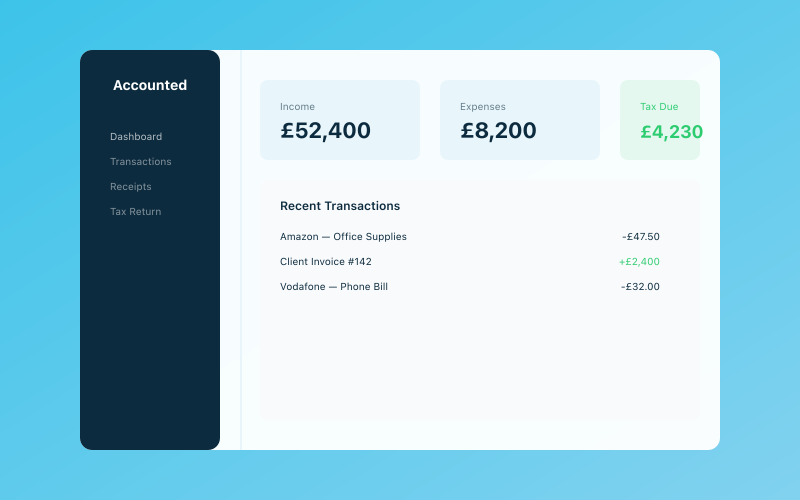 Your Accounted dashboard — income, expenses, and tax at a glance
You'll need to register with HMRC for Self Assessment, which you can do through the Government Gateway. The process typically takes a few days to complete — HMRC will send your Unique Taxpayer Reference (UTR) by post, which is where having a UK address becomes important.
If you don't have a fixed UK address, there are a few options. You could use a family member's address, a mail forwarding service, or a registered office address service. Just make sure you'll actually receive the post, because missing important letters from HMRC is a fast track to problems.
One thing to bear in mind: registering as a sole trader while abroad doesn't change your tax residency status. If you're still UK tax resident — which you likely are if you haven't been away for a full tax year — you'll pay UK tax on your worldwide income. We've covered this in detail in our guide to working abroad temporarily and UK tax.
Getting Your Banking Sorted
This is one of the trickiest bits of setting up while travelling, and it's worth tackling early.
Most UK business bank accounts require some form of identity verification, and many still prefer you to be in the UK when you apply. However, several digital-first banks — such as Starling, Monzo Business, and Tide — allow you to open an account from abroad using your smartphone. You'll typically need your passport, a UK address, and a selfie for verification.
Having a dedicated business bank account from day one is strongly recommended, even though it's not legally required for sole traders. Mixing personal and business finances is a recipe for bookkeeping chaos, especially when you're dealing with multiple currencies and foreign transaction fees.
Speaking of currencies, if you're earning in pounds but spending in local currencies, keep an eye on exchange rate fees. Some banks charge hefty margins on foreign transactions. A multi-currency account or a specialist card like Wise can save you a surprising amount over time.
Here are a few practical tips for banking on the road:
- Open your business account before you leave if possible. It's almost always easier.
- Set up mobile banking and ensure you have access to all security features (authentication apps, backup codes, etc.).
- Keep a backup payment method. If your main card gets blocked for suspicious activity (common when you're switching countries frequently), you need a fallback.
- Download offline copies of your bank statements regularly. Internet access isn't always reliable when you're travelling.
Building Your Admin Foundation on the Move
The temptation when you're travelling is to focus entirely on the fun parts of your business — finding clients, doing the work, building your brand — and leave the boring admin for later. Don't. "Later" has a nasty habit of turning into "never," and then you're facing a mountain of unsorted receipts and unexplained transactions come January.
Here's the minimum admin foundation you should set up before (or immediately after) you start trading:
Bookkeeping software. You need something cloud-based that you can access from any device, anywhere. Accounted is designed specifically for UK sole traders, and Penny — our AI assistant — can categorise your transactions and help you keep on top of things even when you're distracted by sunset cocktails. The point is to build good habits from the start, because catching up later is always harder than keeping up in real time.
A system for receipts. Whether you use an app to photograph receipts or save digital receipts in a dedicated email folder, you need a system. HMRC expects you to keep records of all business income and expenses for at least five years. Shoving paper receipts into your backpack isn't a system.
An invoicing process. If you're providing services, you need to invoice clients promptly and professionally. Cloud-based invoicing tools let you send invoices from anywhere and track who's paid and who hasn't.
A simple filing system. Create folders (physical or digital) for contracts, invoices, receipts, bank statements, and HMRC correspondence. It doesn't need to be complicated, but it does need to exist.
Choosing What to Sell
If you're setting up a business specifically to fund your travels, the type of business matters more than you might think.
Service-based businesses tend to work best for travellers because there's no physical product to ship, store, or deal with at customs. Freelance writing, web development, graphic design, virtual assistance, consulting, social media management, online tutoring — these are all viable options that need nothing more than a laptop and a decent Wi-Fi connection.
Product-based businesses are trickier on the road. Dropshipping can work if you set it up properly, but anything that requires you to handle inventory is going to be a logistical nightmare unless you have someone back in the UK managing that side of things.
Digital products — ebooks, courses, templates, printables — sit somewhere in between. They take effort to create upfront but can generate income without ongoing fulfilment headaches.
Whatever you choose, think about time zones. If your clients are in the UK and you're twelve hours ahead, communication can get awkward. Many travelling sole traders find it helpful to set clear working hours and communicate them upfront, rather than trying to be available around the clock.
Tax Obligations You Can't Ignore
Setting up a business while travelling doesn't exempt you from any of the usual UK tax obligations. Here's what you need to stay on top of:
Self Assessment. You'll need to file a tax return for any tax year in which you were self-employed, even if you didn't make a profit. The deadline is 31 January following the end of the tax year (so 31 January 2028 for the 2026/27 tax year).
National Insurance. As a sole trader, you'll pay Class 2 and Class 4 National Insurance contributions on your profits. Class 2 is a flat weekly rate; Class 4 is a percentage of your profits above a threshold.
VAT. If your taxable turnover exceeds the VAT registration threshold (currently £90,000), you must register for VAT. If you're just starting out while travelling, you're unlikely to hit this immediately, but keep an eye on it.
Making Tax Digital. From April 2026, sole traders with qualifying income above the threshold need to keep digital records and submit quarterly updates to HMRC. Even if you're below the threshold, getting into the habit of digital record-keeping now will save you effort later.
Overseas tax. Depending on where you are and how long you stay, the country you're in might also have a claim on your income. This is particularly relevant if you stay somewhere for several months. Always check local tax rules before settling in anywhere for an extended period.
Staying Connected and Productive
The practical reality of running a business while travelling is that you'll face challenges you wouldn't encounter at home. Power cuts, unreliable Wi-Fi, noisy hostels, jet lag — these are all productivity killers.
A few things that help:
- Research co-working spaces in advance. Many popular digital nomad destinations have excellent co-working facilities with fast internet, quiet spaces, and networking opportunities. We've written about claiming co-working costs as expenses if you're curious about the tax side.
- Carry a portable Wi-Fi hotspot or local SIM card. Don't rely solely on café Wi-Fi for important client calls.
- Build buffer time into deadlines. Things take longer when you're travelling. Give yourself more time than you think you need.
- Batch your admin. Set aside one morning a week (or a fortnight) to deal with invoicing, bookkeeping, and correspondence. This is much more effective than trying to squeeze it in between sightseeing.
- Back up everything. Use cloud storage and keep copies of critical documents accessible offline. Losing your laptop in a foreign country is bad enough without losing all your business records too.
Legal and Insurance Considerations
Don't forget the less glamorous side of things:
Travel insurance. Standard travel insurance often excludes business activities. Look for a policy that specifically covers you working abroad, including your equipment.
Professional indemnity insurance. If you're providing services — advice, design, code — you should consider this regardless of where you're working. A client dispute doesn't care about your location.
Health insurance. The UK's reciprocal healthcare arrangements vary by country. In many places, you'll need private health insurance. Factor this into your business costs.
Data protection. If you're handling client data, you still need to comply with UK GDPR, even when you're abroad. Be careful about using public Wi-Fi for sensitive work, and make sure your devices are properly secured.
Contracts. Always have clear terms of business with your clients, specifying things like payment terms, jurisdiction (usually England and Wales), and the scope of your work. This is important at the best of times, but even more so when you're in a different country from your clients.
Making It Sustainable
The final piece of the puzzle is sustainability — both financial and personal.
Many travelling sole traders start with enthusiasm and run out of steam (or money) within a few months. The ones who make it work long-term tend to share a few characteristics:
They have a financial buffer. At least three to six months of living expenses saved up before they start.
They treat it as a business first, a lifestyle second. The travel is the reward for doing good work, not a substitute for it.
They stay disciplined with their finances. They know what's coming in, what's going out, and what they owe HMRC. Tools like Accounted help enormously here — Penny keeps track of your numbers so you can focus on the work (and the views).
They're realistic about costs. Travelling can be cheaper than living in the UK, but it's not always as cheap as the Instagram influencers make it look. Factor in visas, insurance, co-working fees, flights, and the occasional tourist-trap dinner.
They plan for the boring bits. Tax returns, quarterly updates, bookkeeping — these things don't stop just because you're in paradise.
Related reading:
- Working Abroad Temporarily — UK Tax
- Co-Living and Co-Working Spaces — Can You Claim the Costs?
- Work From Home Expenses 2025/26
Accounted helps UK sole traders stay on top of their bookkeeping and tax. Start your free 30-day trial at getaccounted.co.uk.
Related Reading
- How to Start a Courier or Delivery Business
- Retiring From Teaching and Starting a Consultancy — Tax Guide
View our pricing and start your free 30-day trial today.
Starting out? Accounted is built for UK sole traders from day one — from £14/month. Get started →
Business & Operations Advisors
Our business advisors cover the practical side of running a UK sole trader business — from HMRC registration to managing growth. Content is written for real business owners in plain English, not accountants.
Ready to try Accounted?
Join UK sole traders who are simplifying their bookkeeping and tax.
Start your 14-day free trial