How to Start a Courier or Delivery Business
The courier and delivery industry in the UK has grown enormously over the past few years, and the demand for reliable delivery services shows no sign of slowing down. Whether it's same-day parcels, medical supplies, legal documents, or last-mile e-commerce deliveries, businesses and individuals need things moved from A to B quickly and safely.
Starting a courier business is one of the most straightforward paths into self-employment. The startup costs are relatively low, you can begin with a vehicle you already own, and there's a wide range of work available — from gig-economy deliveries to dedicated commercial contracts. Here's how to get it right from the start.
Types of Work, Vehicles and Getting Registered
Before you invest in a vehicle or sign up to a platform, it's worth understanding the different types of courier work available. Same-day couriers collect and deliver time-sensitive items within hours — this tends to be the highest-paying work. Multi-drop deliveries involve delivering multiple parcels along a planned route, often working with companies like Amazon, DPD, Hermes (now Evri), or Royal Mail. Specialist deliveries cover medical samples, legal documents, fragile items, or high-value goods and can command premium rates. Last-mile delivery — the final leg from depot to customer — is the fastest-growing segment. Furniture and large-item delivery requires a larger vehicle but offers higher fees. Food delivery through platforms like Deliveroo, Uber Eats, or Just Eat has lower barriers to entry but generally lower pay per delivery. Many couriers start with one type and diversify as they learn the market.
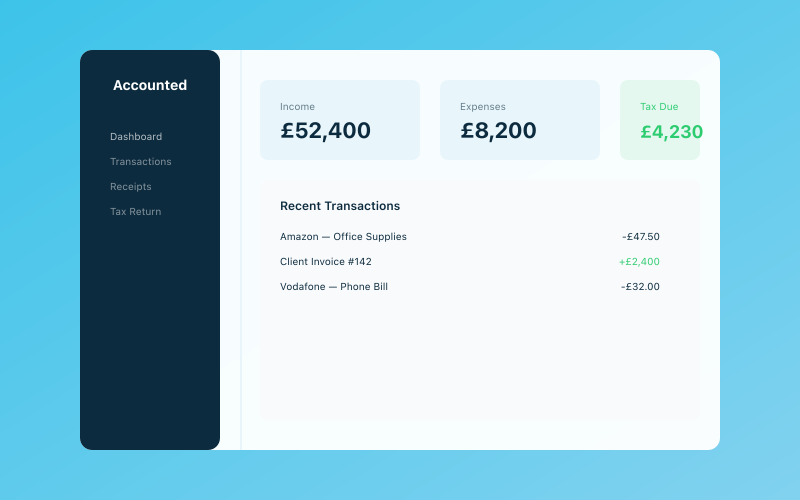 Your Accounted dashboard — income, expenses, and tax at a glance
Your vehicle is your most important business asset. A car works for document delivery and small parcels. A small van (Ford Transit Connect, VW Caddy) suits multi-drop parcel delivery. A medium van (Ford Transit, Mercedes Sprinter SWB) is the most versatile option. A large van (Luton, Sprinter LWB) handles furniture delivery and high-volume routes. Motorcycles and bicycles are ideal for city-centre deliveries. If money is tight, begin with whatever vehicle you have and upgrade once the revenue justifies it. Whatever you choose, make sure it's reliable — breaking down mid-route with a van full of parcels is not a situation you want.
Here's what you need to sort before your first delivery. Register as self-employed with HMRC — you'll need to register for Self Assessment. Our guide to registering as self-employed with HMRC walks you through it. Goods in transit insurance covers items you're carrying if they're lost, stolen, or damaged — most businesses require it. Courier insurance (hire and reward) is absolutely essential — standard vehicle insurance doesn't cover you for carrying goods for payment, and if you have an accident on a standard policy, your insurer can refuse to pay out. Public liability insurance covers injury or damage on a client's premises. If you're using a vehicle over 3.5 tonnes, you'll need a standard operator's licence from the Traffic Commissioner. For our sole trader insurance guide, which covers the basics of what sole traders need.
Setting Rates and Finding Work
Courier pricing varies hugely depending on the type of work, distance, urgency, and competition in your area. Same-day courier work typically pays £1.00–£2.00 per mile, with minimum charges of £15–£30 for local jobs. Multi-drop parcel delivery runs at £1.00–£1.50 per drop — an experienced driver can manage 80–120+ drops per day on a dense urban route. Dedicated/contract work offers day rates of £120–£250+ depending on vehicle size and hours. Platform work like Amazon Flex typically pays £13–£16 per hour.
When setting your own rates for direct clients, factor in fuel costs, vehicle wear and tear, insurance, time spent loading and waiting (not just driving), your own tax and National Insurance, and vehicle financing or depreciation. A common mistake is looking at gross revenue and thinking you're doing well without accounting for costs. Always calculate your profit, not just turnover.
There are several routes to building a client base. Courier exchanges and networks like APC Overnight, CitySprint, Speedy Freight, and Absolutely Couriers connect independent couriers with jobs. Multi-drop contracts with Amazon Logistics, DPD, Yodel, and Evri provide reliable but demanding work. Direct clients are the most profitable long-term strategy — approach solicitors, estate agents, medical practices, engineering firms, and online retailers. Local businesses and e-commerce retailers often need affordable local delivery. Specialist markets like medical courier work and art transportation pay well with less competition. A simple website explaining your services and coverage area helps potential clients find you.
Managing Your Finances
Courier work generates a high volume of transactions — fuel purchases, toll charges, parking, vehicle repairs, insurance payments, and income from multiple sources. Keeping on top of it all is essential.
Track your mileage. This is your biggest deductible expense. You can either claim actual vehicle costs (fuel, insurance, repairs, financing) or use HMRC's simplified expenses (45p per mile for the first 10,000 miles, 25p thereafter). You can't switch methods mid-year, so work out which gives you the better deal. Keep a mileage log — HMRC expects detailed records.
Record all expenses. Common allowable expenses for couriers include fuel (if using actual costs method), vehicle insurance (courier/hire-and-reward policy), vehicle servicing, MOT, and repairs, goods in transit insurance, public liability insurance, phone and sat-nav costs, parking and toll charges, vehicle cleaning, PPE (high-vis, safety boots), and accounting software subscriptions.
Using Accounted to track your income and expenses makes the whole process much simpler. Penny, the AI assistant, can help categorise your transactions and flag anything that looks out of place — which is particularly useful when you've got dozens of small expenses every week.
Save for tax. Set aside 25–30% of your earnings in a separate savings account. Invoice promptly if you're working direct with clients — late invoicing leads to late payment, which leads to cash flow problems. For more on getting paid on time, check out our guide on handling late-paying clients.
Understand your employment status. This is a big one. If you work exclusively for one company, use their vehicle, wear their uniform, and follow their schedule, HMRC may consider you an employee rather than self-employed — regardless of what your contract says. Make sure your working arrangements genuinely reflect self-employment.
Growing Your Business and Avoiding Pitfalls
Once you've established yourself, there are several ways to scale. Adding vehicles and taking on another driver is the most common growth path. Diversifying into specialist capabilities — temperature-controlled deliveries, fragile item handling, secure document transport — opens higher-value markets. Winning contracts from larger businesses and logistics companies provides predictable revenue. Investing in vehicle signwriting, a professional website, and consistent branding builds trust and commands better rates. Route optimisation software, real-time tracking, and automated proof-of-delivery systems make you more efficient and more attractive to larger clients.
Having a business plan helps you stay focused as you grow. Our guide to writing a business plan is a good starting point.
The biggest pitfalls to avoid: operating on a standard motor policy is illegal and leaves you exposed — get proper courier insurance from day one. Ignoring vehicle maintenance costs you days of earnings plus repair bills. Undercharging without factoring in all your costs makes busy days unprofitable. Not saving for tax means your first Self Assessment bill comes as a shock. And overworking — long hours behind the wheel take a toll on your health, concentration, and safety.
Starting a courier business is about as straightforward as self-employment gets. You need a vehicle, the right insurance, a registration with HMRC, and the willingness to deliver reliably. The rest is about building relationships, managing your money, and turning up when you say you will. Get registered, get insured, and start delivering.
Related reading:
- How to Register as Self-Employed with HMRC
- How to Write a Business Plan
- How to Handle Late-Paying Clients
Accounted helps UK sole traders stay on top of their bookkeeping and tax. Start your free 30-day trial at getaccounted.co.uk.
Related Reading
- Your First 90 Days as a New Sole Trader — A Survival Guide
- How to Start a Social Media Management Business
- Starting a Business in London — Costs, Taxes, and Tips
View our pricing and start your free 30-day trial today.
Starting out? Accounted is built for UK sole traders from day one — from £14/month. Get started →
Business & Operations Advisors
Our business advisors cover the practical side of running a UK sole trader business — from HMRC registration to managing growth. Content is written for real business owners in plain English, not accountants.
Ready to try Accounted?
Join UK sole traders who are simplifying their bookkeeping and tax.
Start your 14-day free trial