Your First 90 Days as a New Sole Trader — A Survival Guide
Welcome to Self-Employment (Deep Breath)
You've done it. You've decided to work for yourself. Maybe you've handed in your notice, maybe you're starting alongside your day job, or maybe you woke up one morning and thought, "I'm going to make this hobby into a proper business."
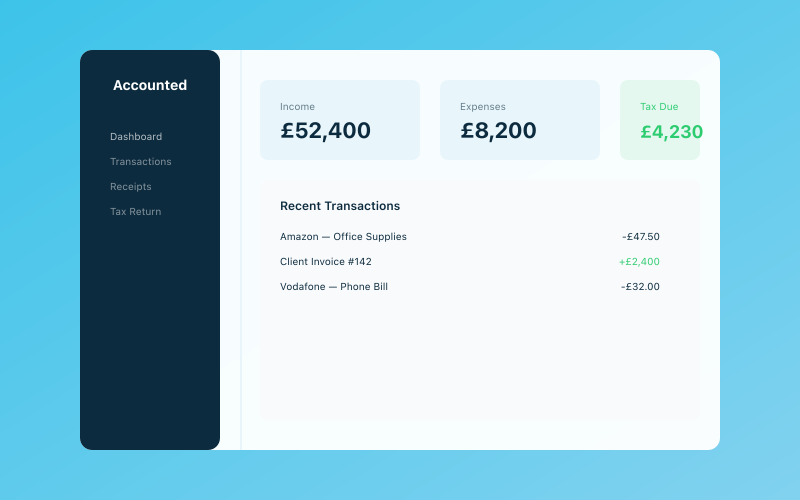 Your Accounted dashboard — income, expenses, and tax at a glance
Whatever brought you here, the first 90 days are crucial. Not because you need to have everything figured out — you won't, and that's completely normal — but because the habits you build now will determine whether you thrive or merely survive.
This isn't a business plan template or a motivational pep talk. It's a practical, week-by-week guide to getting your foundations right. Follow it, and by the end of month three, you'll have a business that's properly set up, financially organised, and ready to grow.
Weeks 1-2: The Foundations
These first two weeks are about admin. Not glamorous, but essential. Think of it as building the house before you start decorating.
Register with HMRC
You need to register as self-employed with HMRC. Technically, you have until 5th October following the end of the tax year in which you started trading, but do it now while it's on your mind. The process takes about 15 minutes online, and you'll receive your Unique Taxpayer Reference (UTR) within 10 working days.
You'll need:
- Your National Insurance number
- Your personal details (name, address, date of birth)
- Your business start date
- A description of what your business does
Our step-by-step registration guide with screenshots walks you through the entire process.
Open a Business Bank Account
You're not legally required to have a separate business bank account as a sole trader, but you absolutely should have one. Mixing personal and business finances is the single biggest mistake new sole traders make. It makes bookkeeping a nightmare, tax returns painful, and HMRC investigations more likely.
Many banks offer free business current accounts for the first year or two. Starling, Tide, and Mettle are popular choices with no monthly fees. Have a look at our business bank account guide for a full comparison.
Set up your account and start using it for all business income and expenses from day one.
Set Up Bookkeeping
You need a system for tracking income and expenses. This doesn't need to be complicated, but it does need to exist. With Making Tax Digital coming into effect for sole traders earning over £50,000 from April 2026, digital record-keeping isn't optional anymore — it's a legal requirement.
Your options range from spreadsheets (technically compliant if linked to MTD software) to full accounting software. Accounted is designed specifically for sole traders and freelancers, with Penny — our AI bookkeeper — handling the categorisation and organisation automatically. Whatever you choose, set it up now, not in January when you're scrambling to file your tax return.
Get Your Paperwork Sorted
While you're in admin mode:
- Set up a filing system (digital is fine) for receipts, invoices, and contracts
- Get business insurance if you need it — public liability, professional indemnity, or both
- Register with the ICO if you process personal data (£40/year for sole traders)
- Check if you need any licences for your specific trade
Weeks 3-4: Money Foundations
Now that the admin basics are done, it's time to get your financial house in order.
Start Tracking Every Expense
From today, keep a record of every business expense. Every. Single. One. The coffee you bought while meeting a client. The printer ink. The portion of your phone bill used for business. The mileage to a networking event.
These are all allowable expenses that reduce your tax bill, but only if you record them. A receipt lost is money lost.
Develop a habit: when you spend money on the business, capture the receipt immediately. Take a photo, upload it to your bookkeeping software, or at minimum, drop it in a dedicated folder on your phone. If you're using Accounted, Penny can handle receipt scanning and categorisation through WhatsApp — just snap a photo and send it.
Understand Your Tax Obligations
Let's get the numbers clear for 2025/26:
- Personal Allowance: £12,570 (no tax on the first £12,570 of income)
- Basic rate: 20% on income from £12,571 to £50,270
- Higher rate: 40% on income from £50,271 to £125,140
- Additional rate: 45% on income above £125,140
- Class 2 NI: £3.45 per week (paid through Self Assessment)
- Class 4 NI: 6% on profits between £12,570 and £50,270, then 2% above £50,270
If you're self-employed alongside a PAYE job, your Personal Allowance will already be used up by your salary, so your self-employment income will be taxed from the first pound.
Set Aside Money for Tax
This is non-negotiable. Open a separate savings account (many banks let you create "pots" or "spaces" within your account) and transfer a percentage of every payment you receive into it.
How much? A simple rule:
- If self-employment is your only income: set aside 25-30% of profits
- If you also have a PAYE job: set aside 30-40% (since your self-employment income is likely taxed at a higher marginal rate)
The amount you actually owe might be less, but it's far better to over-save and get a nice surprise than to under-save and face a January panic.
Month 2: Getting Going
The admin is done. Now it's time to actually run your business.
Send Your First Invoice
There's something thrilling about sending your first invoice. It makes everything feel real. But make sure you get it right:
Your invoice should include your name and address, the customer's name and address, a unique invoice number, the date, a clear description of the work, the amount due, your payment terms (14 or 30 days is standard), and your bank details. Set clear payment terms and don't be afraid to chase — late payment is one of the biggest cash flow killers for small businesses.
Marketing Basics
You don't need a sophisticated marketing strategy in month two. But you do need to start telling people you exist. Here are the essentials:
- Tell everyone you know — friends, family, former colleagues. You'd be amazed how many first clients come through personal connections.
- Set up a Google Business Profile — it's free and makes you findable in local search results.
- Pick one social media platform and start posting — consistency beats perfection.
- Get business cards — yes, physical ones. They still work at networking events.
If you want to go deeper on marketing without spending money, our guide on pre-launch marketing on zero budget has plenty of practical ideas.
Start Networking
Networking feels awkward, but it's one of the most effective ways to find clients early on. Look for local business events (many are free), industry meetups, online communities in your niche, and co-working space socials. The goal isn't to sell — it's to build relationships. Be genuinely interested in other people's businesses, and referrals will follow.
Month 3: Review and Refine
You've been at this for two months now. It's time to step back, look at the numbers, and adjust.
Review Your Finances
Open your bookkeeping software and look at the big picture:
- How much have you earned? Is it in line with your expectations?
- What are your biggest expenses? Are any unnecessary?
- What's your profit margin? Revenue minus expenses — are you actually making money?
- How much tax will you owe? Use a tax calculator to estimate, or let Penny give you a projection.
This isn't about judgement — it's about information. You can't improve what you don't measure.
Adjust Your Pricing
Most new sole traders underprice their services. If you're fully booked and turning away work, your prices are too low. If nobody's biting, your prices might be too high — or your marketing isn't reaching the right people.
Research what competitors charge. Factor in your experience, your overheads, and the value you deliver. Remember: you need to cover not just your living costs, but also tax, NI, pension contributions, holidays, sick days, and the inevitable quiet periods.
A good rule of thumb: take what you'd expect to earn as an employee, add 30% for tax and NI, add 20% for holidays and sick days, and divide by the number of billable hours you can realistically work. That's your minimum hourly rate.
Build Routines
By month three, you should be establishing routines that keep your business running smoothly:
- Weekly: Review your cash flow, chase unpaid invoices, plan the week ahead
- Monthly: Reconcile your bank account, review your profit and loss, set aside tax money
- Quarterly: Review your pricing, assess your marketing, check your goals
These don't need to take long — an hour a week for the weekly tasks, a couple of hours for the monthly review. But the consistency is what matters.
The Emotional Journey
Let's talk about the bit that nobody prepares you for: the emotional rollercoaster.
Imposter Syndrome Is Normal
Almost every new sole trader experiences imposter syndrome. That voice that says, "Who am I to charge for this? What if they find out I'm making it up as I go along?" It's incredibly common, and it doesn't mean you're not good enough.
Here's the secret: most successful business owners still feel this way sometimes. The difference is they do it anyway. You don't need to feel confident to act confidently.
The Feast-and-Famine Cycle
Some weeks you'll be overwhelmed with work. Other weeks you'll have nothing. This is normal in the early stages. Over time, as you build a client base and get referrals, the work becomes more consistent. But in the first 90 days, expect highs and lows.
Loneliness
Going from an office to working alone is a big adjustment. Combat it by working from a cafe or co-working space occasionally, joining online communities for sole traders, and attending networking events (even if you hate them).
Mistakes Everyone Makes
After working with thousands of sole traders, we see the same mistakes in the first 90 days: not registering with HMRC soon enough, mixing personal and business finances, not tracking expenses, underpricing, trying to do everything at once, ignoring bookkeeping, not setting aside tax money, and comparing yourself to established businesses. The antidote to all of these? Start with good habits and use tools like Accounted that keep you on track.
Building Sustainable Habits From Day One
The businesses that succeed long-term are the ones with the best habits. Build these into your routine from day one: record income and expenses as they happen, invoice promptly, set aside tax money immediately, and review your numbers monthly.
You've Got This
The first 90 days are a whirlwind. There's a lot to learn, a lot to set up, and a lot to figure out. But you don't need to have it all sorted by day 91. You just need to have the foundations in place and the habits forming.
Accounted was built for exactly this moment — the early days when you need simple, clear financial management without the overwhelm. Penny handles your bookkeeping in the background, so you can focus on finding customers, delivering great work, and building the business you've dreamed about. One day at a time.
Related Reading
- How to Register as Self-Employed with HMRC
- Tax Deductions Every Sole Trader Should Know About
- How to Open a Business Bank Account
- Career Changers Going Freelance — A Complete Tax Starter Guide
- How to Start a Mobile Bar Business
- Starting a Pet Sitting and Dog Boarding Business
Starting out? Accounted is built for UK sole traders from day one — from £14/month. Get started →
Business & Operations Advisors
Our business advisors cover the practical side of running a UK sole trader business — from HMRC registration to managing growth. Content is written for real business owners in plain English, not accountants.
Ready to try Accounted?
Join UK sole traders who are simplifying their bookkeeping and tax.
Start your 14-day free trial