How to Start a Social Media Management Business
If you spend half your life on Instagram, LinkedIn, or TikTok and people regularly tell you that you're "really good at social media," there's a genuine business opportunity sitting right in front of you. Social media management is one of the fastest-growing freelance services in the UK, and the demand shows no sign of slowing down.
Small businesses know they need a social media presence, but most don't have the time, skills, or inclination to manage it themselves. That's where you come in. In this guide, we'll cover how to start a social media management business from scratch — from registering with HMRC to landing your first clients and keeping the finances tidy.
What You'll Do and How to Set Up
Before you set your rates and start pitching, it's worth defining what you'll actually offer. Social media management can cover a lot of ground: content creation (writing posts, designing graphics, shooting video), content scheduling, community management (responding to comments, messages, and reviews), strategy development, analytics and reporting, paid advertising, influencer outreach, and social listening.
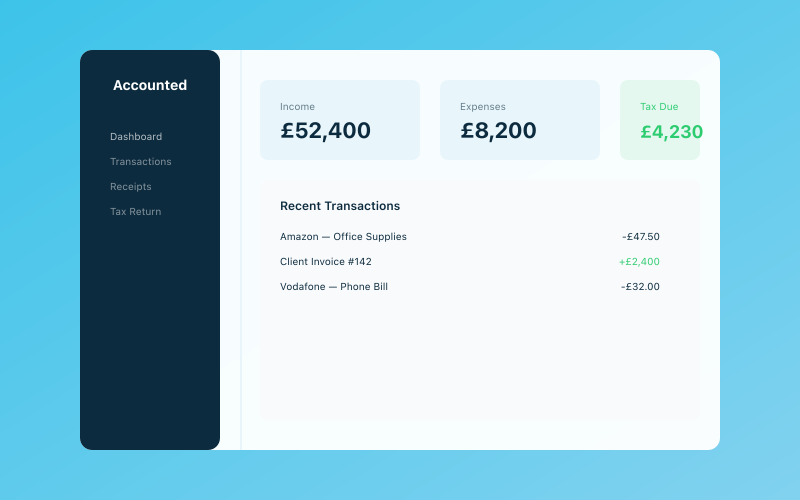 Your Accounted dashboard — income, expenses, and tax at a glance
Most social media managers don't do all of these things. Many focus on content creation and scheduling for small businesses, while others specialise in paid advertising or strategy for larger companies. Think about where your strengths lie and what you genuinely enjoy — that's your starting point.
The mechanics of setting up are straightforward. Most social media managers start as sole traders. You'll need to register with HMRC for Self Assessment, which you can do online. Our step-by-step guide to registering as self-employed makes the process painless. Choose a professional business name, secure matching domain and social media handles, and get your online presence polished — it's your calling card.
Professional indemnity insurance is a smart move. If a client claims your work caused them a financial loss (say, a poorly worded post that damaged their brand), you're covered. Our sole trader insurance guide has more detail on the types of cover available. Open a business bank account to keep your income and expenses separate from your personal finances, and set up your tools: a scheduling platform (Buffer, Hootsuite, Later, or similar), a design tool like Canva, analytics tools, a project management tool, and cloud storage for client assets. Many of these offer free tiers that are perfectly adequate when you're starting out.
You might also consider specialising in a niche — hospitality, health and wellness, e-commerce, professional services, trades, or beauty and aesthetics. Specialising makes your marketing more targeted, your expertise deeper, and your pricing easier to justify. You could also specialise by platform, focusing exclusively on Instagram and TikTok for visual brands or LinkedIn for B2B companies.
Pricing Your Services
Pricing is one of the trickiest parts of starting out. Charge too little and you'll burn out; charge too much before you've built a track record and you'll struggle to win clients.
Monthly retainer. This is the most popular model. Clients pay a fixed monthly fee for an agreed set of services. For a sole trader managing content and community for a small business, retainers typically range from £300 to £800 per month. For more comprehensive packages including strategy, paid ads, and analytics, £1,000 to £3,000+ per month is common.
Hourly rate. Suitable for ad-hoc work or consultancy. Rates for social media managers in the UK typically range from £25 to £75 per hour, depending on experience and specialisation.
Project-based pricing. Works well for one-off tasks like setting up a new account, creating a content strategy, or running a specific campaign.
Per-platform pricing. Some managers charge per social media platform. For example, £300 per month per platform, with discounts for multiple platforms.
When setting your prices, factor in the time spent on content research, creation, scheduling, engagement, reporting, and client communication. A single Instagram post might take 15 minutes to publish, but the research, copywriting, design, and hashtag strategy behind it can easily take an hour or more. Don't forget to account for software costs, your own taxes, pension contributions, and the fact that you won't be billing for every working hour.
Landing Your First Clients
Here's the good news: finding social media management clients is, fittingly, all about social media.
Showcase your own profiles. Your personal and business social media accounts are your portfolio. If they're inconsistent, poorly designed, or inactive, prospective clients won't trust you with theirs. Practice what you preach.
Create case studies. Even if you start with a few free or discounted projects, document the results. Before-and-after metrics, screenshots, and testimonials are incredibly persuasive.
Network locally. Many small businesses prefer to work with someone local. Attend networking events, join your local chamber of commerce, and introduce yourself to business owners in your area.
Use LinkedIn strategically. Post valuable content about social media marketing, engage with business owners in your target niche, and don't be afraid to reach out directly with a personalised message.
Offer a free audit. Reviewing a potential client's social media presence and offering specific, actionable advice is a powerful way to demonstrate your value. Keep it concise — you're showing expertise, not giving away the whole playbook.
Ask for referrals. Happy clients are your best marketing asset. Once you've delivered great results, ask if they know anyone else who might benefit from your services.
You can also list on freelance platforms like PeoplePerHour, Bark, and Fiverr for early visibility, though the work tends to be lower-paid. Treat them as a stepping stone, not a long-term strategy.
Managing the Financial Side
Running a social media management business doesn't involve complex finances, but you still need to stay organised. Track all income and expenses — every client payment, software subscription, course, and business-related purchase needs recording. Accounted makes this straightforward — you can connect your bank account and let Penny, the AI bookkeeping assistant, handle much of the categorisation automatically.
Allowable expenses for social media managers typically include software and app subscriptions, hardware (laptop, phone, camera, lighting), internet and phone bills (business proportion), home office costs, training and courses, marketing and advertising, travel to client meetings, and professional insurance.
As a sole trader, you'll pay Income Tax and National Insurance on your profits. A good rule of thumb is to set aside 25–30% of your income for tax. Payments on account mean you might need to pay in advance, so plan ahead. Use proper invoices with your business name, UTR number, payment terms, and a clear description of services.
Having a proper business plan helps you set targets and track your progress. Our guide to writing a business plan can help you get one together without overcomplicating things.
Staying Current and Scaling Up
Social media changes fast. Algorithms shift, new platforms emerge, features launch and disappear. Staying on top of industry changes is part of the job. Follow industry leaders and publications. Take courses when new platforms or features gain traction. Experiment with new content formats on your own channels before rolling them out for clients. The social media managers who thrive long-term are the ones who never stop learning.
Once you've hit capacity with your existing client base, you've got options. Raising your prices is the simplest way to earn more without working more. You can subcontract, bringing in freelance support for content creation or scheduling while you focus on strategy and client relationships. Productising your services with templated packages makes them more efficient to deliver. Adding complementary services like email marketing, blog writing, website management, and SEO are natural extensions. And if you want to grow into a full agency, start by hiring one part-time person and scale from there.
Watch out for common mistakes: working without a contract (always define scope, deliverables, revision limits, and payment terms in writing), overcommitting (quality always beats quantity), ignoring your own admin, not tracking time (you can't price accurately until you know how long tasks actually take), and chasing vanity metrics (clients care about results — enquiries, sales, website traffic — not just likes).
Starting a social media management business is accessible, flexible, and genuinely fun if you love the creative side of digital marketing. The startup costs are minimal, the demand is strong, and with the right approach, you can build a thriving business around a skill you already have. Get registered, polish your own profiles, and start showing people what you can do.
Related reading:
- How to Register as Self-Employed with HMRC
- How to Write a Business Plan
- The Complete Guide to Sole Trader Insurance
Accounted helps UK sole traders stay on top of their bookkeeping and tax. Start your free 30-day trial at getaccounted.co.uk.
Related Reading
- How to Start a Bookkeeping Business
- NHS Workers Going Private — Tax When Transitioning to Self-Employment
- Starting a Business While on Maternity Leave — What You Need to Know
View our pricing and start your free 30-day trial today.
Starting out? Accounted is built for UK sole traders from day one — from £14/month. Get started →
Business & Operations Advisors
Our business advisors cover the practical side of running a UK sole trader business — from HMRC registration to managing growth. Content is written for real business owners in plain English, not accountants.
Ready to try Accounted?
Join UK sole traders who are simplifying their bookkeeping and tax.
Start your 14-day free trial