Starting a Business While on Maternity Leave — What You Need to Know
Maternity leave can be a time of enormous change. Between the sleep deprivation and the nappy changes, many new parents find themselves thinking about their working life in a completely new way. Some realise they don't want to return to their old job. Others spot a gap in the market — often related to parenthood itself. And a surprising number decide that maternity leave is the perfect time to start a business.
If that sounds like you, you're not alone. Thousands of UK women launch businesses during or immediately after maternity leave each year. It can work brilliantly, but there are some important things to understand about how it affects your benefits, your tax position, and your employment status. Let's go through them.
Can You Legally Work While on Maternity Leave?
Yes, you can — but with conditions. If you're employed and receiving Statutory Maternity Pay (SMP) or Maternity Allowance (MA), there are rules about when and how much you can work.
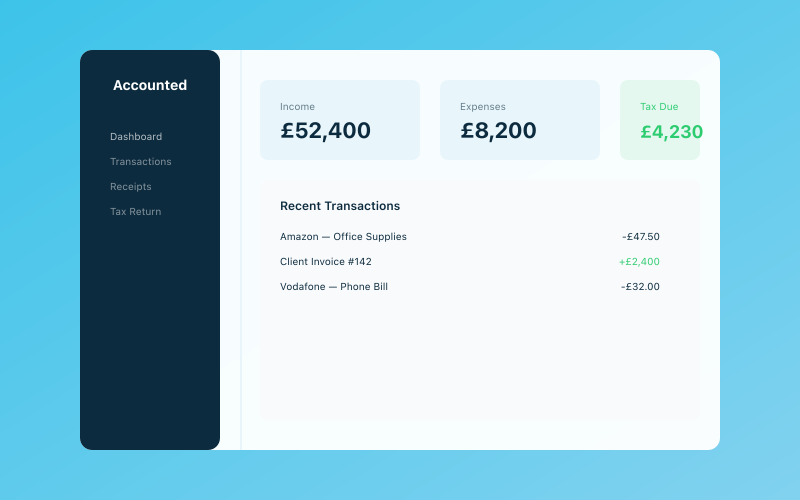 Your Accounted dashboard — income, expenses, and tax at a glance
Keeping in Touch (KIT) days. Employees on maternity leave are entitled to up to 10 Keeping in Touch days with their employer. These are paid days where you can do work, attend training, or go to meetings without losing your SMP. But KIT days are specifically about work for your employer — they don't apply to work for your own new business.
The Statutory Maternity Pay rules. SMP is paid by your employer for up to 39 weeks. During the first six weeks, you receive 90% of your average weekly earnings, then £184.03 per week (or 90% of your average earnings if lower) for the remaining 33 weeks. Here's the important bit: working for your employer during the maternity pay period (beyond KIT days) can stop your SMP. But doing self-employed work doesn't affect your SMP in the same way.
Self-employment during maternity leave. HMRC draws a distinction between working for your employer and working for yourself. Starting and running your own business while receiving SMP is generally permissible — your SMP comes from your employer based on your employment, and your self-employed activities are a separate matter. However, the practical question of whether you can meaningfully run a business with a newborn is a different issue entirely (more on that later).
If you're receiving Maternity Allowance rather than SMP (which applies if you're already self-employed or don't qualify for SMP), the rules are slightly different. You're allowed to do up to 10 "Keeping in Touch" days without it affecting your MA, but work beyond that can result in your MA being stopped for those weeks. We've covered this in more detail in our guide to maternity allowance for the self-employed.
Registering as Self-Employed
If you're starting a business, you need to register as self-employed with HMRC. You should do this as soon as you start trading — which HMRC defines as when you start doing work with the intention of making a profit, not when you actually earn your first pound.
Registration is straightforward and can be done online. You'll receive a Unique Taxpayer Reference (UTR) number, and you'll be registered for Self Assessment, which means filing a tax return each year. For a step-by-step walkthrough, our guide on how to register as self-employed with HMRC covers everything you need to do.
There's no conflict between being employed (on maternity leave) and being self-employed at the same time. Many people in the UK hold both statuses simultaneously. You'll pay income tax on your combined earnings and National Insurance on each income stream separately.
How Starting a Business Affects Your Benefits
This is where things require careful attention. Different benefits have different rules about self-employment income:
Statutory Maternity Pay (SMP). As mentioned, self-employed income doesn't directly affect your SMP. Your employer pays SMP based on your employment, and what you earn from your own business is separate.
Maternity Allowance (MA). If you're claiming MA, working more than your 10 KIT days can affect your payments. However, simply setting up a business — registering, building a website, making plans — isn't the same as "working" for MA purposes. The issue arises when you're actively earning income from the business.
Universal Credit. If you're receiving Universal Credit, self-employment income will affect your payments. UC applies a "minimum income floor" to self-employed earners after a 12-month start-up period, which assumes you're earning at least the equivalent of minimum wage for your expected hours, even if you're not. This can significantly reduce your UC payments.
Tax Credits. If you're still on the legacy tax credits system, self-employment income must be reported and will affect your entitlement.
Child Benefit. This isn't affected by self-employment unless your combined household income exceeds £60,000, in which case the High Income Child Benefit Charge applies.
If you're receiving any means-tested benefits, it's essential to understand how self-employment income will interact with them. The last thing you want is an unexpected overpayment demand because you didn't report your new business income.
Setting Up Your Business Properly
Starting a business during maternity leave has one significant advantage: you have a defined period (up to 52 weeks) when you're not at your old job, which gives you time to plan, set up, and test your business idea before you have to make a decision about returning to work.
Use this time wisely. The administrative side of setting up is something you can do during nap times and quiet evenings:
- Register with HMRC as self-employed
- Open a separate business bank account to keep your finances clean from the start
- Set up your bookkeeping — this is much easier if you start properly from day one rather than trying to reconstruct things later. Accounted is designed for exactly this situation — Penny learns your business as you go, categorising expenses and tracking income so you always know where you stand
- Research your market and develop your offering
- Build your online presence — a simple website and social media accounts
- Write a business plan — even a basic one helps you think through your idea. Our guide to writing a business plan can help with this
The key is to start with the foundation so that when you're ready to actively trade, everything is in place.
Managing Time and Expectations
Let's be honest: running a business with a baby is hard. The early months of parenthood are unpredictable, and your availability will be dictated by feeding schedules, sleep patterns, and the general chaos of life with a small person.
Successful mumpreneurs (a word some love and others loathe) tend to share a few traits:
Realistic expectations. Your business will grow slowly in the early months, and that's fine. You're not trying to build a FTSE 100 company before your baby's first birthday. You're laying the groundwork for something that will grow over time.
Flexible business models. Businesses that can be done in short bursts — an hour here, twenty minutes there — work better around a baby than those requiring long, uninterrupted blocks of time. Online businesses, freelance services, and product-based businesses that can be worked on in batches tend to be good fits.
Support networks. Whether it's a partner who can take the baby for a few hours, family who can help, or a parent-and-baby group where you meet other people in the same situation, having support makes an enormous difference.
Self-compassion. Some days you'll get loads done. Other days, you'll achieve nothing except keeping a tiny human alive. Both of those are perfectly valid.
Tax and Financial Considerations
When you start earning self-employed income, you'll need to declare it on your Self Assessment tax return. This is in addition to any employment income you're receiving (your maternity pay counts as employment income and is reported by your employer).
A few things to bear in mind:
Personal allowance. In 2025/26, the personal allowance is £12,570. If your total income (employment plus self-employment) is below this, you won't pay income tax. Many women on maternity leave will have lower employment income than usual, which means there may be more of the personal allowance available to absorb early business earnings.
National Insurance. Self-employed earners pay Class 2 and Class 4 National Insurance. Class 2 is a flat weekly rate (currently £3.45 per week) and is only due if your profits exceed the small profits threshold. Class 4 is a percentage of your profits above the lower profits limit. In the early stages, these amounts may be small or zero.
Expenses. You can deduct allowable business expenses from your self-employed income, reducing your taxable profit. This includes costs like equipment, materials, software, marketing, and a proportion of your home costs if you work from home. Getting into the habit of tracking expenses from the start is crucial — and it's exactly what Accounted is built for. For more on what you can claim, see our complete list of sole trader expenses.
Payments on account. Once your tax bill exceeds £1,000, HMRC will require you to make payments on account — advance payments towards next year's tax bill. This catches many new sole traders off guard, so it's worth being aware of it from the start.
Telling Your Employer
You're not legally required to tell your employer that you're starting a business during maternity leave. However, it's worth checking your employment contract for any restrictive clauses — some contracts include non-compete provisions, restrictions on outside business activities, or clauses about intellectual property.
If your new business is in a completely different field from your employment, this is rarely an issue. A marketing manager starting a children's clothing business, for instance, is unlikely to breach any contractual terms. But if you're setting up in the same industry as your employer, or using skills, contacts, or knowledge gained through your employment, it's worth taking legal advice.
It's also worth thinking about what happens at the end of your maternity leave. If you decide not to return to work, you may need to repay any enhanced maternity pay (above the statutory minimum) that your employer provided. Check your maternity policy carefully.
Building for the Long Term
Many of the most successful businesses started by parents during maternity leave are still thriving years later. The key is treating it as a genuine business from the start — not just a hobby or a distraction, but something you're building with intention.
That means proper financial management, legal compliance, and a clear plan for growth. It also means being patient with yourself during a period of life that is, by any measure, extraordinarily demanding.
Starting a business is exciting. Having a baby is life-changing. Doing both at the same time is ambitious — but it's also entirely possible, and thousands of UK women prove it every year.
Accounted helps UK sole traders stay on top of their bookkeeping and tax. Start your free 30-day trial at getaccounted.co.uk
Related reading:
- How to Register as Self-Employed with HMRC
- Maternity Allowance and Tax When Having a Baby
- Your First Year of Self-Employment — A Complete Guide
Related Reading
View our pricing and start your free 30-day trial today.
Starting out? Accounted is built for UK sole traders from day one — from £14/month. Get started →
Business & Operations Advisors
Our business advisors cover the practical side of running a UK sole trader business — from HMRC registration to managing growth. Content is written for real business owners in plain English, not accountants.
Ready to try Accounted?
Join UK sole traders who are simplifying their bookkeeping and tax.
Start your 14-day free trial