Tax When Having a Baby — Maternity Allowance and Benefits
Having a baby changes everything — including your finances. If you're self-employed, the situation is a bit different from employed workers who get statutory maternity or paternity pay through their employer. You won't have an employer topping up your income while you're off, and there's no automatic right to return to a held position because, well, you are the business.
But there is financial support available, and understanding what you're entitled to — and how it affects your tax — can make a real difference during those early months. Let's go through everything you need to know.
Maternity Allowance — The Key Benefit for Self-Employed Mothers
If you're self-employed and pregnant, Maternity Allowance (MA) is the main financial benefit you can claim. It's different from Statutory Maternity Pay (SMP), which is only available to employees. But for many self-employed women, MA provides a decent level of support.
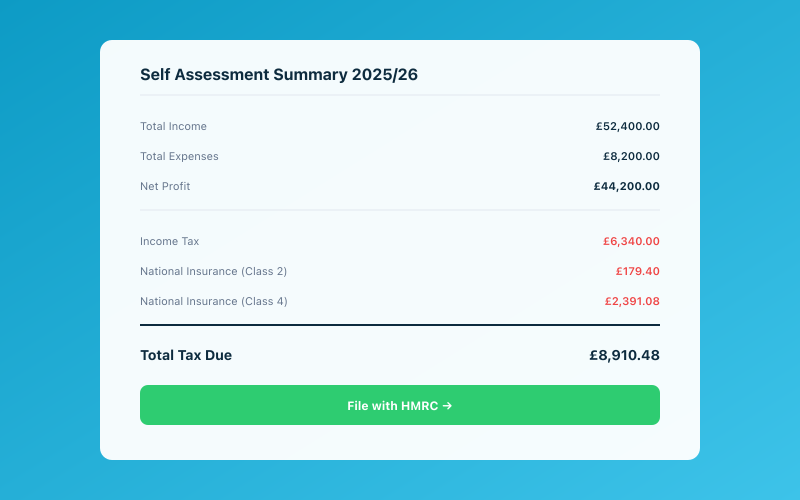 Your Accounted dashboard shows your real-time tax position
To qualify for Maternity Allowance, you need to have been registered as self-employed for at least 26 weeks out of the 66 weeks before your due date (these don't need to be consecutive). You also need to have been paying Class 2 National Insurance contributions during that period.
The amount you receive depends on your earnings, but the standard rate for 2025/26 is up to £187.18 per week, paid for up to 39 weeks. If your average weekly earnings are less than £30, you'll receive a lower rate of £27 per week.
Here's an important detail that catches some people out: you need to have been paying Class 2 NI contributions to qualify. If you've been earning below the Small Profits Threshold and haven't been making voluntary contributions, you might not meet the eligibility criteria. It's worth checking your NI record well in advance of your due date — ideally as soon as you know you're pregnant.
You apply for Maternity Allowance through the Jobcentre Plus, and you can claim from 26 weeks before your due date. The money is paid directly into your bank account every two or four weeks.
Is Maternity Allowance Taxable?
Here's the good news: Maternity Allowance is not taxable. It doesn't count as income for Income Tax purposes, and you don't need to declare it on your Self Assessment tax return. This means you keep the full amount without any deductions.
This is worth bearing in mind when you're planning your finances for the year. If you take several months away from your business, your trading income will be lower, but the Maternity Allowance you receive won't add to your tax bill. This could mean you end up paying less tax overall for the year — potentially significantly less if your reduced trading income keeps you within a lower tax band.
However, it's worth noting that while MA isn't taxable, it can affect your entitlement to other means-tested benefits. If you're claiming Universal Credit or other benefits alongside MA, the interaction between them can be complex. Check with a benefits adviser or use an online benefits calculator to understand your specific situation.
Child Benefit — What Every Parent Should Know
Child Benefit is available to all parents, regardless of whether you're employed or self-employed. For your first child, you receive £26.05 per week (2025/26 rate), and for each subsequent child, £17.25 per week.
However, there's a catch for higher earners. The High Income Child Benefit Charge (HICBC) applies when one parent in the household earns more than £60,000. If either parent earns between £60,000 and £80,000, a portion of the Child Benefit must be repaid through Self Assessment. If either parent earns over £80,000, the full amount is effectively clawed back.
For self-employed people, "earnings" for HICBC purposes means your adjusted net income — basically your taxable profit after deducting pension contributions and certain other reliefs. This means making pension contributions could bring you below the £60,000 threshold and preserve your Child Benefit. It's one of those planning opportunities that's definitely worth considering.
Even if your income means you'd have to repay the Child Benefit, it's still worth claiming it. This is because receiving Child Benefit builds up your National Insurance credits, which count towards your State Pension entitlement. You can opt to receive the payments and repay through Self Assessment, or you can opt out of receiving the money but still register for the NI credits.
Tax Credits, Universal Credit, and Other Support
Depending on your household income, you might be eligible for additional support.
Universal Credit has largely replaced Tax Credits for new claims. If your household income is low enough, you could receive UC to supplement your Maternity Allowance and any reduced business income. Self-employed claimants on UC are subject to the Minimum Income Floor (MIF), which assumes you're earning a certain amount even if your actual earnings are lower — but crucially, the MIF is suspended during your "start-up period" (the first 12 months of self-employment) and during pregnancy and the early weeks after birth.
Sure Start Maternity Grant is a one-off payment of £500 available to those receiving certain benefits (including UC) who are having their first child. You need to apply within 11 weeks of the due date or within six months of the birth.
Tax-Free Childcare is worth looking into for when you return to work. Through this scheme, for every £8 you pay into a special childcare account, the government adds £2 — up to a maximum of £2,000 per child per year (or £4,000 for disabled children). Both parents need to be working and earning at least the National Minimum Wage for 16 hours a week to qualify, and neither parent can be earning more than £100,000.
Managing Your Business While on Maternity Leave
As a sole trader, there's no legal requirement to take maternity leave. You can work as much or as little as you want while claiming Maternity Allowance. However, there are some rules to be aware of.
You can do up to 10 "Keeping in Touch" (KIT) days during your MA claim period without affecting your payments. These days are for maintaining contact with your business — checking emails, attending meetings, doing essential admin. If you work more than 10 KIT days, your MA could be affected.
In practice, many self-employed people find the boundaries blurry. If you answer a quick client email at 10pm while feeding the baby, does that count as a working day? Technically, it probably does. But HMRC and the DWP aren't going to be monitoring your inbox. The sensible approach is to avoid doing substantive, regular work during your claim period, and to use KIT days strategically for things that genuinely can't wait.
Planning ahead is essential. Before the baby arrives, think about:
- Which clients need to be informed and how far in advance
- Whether you can complete or pause ongoing projects before your due date
- Who (if anyone) can handle urgent matters while you're unavailable
- Your invoicing schedule — make sure all outstanding work is invoiced before you stop working
- Your financial buffer — ideally, have savings to supplement your Maternity Allowance
Accounted makes it easy to keep your bookkeeping tidy even when you're not actively working. Penny can categorise transactions, flag anything that needs attention, and keep your records up to date so that when you're ready to come back, everything is in order. That peace of mind is worth a lot when you've got a newborn.
National Insurance During Maternity
While you're receiving Maternity Allowance, you're automatically credited with Class 1 National Insurance contributions. These credits count towards your State Pension entitlement, which is important because gaps in your NI record can reduce your pension in retirement.
If you're self-employed and not receiving Maternity Allowance (perhaps because you didn't qualify), you should consider making voluntary Class 2 NI contributions to protect your State Pension. The cost is modest — currently £3.45 per week — and the long-term benefit to your pension is significant.
It's also worth noting that if you're receiving Child Benefit for a child under 12 and you're not working, you'll receive NI credits through that route too. This is one of the reasons it's important to register for Child Benefit even if your income means you have to repay the actual payments.
Coming Back to Work — Tax Implications
When you return to self-employment after having a baby, your tax situation resets to normal. Your business income is taxable in the usual way, and you'll need to pick up your Self Assessment filing obligations.
If your income was significantly lower during the year because of your maternity break, your tax bill for that year should be lower too. But watch out for Payments on Account — HMRC may have calculated your advance payments based on a previous, higher-income year. If your income has dropped substantially, you can apply to reduce your Payments on Account to avoid overpaying.
You'll also want to think about childcare costs. While childcare isn't a deductible business expense (it's a personal cost), the Tax-Free Childcare scheme mentioned earlier can help. If you're using a registered childminder or nursery, this is one of the most efficient ways to reduce the real cost of childcare while you work.
For a broader view of how your self-employment finances work alongside family changes, our guide on self-assessment and marriage tax covers some of the related planning opportunities.
Planning Makes All the Difference
Having a baby as a self-employed person takes more planning than it does for an employee, but the financial support available is more substantial than many people realise. Maternity Allowance, Child Benefit, and potentially Universal Credit and Tax-Free Childcare can together provide a meaningful safety net.
The key is to plan early. Check your National Insurance record, understand your eligibility, apply in good time, and put your business finances in order before the baby arrives. That way, you can focus on what actually matters — which definitely isn't your tax return.
Related reading:
- How Married Couples Can Save Tax
- Self-Assessment and Marriage Tax
- When to Start Paying Into a Pension
Accounted helps UK sole traders stay on top of their bookkeeping and tax. Start your free 30-day trial at getaccounted.co.uk.
Related Reading
- Northern Ireland Business Tax — The Unique Rules
- National Insurance When You're Employed and Self-Employed
Start your free trial and let Penny handle your bookkeeping automatically.
Penny, your AI bookkeeper, tracks your tax position in real time and flags opportunities to reduce your bill. Meet Penny →
Tax & Compliance Specialists
Our tax specialists have decades of combined experience in UK sole trader and small business taxation, MTD compliance, and HMRC submissions. All content is reviewed against current HMRC guidance before publication and updated quarterly to reflect legislative changes.
Ready to try Accounted?
Join UK sole traders who are simplifying their bookkeeping and tax.
Start your 14-day free trial