Northern Ireland Business Tax — The Unique Rules
Northern Ireland occupies a unique position in the UK tax landscape. It's part of the United Kingdom, so HMRC is your tax authority and UK tax rules apply. But it also shares a land border with the Republic of Ireland, which is an EU member state. This creates some genuinely unusual situations — particularly around VAT, customs, and goods movements — that don't apply anywhere else in the UK.
If you're self-employed or running a small business in Northern Ireland, most of your day-to-day tax obligations are identical to someone in England, Scotland, or Wales. But there are specific areas where the rules diverge, and understanding them can save you money, hassle, and the odd headache with HMRC.
Income Tax and National Insurance — The Familiar Bits
Let's start with the straightforward stuff. Income tax for self-employed people in Northern Ireland works exactly the same as in England and Wales. You get the same Personal Allowance of £12,570, and the same tax bands:
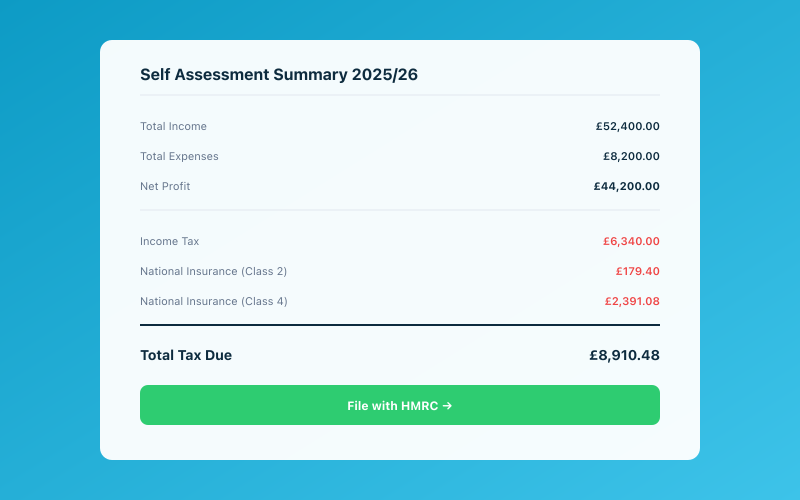 Your Accounted dashboard shows your real-time tax position
- Basic rate: 20% on taxable profits between £12,570 and £50,270
- Higher rate: 40% on profits between £50,270 and £125,140
- Additional rate: 45% on profits above £125,140
Unlike Scotland, Northern Ireland doesn't have devolved income tax powers (at least not yet — the power exists in legislation but hasn't been activated). So your income tax position is identical to someone in Birmingham or Bristol.
National Insurance is also the same. Class 2 contributions at £3.45 per week and Class 4 at 6% on profits between £12,570 and £50,270 (plus 2% above that) for 2025/26.
Self Assessment, Making Tax Digital, and the requirement to keep digital records all apply in Northern Ireland on the same basis as the rest of the UK. If you earn over £50,000, you'll need to comply with MTD for Income Tax from April 2026.
If you're just getting started, our guide on registering as self-employed with HMRC covers everything you need to do.
The Windsor Framework and VAT
Here's where things get interesting. Under the Windsor Framework (which replaced the earlier Northern Ireland Protocol), Northern Ireland follows EU VAT rules for goods, but UK VAT rules for services. This dual regime is unlike anything that applies elsewhere in the UK.
What this means in practice:
If you sell goods in Northern Ireland, your VAT treatment follows EU rules. The VAT rates are still set by the UK Government (the standard rate is 20%, and the reduced and zero rates are the same as in Great Britain), but the underlying framework is the EU VAT Directive. This mostly matters for cross-border movements of goods.
If you sell services, normal UK VAT rules apply — the same as England, Wales, and Scotland.
The VAT registration threshold is £90,000 across the whole UK, including Northern Ireland. If your taxable turnover exceeds this, you must register for VAT. You can also register voluntarily if you're below the threshold — our guide on how much tax you'll pay as a sole trader covers when this might make sense.
Cross-Border Trade With the Republic of Ireland
If you sell goods to customers or buy supplies from businesses in the Republic of Ireland, the rules are more straightforward than they are for businesses in Great Britain trading with the EU.
Goods moving between Northern Ireland and the Republic of Ireland flow freely, with no customs declarations or duties. This is because Northern Ireland effectively remains in the EU's Single Market for goods. For a sole trader in Newry selling products to a shop in Dundalk, or a tradesperson in Derry buying materials from a supplier in Donegal, this means no customs paperwork and no tariffs.
Goods moving between Northern Ireland and Great Britain are where it gets more complicated. Under the Windsor Framework's green lane/red lane system:
- Green lane: Goods moving from Great Britain to Northern Ireland that are destined to stay in Northern Ireland (not moving on to the Republic of Ireland or the wider EU) go through a simplified "green lane" with minimal paperwork. Businesses need to be part of the UK Internal Market Scheme (UKIMS) to use this.
- Red lane: Goods that are "at risk" of moving into the EU are subject to full customs procedures and potentially EU tariffs.
If you're a Northern Ireland sole trader buying stock from a supplier in England, you'll want to make sure your supplier understands the green lane process. In practice, for most small businesses buying goods for their own use or for sale within Northern Ireland, the green lane works smoothly.
The UK Internal Market Scheme (UKIMS)
To benefit from the green lane arrangements, you may need to register for the UK Internal Market Scheme. This is free and applies to businesses that move goods between Great Britain and Northern Ireland.
UKIMS registration is necessary if:
- You're a Northern Ireland business receiving goods from Great Britain
- You want to access the simplified customs arrangements
- You need to declare that goods are "not at risk" of moving to the EU
You can apply through the Government's online service. Once registered, you (or your suppliers in Great Britain) can use simplified declaration processes for goods movements.
For a small sole trader buying the occasional piece of equipment or stock from a supplier in England, this might seem like a lot of bother. But the registration process is relatively painless, and it can prevent delays and additional costs on your deliveries.
Business Rates in Northern Ireland
Business rates in Northern Ireland are handled by Land & Property Services (LPS), not local councils as in England. The system works differently in several ways.
Northern Ireland uses the Net Annual Value (NAV) system for valuing commercial property, rather than the rateable value system used in England and Wales. The rates you pay are calculated by multiplying the NAV by the regional and district rate.
Small Business Rate Relief in Northern Ireland works differently from England:
- Businesses with an NAV up to £2,000 get 50% relief on the non-domestic regional rate
- Businesses with an NAV between £2,001 and £5,000 get 25% relief
- There's no equivalent of the 100% relief available for the smallest businesses in England
The Back in Business scheme and other targeted reliefs are periodically available — check the Department of Finance NI website for current programmes.
Industrial derating is a significant benefit in Northern Ireland. Manufacturing businesses pay only 30% of the normal business rates — a 70% reduction. This is a major advantage for any sole trader or small business involved in manufacturing, food production, or similar activities. It's been a feature of the Northern Ireland rates system for decades and there's no equivalent in Great Britain.
Corporation Tax — The Devolution Question
For completeness, it's worth mentioning corporation tax. The Northern Ireland Assembly has the legislative power to set a different corporation tax rate from the rest of the UK. The idea was to allow Northern Ireland to compete with the Republic of Ireland's famously low 12.5% rate.
However, this power has never been activated, and the Northern Ireland rate remains the same as the UK-wide rate. For small businesses with profits under £50,000, the rate is 19%; for larger companies, it's 25%.
This mainly matters if you're considering incorporating — moving from sole trader to limited company status. The calculation is the same as in the rest of the UK. Our guide on sole trader versus limited company structures covers the pros and cons.
As a sole trader, corporation tax doesn't apply to you directly — you pay income tax on your profits instead.
Employing People Across the Border
If your business operates near the border, you might consider employing someone who lives in the Republic of Ireland, or you might be a Northern Ireland resident working for a business in the Republic.
Cross-border employment creates complex situations around which country's tax and social insurance rules apply. Generally:
- If you employ someone who lives in the Republic but works in Northern Ireland, UK employment law and PAYE applies
- If you employ someone who works in both jurisdictions, EU coordination regulations determine which country's social insurance applies
This is a genuinely complicated area, and professional advice is strongly recommended if you're in this situation. The wrong approach can result in double taxation or non-compliance with one country's rules.
Practical Tips for Northern Ireland Businesses
Keep your receipts and records meticulously. This applies everywhere, but the cross-border dimension in Northern Ireland means you might have transactions in both pounds and euros, with suppliers in both jurisdictions. Good bookkeeping from the start prevents chaos later. Using Accounted to categorise your income and expenses as they happen — with Penny helping to keep everything organised — means you're always on top of your financial position.
Understand your cross-border exposure. If you trade across the border, even occasionally, make sure you understand the VAT and customs implications. Many sole traders in Northern Ireland don't cross the border for business at all, and for them the rules are no different from anywhere else in the UK.
Claim all your expenses. The full list of allowable expenses applies equally in Northern Ireland. Travel between Northern Ireland and the Republic for business purposes is a legitimate expense — fuel, tolls, accommodation, and subsistence are all claimable.
Take advantage of local support. Invest Northern Ireland offers advice, grants, and programmes for businesses of all sizes. InterTradeIreland supports cross-border trade specifically, with funding programmes and practical guidance for businesses operating in both jurisdictions.
Plan for currency fluctuations. If you have income or costs in euros (because you trade with the Republic), currency movements can affect your profitability. Consider this in your pricing and financial planning. For tax purposes, you'll need to convert euro transactions to sterling — use the exchange rate on the date of the transaction, or HMRC's published monthly rates.
Staying Compliant
The unique position of Northern Ireland means there are a few extra things to stay on top of, but for most small sole traders, the reality is simpler than it sounds. If you're not trading goods across the border, your tax obligations are functionally identical to someone in England. If you are trading cross-border, take the time to understand the green lane process and UKIMS registration — it'll save you trouble in the long run.
Whatever your situation, keeping accurate, up-to-date financial records is the foundation of staying compliant. Whether that's tracking mileage for cross-border client visits or categorising expenses correctly, getting the basics right makes everything else easier.
Related Reading
Start your free trial and let Penny handle your bookkeeping automatically.
Accounted helps UK sole traders stay on top of their bookkeeping and tax. Start your free 30-day trial at getaccounted.co.uk.
Penny, your AI bookkeeper, tracks your tax position in real time and flags opportunities to reduce your bill. Meet Penny →
Tax & Compliance Specialists
Our tax specialists have decades of combined experience in UK sole trader and small business taxation, MTD compliance, and HMRC submissions. All content is reviewed against current HMRC guidance before publication and updated quarterly to reflect legislative changes.
Ready to try Accounted?
Join UK sole traders who are simplifying their bookkeeping and tax.
Start your 14-day free trial