How Much Tax Will I Pay as a Sole Trader? Calculator and Examples
One of the first things you want to know when you go self-employed is how much of your profit you will actually get to keep. The answer depends on how much you earn, and the tax system is not as complicated as it looks once you break it down.
This guide uses the 2025/26 tax year rates (6 April 2025 to 5 April 2026) and shows you exactly what you will owe at five different profit levels.
What Taxes Do Sole Traders Pay?
As a sole trader, you pay three main taxes on your profits:
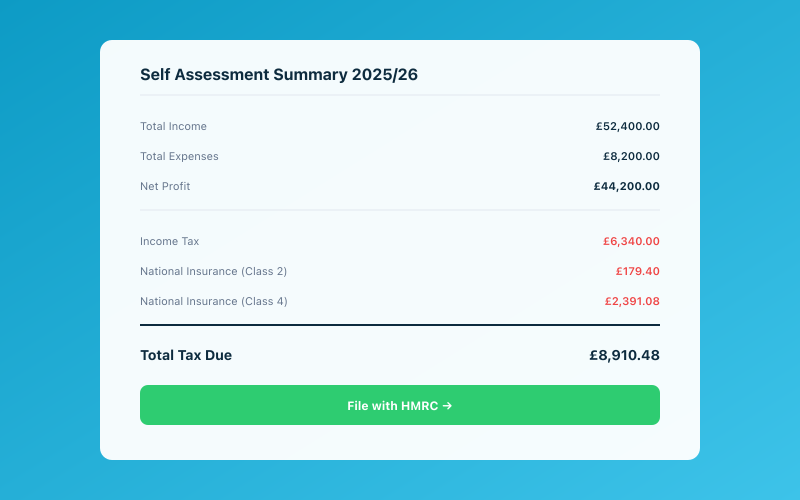 Your Accounted dashboard shows your real-time tax position
Income Tax
This works on a tiered system. You get a tax-free Personal Allowance, and then pay increasing rates on each chunk of income above that.
For 2025/26:
- Personal Allowance: £12,570 — no tax on this
- Basic rate: 20% on profits between £12,571 and £50,270
- Higher rate: 40% on profits between £50,271 and £125,140
- Additional rate: 45% on profits above £125,140
Important: if your total income exceeds £100,000, your Personal Allowance starts to reduce. You lose £1 of allowance for every £2 of income above £100,000. This effectively creates a 60% tax rate on income between £100,000 and £125,140.
Class 2 National Insurance
Class 2 NI is a flat weekly contribution. For 2025/26, the rate is £3.45 per week, which works out to roughly £179.40 per year. You only pay this if your profits are above the Small Profits Threshold of £6,725 per year.
Note: The government has been talking about scrapping Class 2 NI for years, but as of 2025/26 it still exists. From April 2024, it became voluntary for most self-employed people with profits above the threshold, but paying it protects your State Pension entitlement.
Class 4 National Insurance
Class 4 NI is based on your profits and is the bigger one. For 2025/26:
- 6% on profits between £12,570 and £50,270
- 2% on profits above £50,270
This was reduced from 8% in the 2024/25 tax year, so your NI bill is lower than it would have been a couple of years ago.
Worked Examples
Let us work through the numbers at five different profit levels. These assume:
- You have no other income (no employment, no rental income)
- You have the full Personal Allowance of £12,570
- You do not have a student loan
- You are paying Class 2 NI voluntarily to protect your State Pension
Example 1: £20,000 Profit
| Tax | Calculation | Amount | |-----|-------------|--------| | Income Tax | 20% on £7,430 (£20,000 - £12,570) | £1,486.00 | | Class 2 NI | £3.45 x 52 weeks | £179.40 | | Class 4 NI | 6% on £7,430 | £445.80 | | Total tax | | £2,111.20 | | Take-home | | £17,888.80 | | Effective tax rate | | 10.6% |
At £20,000 profit, you keep nearly 90% of your earnings. Not bad at all.
Example 2: £30,000 Profit
| Tax | Calculation | Amount | |-----|-------------|--------| | Income Tax | 20% on £17,430 (£30,000 - £12,570) | £3,486.00 | | Class 2 NI | £3.45 x 52 weeks | £179.40 | | Class 4 NI | 6% on £17,430 | £1,045.80 | | Total tax | | £4,711.20 | | Take-home | | £25,288.80 | | Effective tax rate | | 15.7% |
Example 3: £40,000 Profit
| Tax | Calculation | Amount | |-----|-------------|--------| | Income Tax | 20% on £27,430 (£40,000 - £12,570) | £5,486.00 | | Class 2 NI | £3.45 x 52 weeks | £179.40 | | Class 4 NI | 6% on £27,430 | £1,645.80 | | Total tax | | £7,311.20 | | Take-home | | £32,688.80 | | Effective tax rate | | 18.3% |
Example 4: £50,000 Profit
| Tax | Calculation | Amount | |-----|-------------|--------| | Income Tax | 20% on £37,430 (£50,000 - £12,570) | £7,486.00 | | Class 2 NI | £3.45 x 52 weeks | £179.40 | | Class 4 NI | 6% on £37,430 | £2,245.80 | | Total tax | | £9,911.20 | | Take-home | | £40,088.80 | | Effective tax rate | | 19.8% |
At £50,000 you are still just within the basic rate band, so every pound of profit is taxed at 20% income tax plus 6% NI — a combined 26%.
Example 5: £80,000 Profit
This is where things change. Part of your profit falls into the higher rate band.
| Tax | Calculation | Amount | |-----|-------------|--------| | Income Tax (basic) | 20% on £37,700 (£50,270 - £12,570) | £7,540.00 | | Income Tax (higher) | 40% on £29,730 (£80,000 - £50,270) | £11,892.00 | | Class 2 NI | £3.45 x 52 weeks | £179.40 | | Class 4 NI (lower) | 6% on £37,700 | £2,262.00 | | Class 4 NI (upper) | 2% on £29,730 | £594.60 | | Total tax | | £22,468.00 | | Take-home | | £57,532.00 | | Effective tax rate | | 28.1% |
Once you cross £50,270, each extra pound costs you 42% in combined tax and NI (40% income tax plus 2% Class 4 NI). That is a noticeable jump from the 26% you were paying below the threshold.
What About Student Loans?
If you are still repaying a student loan, add the following to your tax bill:
- Plan 1 (started before September 2012): 9% on profits above £24,990
- Plan 2 (started after September 2012): 9% on profits above £27,295
- Plan 4 (Scottish): 9% on profits above £31,395
- Plan 5 (started after August 2023): 9% on profits above £25,000
- Postgraduate loan: 6% on profits above £21,000
These are collected through your Self Assessment, not deducted at source like they would be if you were employed.
For example, on £40,000 profit with a Plan 2 student loan, you would owe an additional 9% on £12,705 (£40,000 - £27,295) = £1,143.45 on top of your tax bill.
How to Reduce Your Tax Bill
The most effective way to pay less tax is to make sure you are claiming all the expenses you are entitled to. Every pound of legitimate business expense reduces your taxable profit by a pound.
Common expenses sole traders miss:
- Working from home allowance — up to £26/month simplified, or a proportion of actual household bills
- Mileage — 45p per mile for the first 10,000 miles
- Phone and broadband — the business proportion
- Professional subscriptions and insurance
- Tools, equipment, and software
- Training directly related to your current trade
Pension contributions are another powerful tool. Money paid into a pension reduces your taxable income, so if you are near a tax band threshold, a pension contribution could bring you back into the lower band.
How Penny Keeps You on Top of Your Tax
One of the worst feelings in self-employment is not knowing what your tax bill will be until January. You spend all year guessing, and then get a nasty surprise.
Accounted solves this by calculating your estimated tax bill in real time. Penny, the AI bookkeeper, tracks your income and expenses as they happen and keeps a running total of what you are likely to owe. Every time you log a receipt or a bank transaction comes in, your tax estimate updates.
This means you can set aside the right amount each month instead of scrambling to find the cash when the bill lands.
Summary Table
| Profit | Income Tax | NI (Class 2 + 4) | Total Tax | Take-Home | Effective Rate | |--------|-----------|-------------------|-----------|-----------|----------------| | £20,000 | £1,486 | £625 | £2,111 | £17,889 | 10.6% | | £30,000 | £3,486 | £1,225 | £4,711 | £25,289 | 15.7% | | £40,000 | £5,486 | £1,825 | £7,311 | £32,689 | 18.3% | | £50,000 | £7,486 | £2,425 | £9,911 | £40,089 | 19.8% | | £80,000 | £19,432 | £3,036 | £22,468 | £57,532 | 28.1% |
These figures are estimates based on 2025/26 rates and assume no other income. Your actual bill may differ depending on your personal circumstances.
Want to know your exact number? Start a free trial of Accounted and Penny will calculate your real-time tax estimate based on your actual income and expenses — no guesswork needed.
Related Reading
-
Loss Relief for Sole Traders: How to Use Business Losses to Reduce Tax
-
National Insurance for Sole Traders: Class 2 and Class 4 Explained
-
Mixed-Use Property Tax: When Your Home is Also Your Business
Start your free trial and let Penny handle your bookkeeping automatically.
Penny, your AI bookkeeper, tracks your tax position in real time and flags opportunities to reduce your bill. Meet Penny →
Tax & Compliance Specialists
Our tax specialists have decades of combined experience in UK sole trader and small business taxation, MTD compliance, and HMRC submissions. All content is reviewed against current HMRC guidance before publication and updated quarterly to reflect legislative changes.
Ready to try Accounted?
Join UK sole traders who are simplifying their bookkeeping and tax.
Start your 14-day free trial